Health and insurability atlas / Health questionnaires (short forms and full set)
Health questionnaire for life and critical illness cover
Before you meet your advisor, set out your health history in one form. Answer the four choice questions below and the page shows which form is yours. Fill it in online or as a two-page PDF.
Find my form ↓All seven forms ↓
Understand it in 30 seconds
- Which form: answer the three or four choice questions below and the page names your form (at most two for an adult, one for a child).
- How to fill it: tap Fill in online and start typing; the common answers are already set to No, so change only what does not fit. Or download the PDF, type in it with Adobe Reader or Mac Preview, save it and send it to your advisor.
- After you submit: the online form emails you a confirmation with an edit link; to add a line or change an answer, open that link, no need to start again.
- Who can see it: you (through the edit link in the email) and your advisor's account. It never asks for SIN, bank or ID numbers. It prepares the meeting and is not an insurance application, so it starts no underwriting.
Pick your form
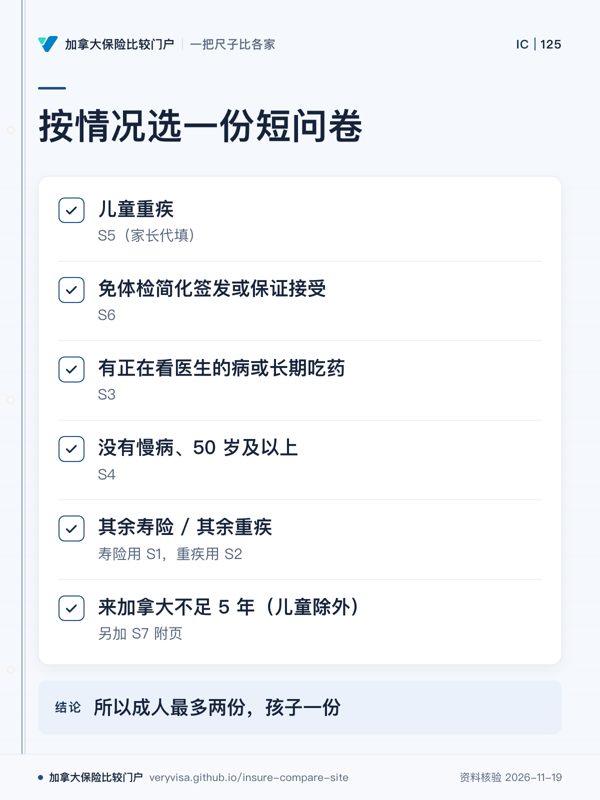
- Child critical illness: S5 (a parent fills in). No-exam simplified issue or guaranteed acceptance: S6.
- Other adults: with a condition or regular medicine use S3; otherwise, aged 50 or over use S4, else S1 for life and S2 for critical illness.
- In Canada under 5 years (except a child): add the S7 add-on, so at most two forms.
Pre-ticked boxes are the most common answers (No, or none); change any that do not fit, and write "not sure" when unsure. The forms contain no SIN, bank or ID numbers; they prepare the meeting and are not an application.
The online version is collected by Google Forms and may be stored outside Canada; only your advisor sees it. If you prefer not to use it, send the PDF to your advisor.
Two ways to fill it, and how each works
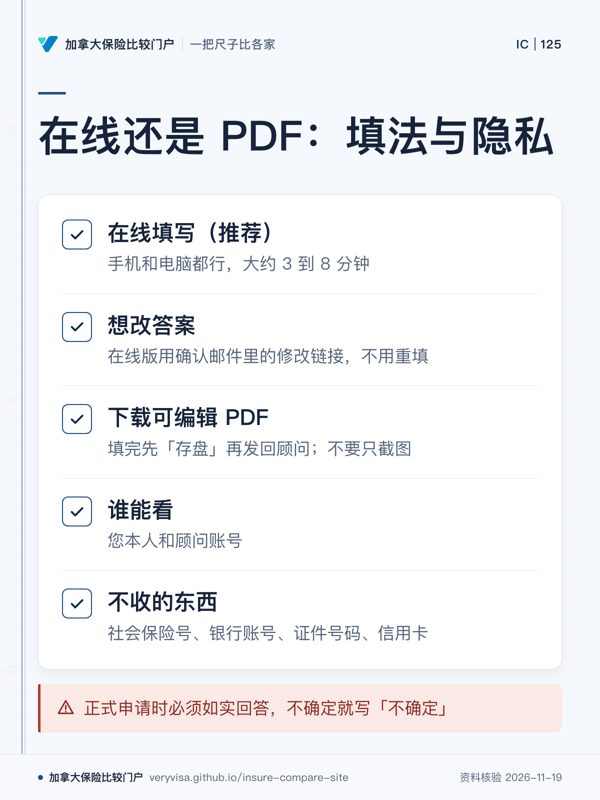
Fill in online (recommended)
- Works on a phone or computer; about 3 to 8 minutes.
- The pre-filled link already ticks the common No / None answers; change only what does not fit.
- After submitting, an edit link arrives by email; use it any time to change answers, and your advisor sees the latest version.
- Collected by Google Forms, so data may be stored outside Canada; if that matters to you, use the PDF.
Download the editable PDF
- Two pages; click and type in the PDF itself, or print it and write by hand.
- On a computer open it in Adobe Acrobat Reader or Mac Preview; on a phone use the Adobe Acrobat Reader app, since a browser's built-in viewer may not keep what you type.
- Save the file (as a new copy) after filling, then send it back to your advisor; a screenshot is not enough.
- The PDF travels only between you and your advisor, not through Google; send it by an email or messaging channel you trust.
After you submit: who sees it, how to change it, privacy
- Who sees it: you and your advisor's account; no page of this website ever shows your answers.
- How to change it: online, use the edit link in the confirmation email; for the PDF, save again and send it with a note saying which copy it replaces.
- What it never asks for: SIN, bank accounts, ID numbers or card numbers. Tell us if any form seems to ask.
- Retention: answers are used only to prepare the meeting, a clean-up reminder is raised once the retention period ends, and you can ask your advisor to delete them at any time.
- Answer truthfully: this is not an application, but the questions on a real application must be answered accurately; wrong answers can void a policy or lead to a denied claim, so write not sure when unsure.
To see how different insurers ask these questions and where the same person may find it smoother: How insurers ask and underwrite, side by side →
Question by question (every question in the short forms)
Each entry matches a question in the short forms; the "More" links on the forms and PDFs point here. Questions shared by several forms appear once.
Full name as on ID
Used in: S1, S2, S3, S4, S6, S7
- Why it is asked
- The insurer needs to match you to your records, so the name must match your ID.
- How to answer
- Copy the English name from your ID. For a child's form, a parent fills in and writes the child's name.
- Common slips
- Using a nickname or an abbreviation. A mismatch later adds a round of paperwork.
- What it may affect
- It does not affect price; a wrong name only slows everything down.
Date of birth
Used in: S1, S2, S3, S4, S6, S7
- Why it is asked
- Age is the first factor in price and in what evidence is asked for; the same health fact is read differently at different ages.
- How to answer
- Use the date of birth on your ID, as year-month-day.
- Common slips
- Writing a lunar date or swapping month and day. Insurance uses the age on your ID.
- What it may affect
- A higher age usually means a higher price and more evidence.
Email
Used in: S1, S2, S3, S4, S6, S7
- Why it is asked
- It is used to send a receipt and a link for later edits, not for mass mailing.
- How to answer
- Write an address you actually read. For a child's form, use a parent's email.
- Common slips
- Using an inbox you rarely open, so the receipt and edit link are missed.
- What it may affect
- It does not affect the outcome.
Sex shown on ID
Used in: S1, S2, S4
Male / Female / X
- Why it is asked
- A few lab values and disease risks are read differently by sex.
- How to answer
- Pick the sex shown on your ID.
- Common slips
- Choosing what you prefer instead of what the ID shows. Underwriting follows the ID.
- What it may affect
- Usually a small effect; it matters only for a few conditions and pregnancy-related questions.
Your status in Canada
Used in: S1, S2, S7
Citizen / Permanent resident / Work permit / Study permit / PR / PNP pending / Visitor or other
- Why it is asked
- Insurers set different eligibility and requirements for residents, work or study permits, and visitors; it also affects how easily records can be obtained.
- How to answer
- Choose the status you hold now. If you are waiting for PR or a nomination, choose the pending option.
- Common slips
- Treating 'applied' as 'granted'.
- What it may affect
- Status decides whether some products are open to you and which extra papers are asked. New immigrants can add form S7.
Height and weight (with units)
Used in: S1, S2, S3, S4
- Why it is asked
- Height and weight give your body mass index (BMI), one of the basic pricing factors.
- How to answer
- A rough figure with units is fine, such as 172 cm / 65 kg or 5'8" / 150 lb.
- Common slips
- Writing a number without units, or pounds as kilograms.
- What it may affect
- A BMI in the usual range generally has no effect; a clearly high or low figure may affect price and bring extra questions.
What are you looking at
Used in: S1
Term life / Permanent or participating life / Not sure
- Why it is asked
- Term and permanent are underwritten to the same health standard, but amount and term change which tests are asked for.
- How to answer
- If unsure, choose 'Not sure'; the advisor compares them at the meeting.
- Common slips
- Assuming 'cheap' means 'term only'. The two serve different purposes.
- What it may affect
- It does not change the health view; it shapes the amount and term discussed next.
Roughly how much life cover (CAD)
Used in: S1
< 250k / 250–500k / 500k–1M / 1–3M / > 3M
- Why it is asked
- The larger the amount, the more exams and papers are usually asked for, so we first need a rough range.
- How to answer
- Pick the closest band; it is not a commitment. The real figure is set at the meeting.
- Common slips
- Writing a small amount to avoid an exam. The amount should follow your family's real need.
- What it may affect
- A larger amount brings more evidence; staying inside a no-exam limit usually means fewer tests (differs by insurer, to be verified).
In the past 12 months, any nicotine (cigarettes, vape, patch, gum) or cannabis?
Used in: S1, S2, S3, S4, S6
No / Yes
- Why it is asked
- Nicotine use is the largest single price factor in life and critical illness cover; cannabis can also change the class.
- How to answer
- Answer for the past 12 months. Even occasional use should be mentioned on the last page.
- Common slips
- Answering No because you 'quit long ago' or 'only sometimes'. Urine or blood tests can detect use.
- What it may affect
- Non-users pay clearly less than users. For cannabis, insurers look at frequency and method and differ in their classes.
In the past 5 years: a hospital stay, surgery, an abnormal test, or a test a doctor asked for that is still not done?
Used in: S1, S2
No / Yes
- Why it is asked
- Recent hospital stays, surgery and abnormal tests are the main clues to recent health; a test that was advised but not done is asked about most.
- How to answer
- Answer what you recall; write 'not sure' for details. Even a minor, resolved surgery deserves one line on the last page.
- Common slips
- Leaving it out because it is 'healed' or 'minor'. The insurer may see it in medical information databases or in a doctor's report, and discovering it later is harder than saying so first.
- What it may affect
- A small resolved event usually has little effect; a pending or undone test can postpone the decision until the result is in.
Do you take prescription medicine regularly? (Birth control, vitamins and occasional cold medicine do not count.)
Used in: S1, S2
No / Yes
- Why it is asked
- A prescription taken regularly points to a health issue that needs ongoing management; underwriters read the condition from the drug name.
- How to answer
- Count only prescribed medicine taken daily or long term. Birth control, vitamins and occasional cold medicine do not count. If yes, choose Yes and also fill in S3 with the drug names.
- Common slips
- Forgetting medicine taken 'to prevent' something, such as a cholesterol or blood-thinning drug. Preventive medicine counts too.
- What it may affect
- The drug name often says more than the diagnosis; a stable, low dose usually has limited impact, and the advisor can ask an insurer anonymously first.
Did a parent or sibling have heart disease, stroke, cancer or diabetes before age 60?
Used in: S1, S4
No / Yes
- Why it is asked
- Family history weighs most for critical illness cover; early heart disease, stroke or cancer in parents or siblings can signal higher risk.
- How to answer
- Count only blood parents and siblings, not in-laws, grandparents or cousins. 'Early' means before 60 (before 50 on the child's form). If you do not know, answer Yes and write 'not sure'.
- Common slips
- Counting illness that came late in life, or leaving out the cause of a parent's early death. Early versus late makes a big difference.
- What it may affect
- Family history alone usually does not lead to a decline; several close relatives with the same early disease may mean a surcharge or more tests. It matters more for critical illness than for life.
High-risk work or hobbies (diving, skydiving, climbing, racing, flying, underground or heights), or living abroad 6+ months in the next 12?
Used in: S1
No / Yes
- Why it is asked
- High-risk work or hobbies and long stays abroad affect eligibility and claim terms.
- How to answer
- Answer for the past and next 12 months. One taster dive is not a 'hobby', but write a line about it.
- Common slips
- Skipping it because you do it 'once a year'. A dispute after a claim is worse for you.
- What it may affect
- It may mean a surcharge, an exclusion for that activity, or more questions; long stays abroad can affect eligibility.
Did you answer Yes to any of questions {a}–{b}? No submits now; Yes opens one short page for a few lines.
Used in: S1, S2, S5, S6
No / Yes
- Why it is asked
- It folds the earlier yes/no questions into one: all No means you are done; Yes opens one page for details.
- How to answer
- If any earlier question was Yes, choose Yes here and then write a line per item on the next page: which question, roughly when, how it is now.
- Common slips
- Answering No here after a Yes above. Your Yes is still passed to the advisor, but the details page is lost.
- What it may affect
- It does not affect the outcome; it only decides whether you fill one more page.
For each Yes: which question, roughly when, and how it is now (write 'not sure' if unsure).
Used in: S1, S2, S5, S6, S7
- Why it is asked
- A single line lets the underwriter decide whether to look further, and avoids back-and-forth questions.
- How to answer
- One line per item: which question, roughly when, how it is now. Write 'not sure' if unsure; no need to dig out records.
- Common slips
- Writing too much or attaching whole records. A few lines are enough now; records are asked for later if needed.
- What it may affect
- A clear note often saves a round of questions and gets you an answer sooner.
Roughly how much critical illness cover (CAD)
Used in: S2
< 50k / 50–100k / 100–250k / > 250k
- Why it is asked
- The larger the amount, the more exams and papers are usually asked for, so we first need a rough range.
- How to answer
- Pick the closest band; it is not a commitment. The real figure is set at the meeting.
- Common slips
- Writing a small amount to avoid an exam. The amount should follow your family's real need.
- What it may affect
- A larger amount brings more evidence; staying inside a no-exam limit usually means fewer tests (differs by insurer, to be verified).
Did a parent or sibling have heart disease, heart attack or stroke before age 60?
Used in: S2
No / Yes
- Why it is asked
- Family history weighs most for critical illness cover; early heart disease, stroke or cancer in parents or siblings can signal higher risk.
- How to answer
- Count only blood parents and siblings, not in-laws, grandparents or cousins. 'Early' means before 60 (before 50 on the child's form). If you do not know, answer Yes and write 'not sure'.
- Common slips
- Counting illness that came late in life, or leaving out the cause of a parent's early death. Early versus late makes a big difference.
- What it may affect
- Family history alone usually does not lead to a decline; several close relatives with the same early disease may mean a surcharge or more tests. It matters more for critical illness than for life.
Did a parent or sibling have cancer? (type and age go on the last page)
Used in: S2
No / Yes
- Why it is asked
- Family history weighs most for critical illness cover; early heart disease, stroke or cancer in parents or siblings can signal higher risk.
- How to answer
- Count only blood parents and siblings, not in-laws, grandparents or cousins. 'Early' means before 60 (before 50 on the child's form). If you do not know, answer Yes and write 'not sure'.
- Common slips
- Counting illness that came late in life, or leaving out the cause of a parent's early death. Early versus late makes a big difference.
- What it may affect
- Family history alone usually does not lead to a decline; several close relatives with the same early disease may mean a surcharge or more tests. It matters more for critical illness than for life.
Any inherited condition in the family (polycystic kidney, Huntington's, familial high cholesterol, hereditary cancer gene)?
Used in: S2
No / Yes
- Why it is asked
- Family history weighs most for critical illness cover; early heart disease, stroke or cancer in parents or siblings can signal higher risk.
- How to answer
- Count only blood parents and siblings, not in-laws, grandparents or cousins. 'Early' means before 60 (before 50 on the child's form). If you do not know, answer Yes and write 'not sure'.
- Common slips
- Counting illness that came late in life, or leaving out the cause of a parent's early death. Early versus late makes a big difference.
- What it may affect
- Family history alone usually does not lead to a decline; several close relatives with the same early disease may mean a surcharge or more tests. It matters more for critical illness than for life.
Which cover are you looking at (tick all)
Used in: S3
Term / permanent life / Critical illness / Other / not sure
- Why it is asked
- Different products read the same condition differently, so we need to know which you are looking at.
- How to answer
- Tick as many as apply; if unsure, pick 'Other / not sure'.
- Common slips
- Ticking only life when you are really more interested in critical illness.
- What it may affect
- It only decides which result table we read.
Which of these do you have or have had? (tick all)
Used in: S3
High blood pressure / High cholesterol / Type 2 diabetes / Type 1 diabetes / Prediabetes / Coronary disease, stent or bypass / Arrhythmia or AFib / Stroke or TIA / Asthma / COPD / Sleep apnea / Depression or anxiety / Thyroid disease or nodule / Hepatitis B or fatty liver / Kidney disease or stones / Cancer history (incl. treated) / Other
- Why it is asked
- A checklist of conditions replaces long questions by body system; you only tick.
- How to answer
- Tick what you have now or have had. Cancer that was treated and conditions off medicine count too. If it is not listed, choose 'Other' and add a line.
- Common slips
- Treating 'the doctor said it is a bit high' as 'none'. Raised blood pressure, sugar or cholesterol that a doctor mentioned counts.
- What it may affect
- Each item decides what the underwriter looks at next and whether a doctor's report is needed. Each condition has a page on this site you can read first.
When each was first diagnosed (e.g. hypertension 2019-05; separate with semicolons)
Used in: S3
- Why it is asked
- How long ago and at what age it was found is key to judging how serious the same condition is.
- How to answer
- One year-month per condition, like 'hypertension 2019-05', separated by semicolons. If unsure write 'about 2019'.
- Common slips
- Writing 'many years ago'. The underwriter needs a rough year.
- What it may affect
- A long, stable history often helps; a recent diagnosis may mean waiting before a decision.
Overall, how well controlled are they now
Used in: S3
Stable, no change in a year / Mostly stable, medication adjusted / Unstable or worsening / Not sure
- Why it is asked
- For the same condition, how steady it is often matters more than its name.
- How to answer
- Choose based on the latest view from you and your doctor. If unsure choose 'Not sure' rather than guess for the doctor.
- Common slips
- Reading 'normal on medicine' as 'no condition'. Needing medicine is itself evidence of control.
- What it may affect
- A stable, unchanged condition usually gets a better outcome; an unstable or worsening one may be postponed until it settles.
Latest readings or lab values with date (e.g. BP 128/80; A1c 6.4%; LDL 2.8; 2026-09)
Used in: S3
- Why it is asked
- The latest readings are the most direct evidence and more convincing than a description.
- How to answer
- Write the most recent figures and the month. If you have none write 'none'; the advisor will tell you where to get them.
- Common slips
- Quoting an old good result. The most recent one is what is needed.
- What it may affect
- Normal recent readings often save a doctor's report.
Medicines you take: name, dose, times a day (one per line; it is on the box)
Used in: S3
- Why it is asked
- Drug names and doses show how serious the condition is and are among the first things underwriters check.
- How to answer
- Copy from the box or the pharmacy slip: name, amount each time, times a day, one per line.
- Common slips
- Writing 'blood-pressure pill' without the name.
- What it may affect
- For the same condition, a low dose of a single drug usually fares better than several drugs.
In the past 2 years: hospital, emergency visit, or a dose increase or medicine change because of these?
Used in: S3
No / Yes
- Why it is asked
- Hospital stays, emergency visits or dose increases in the last two years show recent change.
- How to answer
- Answer for the past 2 years; a routine follow-up with no medicine change is No.
- Common slips
- Treating 'one more tablet' as no change. Dose changes count.
- What it may affect
- Recent change may mean waiting a while before deciding.
Has a doctor mentioned complications (eyes, kidney, nerves, heart) or asked for a test that is not yet done?
Used in: S3
No / Yes
- Why it is asked
- Complications and pending tests are the key to where the condition is heading.
- How to answer
- If a doctor has mentioned them, choose Yes and add a line. Otherwise No.
- Common slips
- Treating 'the doctor said to watch it' as 'not mentioned'.
- What it may affect
- Complications or pending tests may need a doctor's report and may postpone the result.
Apart from the above, any other diagnosis, surgery or hospital stay in the past 5 years?
Used in: S3
No / Yes
- Why it is asked
- The checklist covers only the most common ones; this question catches the rest.
- How to answer
- If yes, choose Yes and add a line; otherwise No.
- Common slips
- Leaving it out as 'unrelated'.
- What it may affect
- An extra diagnosis does not always change the result, but leaving it out causes bigger trouble.
Family doctor and clinic (write 'none' if you have none)
Used in: S3
- Why it is asked
- When a doctor's report is needed the underwriter must know whom to ask; a family doctor with regular follow-up often helps.
- How to answer
- Write the family doctor and clinic. If none, write 'none'.
- Common slips
- Naming a doctor you have not seen for years.
- What it may affect
- A family doctor with regular follow-up often gets the report back sooner.
Which cover (tick all)
Used in: S4
Term life / Permanent life / Critical illness
- Why it is asked
- Over 50, different products ask for quite different tests.
- How to answer
- Tick any that apply; if unsure you may tick all.
- Common slips
- Ticking only one.
- What it may affect
- It only decides which result table we read.
Roughly how much cover (CAD)
Used in: S4
< 250k / 250–500k / 500k–1M / > 1M
- Why it is asked
- The larger the amount, the more exams and papers are usually asked for, so we first need a rough range.
- How to answer
- Pick the closest band; it is not a commitment. The real figure is set at the meeting.
- Common slips
- Writing a small amount to avoid an exam. The amount should follow your family's real need.
- What it may affect
- A larger amount brings more evidence; staying inside a no-exam limit usually means fewer tests (differs by insurer, to be verified).
When was your last full check-up with blood tests
Used in: S4
Within 1 year / 1–3 years ago / Over 3 years / Never
- Why it is asked
- Over 50, a recent full check-up with blood tests lets the underwriter ask for fewer tests.
- How to answer
- Choose by when you last had a full check-up including blood tests.
- Common slips
- Counting a single item, such as only blood pressure, as a full check-up.
- What it may affect
- A complete result within a year can save an exam; never having had one usually means one will be arranged.
Your usual blood pressure in the past 2 years (e.g. 125/80; leave blank if unknown)
Used in: S4
- Why it is asked
- Blood pressure is the single reading most often checked after 50.
- How to answer
- Write your usual reading from the last 2 years, like 125/80; leave blank if unknown. Home readings are fine, say so.
- Common slips
- Quoting only the best reading. Write the usual one.
- What it may affect
- A reading that stays in the normal range often has no effect; if it is high and you take medicine, fill in S3.
In the past 2 years, did a doctor say your blood sugar or cholesterol was high?
Used in: S4
No / Yes
- Why it is asked
- Blood sugar and cholesterol are the two routine tests most often out of range.
- How to answer
- If a doctor said it was high choose Yes and add a line.
- Common slips
- Treating a borderline result as normal.
- What it may affect
- A high result without medicine may bring a request for a recent test; if on medicine, fill in S3.
Cancer screening in the past 3 years
Used in: S4
None / Colonoscopy or stool test / Mammogram or ultrasound / PSA / Other
- Why it is asked
- Cancer screening is the preventive check most valued after 50.
- How to answer
- Tick what you have done; if none, 'None' (already pre-ticked).
- Common slips
- Treating 'done' as 'normal'; the result is in the next question.
- What it may affect
- Screening done on time with a normal result is usually favourable.
Any abnormal result or repeat request in the screening you had?
Used in: S4
No / Yes
- Why it is asked
- An abnormal or repeat-requested screening result should be clarified before applying.
- How to answer
- If yes choose Yes and add a line; otherwise No.
- Common slips
- Treating 'the doctor said it is minor' as no abnormality.
- What it may affect
- A result still under review may postpone the decision until it is clear.
In the past 5 years: hospital, surgery, or regular prescription medicine?
Used in: S4
No / Yes
- Why it is asked
- Recent hospital stays, surgery and abnormal tests are the main clues to recent health; a test that was advised but not done is asked about most.
- How to answer
- Answer what you recall; write 'not sure' for details. Even a minor, resolved surgery deserves one line on the last page.
- Common slips
- Leaving it out because it is 'healed' or 'minor'. The insurer may see it in medical information databases or in a doctor's report, and discovering it later is harder than saying so first.
- What it may affect
- A small resolved event usually has little effect; a pending or undone test can postpone the decision until the result is in.
Child's full name
Used in: S5
- Why it is asked
- The insurer needs to match you to your records, so the name must match your ID.
- How to answer
- Copy the English name from your ID. For a child's form, a parent fills in and writes the child's name.
- Common slips
- Using a nickname or an abbreviation. A mismatch later adds a round of paperwork.
- What it may affect
- It does not affect price; a wrong name only slows everything down.
Child's date of birth
Used in: S5
- Why it is asked
- Age is the first factor in price and in what evidence is asked for; the same health fact is read differently at different ages.
- How to answer
- Use the date of birth on your ID, as year-month-day.
- Common slips
- Writing a lunar date or swapping month and day. Insurance uses the age on your ID.
- What it may affect
- A higher age usually means a higher price and more evidence.
Parent or guardian filling this in
Used in: S5
- Why it is asked
- The insurer needs to match you to your records, so the name must match your ID.
- How to answer
- Copy the English name from your ID. For a child's form, a parent fills in and writes the child's name.
- Common slips
- Using a nickname or an abbreviation. A mismatch later adds a round of paperwork.
- What it may affect
- It does not affect price; a wrong name only slows everything down.
Parent's email
Used in: S5
- Why it is asked
- It is used to send a receipt and a link for later edits, not for mass mailing.
- How to answer
- Write an address you actually read. For a child's form, use a parent's email.
- Common slips
- Using an inbox you rarely open, so the receipt and edit link are missed.
- What it may affect
- It does not affect the outcome.
Child's sex shown on ID
Used in: S5
Male / Female / X
- Why it is asked
- A few lab values and disease risks are read differently by sex.
- How to answer
- Pick the sex shown on your ID.
- Common slips
- Choosing what you prefer instead of what the ID shows. Underwriting follows the ID.
- What it may affect
- Usually a small effect; it matters only for a few conditions and pregnancy-related questions.
Birth
Used in: S5
Full term, normal weight / Premature or low birth weight / Not sure
- Why it is asked
- Birth and newborn history is the key background for a child's critical illness application.
- How to answer
- Answer from the birth record or memory. If unsure choose 'Not sure'.
- Common slips
- Skipping 'premature but healthy now'. Prematurity should still be reported.
- What it may affect
- Premature birth or a NICU stay usually leads to a look at how the child is growing now; a birth defect needs a doctor's note.
Child's height and weight now (with units)
Used in: S5
- Why it is asked
- Growth is the most basic reference for a child's application.
- How to answer
- Write the latest measured height and weight with units.
- Common slips
- Giving the birth figures instead of the current ones.
- What it may affect
- A clear departure from the usual range for age usually brings questions about development.
Vaccinations
Used in: S5
On the BC schedule / Partly / Not vaccinated / Not sure
- Why it is asked
- Vaccination status is routine information on a child's health care.
- How to answer
- Pick according to the BC immunization schedule; if unsure choose 'Not sure'.
- Common slips
- Treating 'a few doses late' as 'not vaccinated'.
- What it may affect
- On schedule usually has no effect; not vaccinated may bring some extra questions.
Was the child in a NICU at birth or infancy, or told of a birth defect (heart, kidney, chromosomes)?
Used in: S5
No / Yes
- Why it is asked
- Birth and newborn history is the key background for a child's critical illness application.
- How to answer
- Answer from the birth record or memory. If unsure choose 'Not sure'.
- Common slips
- Skipping 'premature but healthy now'. Prematurity should still be reported.
- What it may affect
- Premature birth or a NICU stay usually leads to a look at how the child is growing now; a birth defect needs a doctor's note.
Has a doctor raised a development or learning concern (delay, speech delay, autism spectrum, ADHD)?
Used in: S5
No / Yes
- Why it is asked
- Development and learning concerns shape a child's critical illness view, though many have improved.
- How to answer
- Only a doctor's mention counts, not a parent's own worry. If so, choose Yes and add a line.
- Common slips
- Treating 'the teacher said' as 'the doctor said'.
- What it may affect
- Depending on the case it may be insurable or deferred; give timing and the present state.
In the past 5 years: hospital, surgery, regular medicine, or repeated asthma, severe eczema or pneumonia?
Used in: S5
No / Yes
- Why it is asked
- Hospital stays, surgery, long-term medicine and recurrent illness in the past 5 years are the main clues to a child's recent health.
- How to answer
- If yes, choose Yes and write a line on the next page: which, roughly when, how now.
- Common slips
- Treating an asthma inhaler as 'not medicine'. Long-term use counts.
- What it may affect
- One-off, resolved events usually matter little; recurring ones may bring a request for a doctor's report.
Any inherited condition, or heart disease, stroke or cancer before 50, in the child's parents or siblings?
Used in: S5
No / Yes
- Why it is asked
- Family history weighs most for critical illness cover; early heart disease, stroke or cancer in parents or siblings can signal higher risk.
- How to answer
- Count only blood parents and siblings, not in-laws, grandparents or cousins. 'Early' means before 60 (before 50 on the child's form). If you do not know, answer Yes and write 'not sure'.
- Common slips
- Counting illness that came late in life, or leaving out the cause of a parent's early death. Early versus late makes a big difference.
- What it may affect
- Family history alone usually does not lead to a decline; several close relatives with the same early disease may mean a surcharge or more tests. It matters more for critical illness than for life.
Which product type
Used in: S6
Simplified issue (a few questions, no exam) / Guaranteed acceptance (no health questions, usually a waiting period) / Not sure
- Why it is asked
- Simplified issue and guaranteed acceptance are different products with different questions and limits.
- How to answer
- If unsure choose 'Not sure'; the advisor compares.
- Common slips
- Treating guaranteed acceptance as 'covers everything'. It usually has a waiting period and a lower amount.
- What it may affect
- Simplified issue usually asks a few yes/no questions; guaranteed acceptance usually asks none about health but costs more, and death benefits in the first years may be limited.
Roughly how much cover (CAD)
Used in: S6
≤ 50k / 50–150k / 150–250k / > 250k
- Why it is asked
- The larger the amount, the more exams and papers are usually asked for, so we first need a rough range.
- How to answer
- Pick the closest band; it is not a commitment. The real figure is set at the meeting.
- Common slips
- Writing a small amount to avoid an exam. The amount should follow your family's real need.
- What it may affect
- A larger amount brings more evidence; staying inside a no-exam limit usually means fewer tests (differs by insurer, to be verified).
Right now: in hospital, bedridden, on continuous oxygen or dialysis, or needing daily personal care?
Used in: S6
No / Yes
- Why it is asked
- Simplified-issue products usually use a few yes/no screening questions, and a Yes may close that route. These ask the same kind of thing in our own words.
- How to answer
- Answer truthfully. No is the default; a Yes does not always mean a decline, and the advisor will show you other routes.
- Common slips
- Answering No to get through. An untrue answer can lead to a refused claim later.
- What it may affect
- Mostly No lets you continue; a Yes may move you to regular underwriting or guaranteed acceptance. Insurers' questions differ; the insurer's own form governs.
Has a doctor said an illness may shorten your life expectancy markedly (for example, within two years)?
Used in: S6
No / Yes
- Why it is asked
- Simplified-issue products usually use a few yes/no screening questions, and a Yes may close that route. These ask the same kind of thing in our own words.
- How to answer
- Answer truthfully. No is the default; a Yes does not always mean a decline, and the advisor will show you other routes.
- Common slips
- Answering No to get through. An untrue answer can lead to a refused claim later.
- What it may affect
- Mostly No lets you continue; a Yes may move you to regular underwriting or guaranteed acceptance. Insurers' questions differ; the insurer's own form governs.
In the past 5 years: diagnosed or treated for cancer (not minor skin cancer), heart attack, stroke or heart failure?
Used in: S6
No / Yes
- Why it is asked
- Simplified-issue products usually use a few yes/no screening questions, and a Yes may close that route. These ask the same kind of thing in our own words.
- How to answer
- Answer truthfully. No is the default; a Yes does not always mean a decline, and the advisor will show you other routes.
- Common slips
- Answering No to get through. An untrue answer can lead to a refused claim later.
- What it may affect
- Mostly No lets you continue; a Yes may move you to regular underwriting or guaranteed acceptance. Insurers' questions differ; the insurer's own form governs.
Had an organ transplant, or on a transplant waiting list?
Used in: S6
No / Yes
- Why it is asked
- Simplified-issue products usually use a few yes/no screening questions, and a Yes may close that route. These ask the same kind of thing in our own words.
- How to answer
- Answer truthfully. No is the default; a Yes does not always mean a decline, and the advisor will show you other routes.
- Common slips
- Answering No to get through. An untrue answer can lead to a refused claim later.
- What it may affect
- Mostly No lets you continue; a Yes may move you to regular underwriting or guaranteed acceptance. Insurers' questions differ; the insurer's own form governs.
Diagnosed with cirrhosis, kidney failure, advanced lung disease, or AIDS?
Used in: S6
No / Yes
- Why it is asked
- Simplified-issue products usually use a few yes/no screening questions, and a Yes may close that route. These ask the same kind of thing in our own words.
- How to answer
- Answer truthfully. No is the default; a Yes does not always mean a decline, and the advisor will show you other routes.
- Common slips
- Answering No to get through. An untrue answer can lead to a refused claim later.
- What it may affect
- Mostly No lets you continue; a Yes may move you to regular underwriting or guaranteed acceptance. Insurers' questions differ; the insurer's own form governs.
In the past 12 months: 2+ hospital stays for one cause, or a planned surgery not yet done?
Used in: S6
No / Yes
- Why it is asked
- Simplified-issue products usually use a few yes/no screening questions, and a Yes may close that route. These ask the same kind of thing in our own words.
- How to answer
- Answer truthfully. No is the default; a Yes does not always mean a decline, and the advisor will show you other routes.
- Common slips
- Answering No to get through. An untrue answer can lead to a refused claim later.
- What it may affect
- Mostly No lets you continue; a Yes may move you to regular underwriting or guaranteed acceptance. Insurers' questions differ; the insurer's own form governs.
In the past 24 months, declined, postponed or cancelled by another insurer for health reasons?
Used in: S6
No / Yes
- Why it is asked
- Simplified-issue products usually use a few yes/no screening questions, and a Yes may close that route. These ask the same kind of thing in our own words.
- How to answer
- Answer truthfully. No is the default; a Yes does not always mean a decline, and the advisor will show you other routes.
- Common slips
- Answering No to get through. An untrue answer can lead to a refused claim later.
- What it may affect
- Mostly No lets you continue; a Yes may move you to regular underwriting or guaranteed acceptance. Insurers' questions differ; the insurer's own form governs.
Country or region you came from
Used in: S7
- Why it is asked
- Where you came from and how long ago decides which country holds your records.
- How to answer
- Write the country or region and the year-month you arrived.
- Common slips
- Writing 'a few years ago'. Give the year-month.
- What it may affect
- Arrival under about 2–5 years ago may bring extra papers or limits (differs by insurer, to be verified).
When you arrived in Canada (e.g. 2024-03)
Used in: S7
- Why it is asked
- Where you came from and how long ago decides which country holds your records.
- How to answer
- Write the country or region and the year-month you arrived.
- Common slips
- Writing 'a few years ago'. Give the year-month.
- What it may affect
- Arrival under about 2–5 years ago may bring extra papers or limits (differs by insurer, to be verified).
BC Medical Services Plan (MSP)
Used in: S7
In effect / In waiting period / None
- Why it is asked
- Whether you have provincial coverage, a family doctor and local records decides how fast the insurer can see your health history.
- How to answer
- Answer as it is. Newly arrived or in the waiting period is normal; choose 'In waiting period' or 'None'.
- Common slips
- Assuming no family doctor means 'no records'. Check-up or lab records count.
- What it may affect
- Few Canadian records do not mean you cannot be insured; usually one more explanation is asked, or home-country records are used instead.
A family doctor in Canada
Used in: S7
Yes / Looking / No
- Why it is asked
- Whether you have provincial coverage, a family doctor and local records decides how fast the insurer can see your health history.
- How to answer
- Answer as it is. Newly arrived or in the waiting period is normal; choose 'In waiting period' or 'None'.
- Common slips
- Assuming no family doctor means 'no records'. Check-up or lab records count.
- What it may affect
- Few Canadian records do not mean you cannot be insured; usually one more explanation is asked, or home-country records are used instead.
Check-up or lab records in Canada
Used in: S7
Within 1 year / Older / None
- Why it is asked
- Whether you have provincial coverage, a family doctor and local records decides how fast the insurer can see your health history.
- How to answer
- Answer as it is. Newly arrived or in the waiting period is normal; choose 'In waiting period' or 'None'.
- Common slips
- Assuming no family doctor means 'no records'. Check-up or lab records count.
- What it may affect
- Few Canadian records do not mean you cannot be insured; usually one more explanation is asked, or home-country records are used instead.
Do you keep your immigration medical (IME) result
Used in: S7
Yes / No or not sure
- Why it is asked
- The immigration medical is a full exam by a designated doctor and can serve as good evidence.
- How to answer
- If you have it, choose Yes. Keep the result yourself; whether it is usable is for the insurer to decide.
- Common slips
- Assuming it replaces an insurance exam. Usually it does not directly.
- What it may affect
- If you have it, the advisor can refer to it first, which usually makes things clearer.
In the past 5 years in your home country: hospital, surgery, regular medicine or a major diagnosis?
Used in: S7
No / Yes
- Why it is asked
- Hospital stays, surgery and long-term medicine in your home country matter just as much and are asked about.
- How to answer
- If yes choose Yes and write a line on the last page.
- Common slips
- Thinking 'abroad does not count'. It does.
- What it may affect
- If so, home-country records and a translation may be needed.
Can you get your home-country records
Used in: S7
Yes, I have copies / Yes, must request / Probably not / Not sure
- Why it is asked
- Whether you can get home-country records decides how long things take.
- How to answer
- Answer as it is. Not being able to get them does not always lead to a decline, but tell the advisor early.
- Common slips
- Waiting until asked before looking for the records. Checking early can save weeks.
- What it may affect
- If prepared early you often wait weeks less; if not obtainable, a statement or a new exam may stand in.
Language of the records
Used in: S7
Chinese or English / Other, needs translation / No records
- Why it is asked
- Records not in Chinese or English need a translation, which takes time.
- How to answer
- Choose by the language of the records.
- Common slips
- Translating them yourself. A recognised translation is usually required.
- What it may affect
- Records that need translating may add some weeks; cost and requirements are for the insurer to set.
Home-country hospitals or clinics, city and rough years in the past 5 years (write 'none' if none)
Used in: S7
- Why it is asked
- A single line lets the underwriter decide whether to look further, and avoids back-and-forth questions.
- How to answer
- One line per item: which question, roughly when, how it is now. Write 'not sure' if unsure; no need to dig out records.
- Common slips
- Writing too much or attaching whole records. A few lines are enough now; records are asked for later if needed.
- What it may affect
- A clear note often saves a round of questions and gets you an answer sooner.
The full question set
The full set has 21 sections and about 150 questions, with life and critical illness each taking what applies. It is for reference and does not need filling in. Each section says why it is asked, how to answer, common slips and what it may affect, and links to the matching conditions in the atlas. Where a single question has no note of its own, the section note applies.
Section 1: Identity & what you are applying for
- Why it is asked
- We need to know who you are and what you want to buy, so the underwriter can judge your health against the right product and amount. No SIN, bank or ID numbers are asked.
- How to answer
- Fill in truthfully. If unsure of intent, choose 'Not sure'.
- Common slips
- Treating the product and amount as a commitment. They only decide what is asked next.
- What it may affect
- They decide which product and amount your health is read against and whether more papers are needed.
17 questions in this section
1. Client code (only if your advisor gave you one)
2. Full name as on ID
3. Date of birth
Why: Age is the first factor in price and in the exams asked for.
4. Email
Why: Used to send the receipt and a link for later edits.
5. Sex shown on ID
Male / Female / X
Why: Some test values and disease risks are read differently by sex.
6. Status in Canada
Citizen / Permanent resident / Work permit / Study permit / PNP / PR pending / Visitor or other
Why: Insurers set different limits and requirements for new immigrants and for work or study permits.
7. When you arrived in Canada (year-month) and your city
8. Occupation and main duties
Why: Some occupations (heights, underground, remote work, law enforcement) affect the rate.
9. Does work regularly involve heights, underground, explosives, heavy machinery, remote areas or firearms?
No / Yes
10. Any of these hobbies in the past 12 months or planned in the next 12?
None / Scuba diving / Skydiving / paragliding / Climbing / mountaineering / Racing / Piloting / Backcountry skiing / Other
Why: High-risk activities may mean a surcharge or exclusion; saying so avoids disputes after a claim.
11. In the next 12 months, do you plan to live outside Canada for over 6 months or travel to an area your government warns against?
No / Yes
12. Have you lived or worked abroad for 6+ months in the past 5 years?
No / Yes
Why: Long residence abroad affects eligibility and how medical records are obtained.
13. What are you looking at
Term life / Permanent life / Not sure
Why: Term and permanent follow the same health standard, but amount and term change which tests are asked for.
14. Life insurance amount wanted (CAD)
< 250k / 250–500k / 500k–1M / 1–3M / > 3M
Why: The larger the amount, the more exams and papers are asked for.
15. Critical illness amount wanted (CAD)
< 50k / 50–100k / 100–250k / > 250k
Why: A higher critical illness amount brings more requirements; it is more sensitive to family history and some tests.
16. Add a children's critical illness rider
No / Yes
17. Will this replace an existing policy?
No / Yes / Undecided
Why: Compare the old policy before replacing it; exclusions and pre-existing-condition clauses restart on a new one.
Section 2: Height & weight
- Why it is asked
- Height and weight give your BMI, a basic pricing factor; a sudden change is also asked about.
- How to answer
- A rough figure with units.
- Common slips
- No units; pounds as kilograms.
- What it may affect
- A BMI in the usual range generally has no effect; a clear departure may affect price.
Related conditions: Obesity and BMI bands
4 questions in this section
1. Height (cm, or ft-in)
2. Weight (kg, or lb)
3. In the past 12 months, did your weight change by more than 10 lb (about 4.5 kg) without trying?
No / Yes
4. If yes: the cause and whether a doctor checked it
Section 3: Tobacco, cannabis, alcohol & drugs
- Why it is asked
- Nicotine use is the largest single pricing factor; cannabis, alcohol and drugs shape the overall risk view. Honest answers are safest; tests may check nicotine and cannabis.
- How to answer
- Answer for the past 12 months; alcohol as an average of drinks per week.
- Common slips
- Thinking 'occasional' does not count. Tests may check.
- What it may affect
- Nicotine is the biggest price factor; cannabis, alcohol and drugs shape the overall risk view.
10 questions in this section
1. In the past 12 months, any nicotine product (cigarettes, cigars, pipe, vape, patch, gum, lozenge)?
No / Yes
2. If yes: which
Cigarettes / Cigars / pipe / Vape / Nicotine replacement / Smokeless
3. If yes: daily or weekly amount, last use, and how long ago you quit
4. In the past 12 months, any cannabis (inhaled, vaped, edible, oil, or medical)?
No / Yes
Why: Insurers class cannabis differently: usually by frequency, method and whether nicotine is also used.
5. If yes: how often
< monthly / 1–3 / month / 1–3 / week / 4+ / week / Daily
6. If yes: main method
Smoked or vaped / Edibles / Oils / sprays / Medical (prescribed)
7. Average drinks per week (1 = a beer, a glass of wine or a shot)
8. Ever had alcohol-related problems: advised to cut down, treatment, fines or accidents?
No / Yes
9. In the past 10 years, non-medical drug use (other than cannabis) or addiction treatment?
No / Yes
10. If yes: substance, last use, treatment
Section 4: Heart & circulation
- Why it is asked
- Heart and vascular disease weigh most in both products. Underwriters look at when it was found, how well it is controlled and what tests were done.
- How to answer
- Answer the gate first, then item by item. Give your usual recent blood-pressure and lipid readings.
- Common slips
- Treating 'normal on medicine' as none. Abnormal heart tests, or ones advised but not done, count.
- What it may affect
- Heart and vascular disease weighs most for both products: how long, how well controlled and what was done decide a surcharge or postponement.
Related conditions: High blood pressure (hypertension), High cholesterol, Coronary artery disease (incl. stent or bypass), Atrial fibrillation, Stroke and TIA (mini-stroke)
10 questions in this section
1. Have you ever had any heart or blood-vessel problem (high blood pressure, high cholesterol, chest pain, heart attack, irregular rhythm, murmur, stroke, clot, aneurysm)?
No / Yes
2. High blood pressure (diagnosed, or told it was high)
No / Yes, on medication / Yes, no medication
3. If yes: year found, usual recent readings (e.g. 130/80), medication
4. High cholesterol or lipids
No / Yes, on medication / Yes, no medication
5. Chest pain, angina, heart attack, heart failure, bypass or stent
No / Yes
Why: These are core critical illness conditions; a doctor's report is almost always asked for.
6. If yes: when, treatment, present symptoms and medication
7. Rhythm problem, palpitations, atrial fibrillation, murmur, valve problem, cardiomyopathy or congenital heart disease
No / Yes
8. Stroke, TIA (mini-stroke), carotid narrowing, aneurysm or blood clot
No / Yes
9. If yes to the two items above: when, treatment, any lasting effect
10. Any abnormal ECG, stress test, echocardiogram, cardiac CT or angiogram, or advised but not done?
No / Yes
Section 5: Diabetes & endocrine
- Why it is asked
- Diabetes is rated on type, age at diagnosis, recent A1c control and complications, so we ask in detail.
- How to answer
- Give the year, latest A1c and treatment.
- Common slips
- Treating prediabetes as none.
- What it may affect
- Rated on type, age at diagnosis, recent control and complications, which vary a lot.
Related conditions: Type 2 diabetes, Type 1 diabetes, Thyroid nodules, Obesity and BMI bands
9 questions in this section
1. Have you ever had diabetes, high blood sugar (prediabetes), thyroid disease, gout or another hormone problem?
No / Yes
2. Diabetes status
None / Prediabetes / Type 1 / Type 2 / Gestational only (resolved)
3. If yes: year and age at diagnosis
4. Latest A1c value and date
5. Diabetes treatment
Diet / exercise / Pills / Insulin / Pump or CGM
6. Any diabetes complications
None / Eye / Kidney / Nerve / Heart / vessels / Foot ulcer / amputation
7. Thyroid disease (over/under-active, nodule, surgery)
None / Yes, stable on medication / Nodule, surgery or cancer concern
8. Gout, high uric acid or adrenal / pituitary disorder
No / Yes
9. Weight-loss surgery or injectable weight-loss drugs (e.g. GLP-1 type)?
No / Yes
Why: Weight-loss drugs and surgery are a recent common underwriting item; give the start date and weight change.
Section 6: Cancer & tumours
- Why it is asked
- Cancer matters most for both products: type, stage, time since treatment ended and recurrence decide eligibility and waiting time.
- How to answer
- Give type, diagnosis date, stage and the date the last treatment ended.
- Common slips
- Leaving out benign tumours or polyps as 'not cancer'.
- What it may affect
- Type, stage, time since treatment and recurrence decide eligibility and the wait.
Related conditions: History of breast cancer, History of thyroid cancer, History of prostate cancer
9 questions in this section
1. Have you ever had cancer, leukaemia or lymphoma, or a benign tumour, polyp, cyst, abnormal biopsy or smear, suspicious nodule or lump under follow-up?
No / Yes
2. Type and site (e.g. breast, thyroid, colon, prostate, skin)
3. Date of diagnosis (year-month)
4. Stage or grade (from the pathology report; write unknown if not sure)
5. Treatment received
Surgery / Chemotherapy / Radiation / Targeted / immunotherapy / Hormone therapy / Watch only
6. Date last treatment ended; how often you are now checked; latest result
7. Has it recurred or spread, or are you still in treatment?
No / Yes
8. Genetic testing (e.g. BRCA) done?
Not done / Done, negative / Done, positive or uncertain
9. Skin: removal of a melanoma or suspicious mole?
No / Yes
Section 7: Brain & nervous system
- Why it is asked
- Nervous-system disease affects long-term outlook and independence; underwriters look at frequency and stability.
- How to answer
- Give frequency and the last episode.
- Common slips
- Treating migraine as 'not a condition'.
- What it may affect
- Frequency and stability inform long-term outlook and independence.
Related conditions: Stroke and TIA (mini-stroke)
8 questions in this section
1. Have you had migraine, seizures, head injury, fainting, numbness or weakness, MS, Parkinson's or memory problems?
No / Yes
2. Migraine or chronic headaches
No / Occasional / Frequent or on preventive medication
3. Epilepsy or seizures
No / Yes
4. If yes: last seizure, episodes per year, medication
5. MS, Parkinson's, ALS, myasthenia gravis, Huntington's or peripheral neuropathy
No / Yes
6. Marked memory loss, cognitive problems, diagnosed MCI or dementia
No / Yes
7. Serious head injury, coma, brain surgery, or abnormal head CT/MRI
No / Yes
8. Unexplained fainting or recurrent dizziness
No / Yes
Section 8: Mental health
- Why it is asked
- Mental health is asked about often. Underwriters mostly look at severity, treatment length and impact on work, not whether you ever sought help.
- How to answer
- Give diagnosis, start month and present treatment.
- Common slips
- Thinking counselling 'does not count'. Seeking help is not a bad thing; being honest is safer.
- What it may affect
- Mostly severity, treatment length and impact on work, not whether you sought help.
Related conditions: Depression and anxiety
7 questions in this section
1. Have you ever been diagnosed with or treated for depression, anxiety, panic, bipolar, PTSD, ADHD, an eating disorder or another mental-health condition?
No / Yes
2. Diagnosis
Depression / Anxiety / panic / Bipolar / PTSD / ADHD / Eating disorder / Psychosis / OCD / Other
3. When first diagnosed (year-month); still under treatment?
4. Treatment
Counselling only / Medication / Hospital admission / ECT / TMS
5. Sick leave of 2+ consecutive weeks, or hospital stay, because of it?
No / Yes
6. Ever self-harm, or thoughts or attempts of suicide?
No / Yes
Why: Underwriters must ask this; answer honestly and the advisor will handle it confidentially.
7. If yes: when last, and how things are now
Section 9: Lungs & sleep
- Why it is asked
- Asthma, COPD and sleep apnea affect long-term risk; severity and regular treatment matter.
- How to answer
- For asthma, give medicine frequency; for sleep apnea, say whether you use CPAP.
- Common slips
- Leaving out suspected sleep apnea that was never tested.
- What it may affect
- Severity and regular treatment are what matter.
Related conditions: Asthma, COPD (chronic obstructive pulmonary disease), Sleep apnea
6 questions in this section
1. Have you had asthma, COPD, emphysema, sleep apnea, tuberculosis, lung scarring, chronic cough or coughing blood?
No / Yes
2. Asthma
None / Mild, occasional reliever / Daily controller / Hospitalised or oral steroids
3. COPD, emphysema, chronic bronchitis or lung fibrosis
No / Yes
4. Sleep apnea
No / Yes, using CPAP / Yes, untreated / Suspected, not tested
5. Tuberculosis (incl. latent treatment), lung surgery or pulmonary embolism
No / Yes
6. Unexplained long cough, coughing blood or abnormal chest imaging
No / Yes
Section 10: Liver, kidney & digestive
- Why it is asked
- Liver, kidney and chronic digestive disease affect outlook; recent lab values are usually needed.
- How to answer
- Give the latest test or scan result.
- Common slips
- Ignoring 'common minor issues' like fatty liver or kidney stones.
- What it may affect
- Liver, kidney and chronic digestive disease affect outlook; recent values are usually needed.
Related conditions: Hepatitis B, Fatty liver disease, Kidney stones
9 questions in this section
1. Have you had hepatitis, fatty liver, abnormal liver tests, cirrhosis, kidney disease, protein or blood in urine, kidney stones, Crohn's, colitis, GI bleeding or pancreatitis?
No / Yes
2. Hepatitis (B, C, other), cirrhosis or persistently high liver enzymes
No / Yes
3. Fatty liver or abnormal liver ultrasound
No / Yes
4. Kidney disease, reduced function, protein/blood in urine, polycystic kidney, transplant or dialysis
No / Yes
5. Kidney stones, recurrent urinary infections, prostate or bladder problems
No / Yes
6. Crohn's, ulcerative colitis or celiac disease
No / Yes
7. Peptic ulcer, GI bleeding, repeated blood in stool, or abnormal colonoscopy/endoscopy (e.g. polyps)
No / Yes
8. Pancreatitis, gallbladder or bile-duct disease
No / Yes
9. For any yes above: which one, when, and latest test or scan result
Section 11: Bones, joints & back
- Why it is asked
- Back and joint problems are common; what matters is impact on work, long sick leave or disability benefits.
- How to answer
- Say whether it affects work or caused long leave.
- Common slips
- Ignoring a healed work injury.
- What it may affect
- Underwriters care about impact on work, long sick leave or disability benefits.
7 questions in this section
1. Have you had back pain, neck or spine problems, arthritis, fractures, osteoporosis, fibromyalgia, chronic fatigue or a work injury?
No / Yes
2. Back pain, neck or disc problems
No / Occasional, seen a doctor / Recurrent, imaging or treatment / Surgery
3. Arthritis (e.g. osteoarthritis) or osteoporosis
No / Yes
4. Fibromyalgia, chronic fatigue or chronic pain
No / Yes
5. Fracture, ligament tear or other surgery-needing orthopaedic injury in the past 5 years
No / Yes
6. Time off work over 4 weeks, or any workers' compensation, disability benefit or insurance claim for illness or injury?
No / Yes
7. For any yes above: which, when, and how things are now
Section 12: Autoimmune & rheumatic
- Why it is asked
- These conditions often need long-term immune drugs; underwriters look at the type, how active it is, and medication.
- How to answer
- Give the name, year and medicine.
- Common slips
- Treating 'high antibodies' as none.
- What it may affect
- These usually need long-term medicine; the drug and control decide the view.
4 questions in this section
1. Have you had lupus, rheumatoid arthritis, psoriasis, ankylosing spondylitis, scleroderma, Sjögren's, vasculitis or another autoimmune disease?
No / Yes
2. Condition and year diagnosed
3. Medication class now
None / NSAIDs / Steroids / Conventional immune-suppressants / Biologics / targeted drugs
4. In the past 2 years, hospital stay or a clear flare-up?
No / Yes
Section 13: Infectious disease
- Why it is asked
- Hepatitis B/C and HIV results affect eligibility; these are asked of everyone and are not aimed at anyone.
- How to answer
- Give the name and treatment status.
- Common slips
- Assuming 'cured' means no need to write.
- What it may affect
- Hepatitis B, TB, HIV and similar affect underwriting; insurers differ.
Related conditions: Hepatitis B
4 questions in this section
1. Have you been told you have hepatitis B, C, HIV, syphilis or another infection needing long-term follow-up, or had a positive or unclear test?
No / Yes
2. Which one, when told, current treatment and follow-up, latest result
3. In the past 5 years, an HIV test because of a suspected exposure (not routine donation, immigration or prenatal screening)?
No / Yes
4. Hospitalised for a severe infection, or a tropical disease needing long treatment?
No / Yes
Section 14: Recent care & tests
- Why it is asked
- This section cross-checks the earlier answers and finds anything you did not think to mention. Say 'not sure' if you are unsure; the doctor's report fills in gaps.
- How to answer
- List what you recall; give year-month for stays and surgery.
- Common slips
- Leaving out tests advised but not done.
- What it may affect
- Recent care is the main line for recent health; unfinished tests may postpone the decision.
12 questions in this section
1. Family doctor name and clinic city (used if a doctor's report is requested)
Why: You may leave the clinic blank, but with no family doctor the insurer may ask for extra tests.
2. Approximate date of your last full check-up
3. In the past 5 years, hospital stay, surgery or an emergency visit?
No / Yes
4. If yes: date, reason and result (one line each)
5. In the past 5 years, seen a specialist (heart, cancer, neurology, kidney, GI, rheumatology, haematology, psychiatry…)?
No / Yes
6. If yes: specialty, reason, still seeing them?
7. In the past 5 years, any abnormal blood or urine result (sugar, liver, kidney, lipids, tumour marker, blood count)?
No / Yes
8. In the past 10 years, any abnormal biopsy, endoscopy, ultrasound, CT, MRI, ECG or X-ray, or asked to repeat one?
No / Yes
9. Any test, referral, surgery or result you are waiting for now, or advised but not yet done?
No / Yes
Why: This is the question most likely to change timing: with a pending matter, you usually wait for the result before applying.
10. If yes: what is pending and when expected
11. In the past 12 months, any symptom you saw a doctor about that was not mentioned above (lasting fatigue, fever, unexplained pain, lump, bleeding…)?
No / Yes
12. If yes: symptom, when, what the doctor said
Section 15: Current medication
- Why it is asked
- Drug names help the underwriter infer condition and control, sometimes more than the diagnosis. Copy from the label or pharmacy list; approximate is fine.
- How to answer
- Copy name, dose, frequency and start from the box.
- Common slips
- Leaving out preventive medicine.
- What it may affect
- The drug often says more than the diagnosis.
6 questions in this section
1. Any regular prescription medicine now (excluding contraceptive pills and vitamins)?
No / Yes
2. If yes: list them (drug, dose and frequency, start date, what for)
3. Regular over-the-counter drugs or supplements (e.g. aspirin, herbal remedies)?
No / Yes
4. If yes: name and purpose
5. In the past 5 years, medication stopped for medical reasons, or prescribed but not taken?
No / Yes
6. Drug allergies or severe reactions (e.g. anaphylaxis)
Section 16: Family history
- Why it is asked
- Family history weighs heavily in critical illness cover: early disease in close relatives raises risk. Count biological parents and siblings only; write 'not sure' where unsure.
- How to answer
- Only blood parents and siblings; give the condition and age at diagnosis.
- Common slips
- Counting grandparents or in-laws.
- What it may affect
- Early heart disease, stroke, cancer and inherited conditions weigh most for critical illness.
Related conditions: History of breast cancer, Coronary artery disease (incl. stent or bypass), Stroke and TIA (mini-stroke), Type 2 diabetes
12 questions in this section
1. Has any biological parent or sibling had, or died of, any of the following before age 60?
No / Yes
2. Heart disease (heart attack, failure, bypass/stent, cardiomyopathy)
None / Father / Mother / Sibling
3. Stroke or brain aneurysm
None / Father / Mother / Sibling
4. Cancer
None / Father / Mother / Sibling
5. If cancer: which relatives, which cancer, age at diagnosis (breast, ovarian, colon, prostate, pancreatic matter especially)
6. Diabetes
None / Father / Mother / Sibling
7. Kidney disease (incl. polycystic kidney)
None / Father / Mother / Sibling
8. Huntington's, ALS, early-onset Alzheimer's or Parkinson's
None / Father / Mother / Sibling
9. Other inherited disease (familial hypercholesterolaemia, muscular dystrophy, cystic fibrosis, Marfan, hereditary cancer syndrome)
None / Father / Mother / Sibling
10. For each relative ticked: the condition and age at onset; add any known genetic result
11. Father: living? If deceased, age and cause
Why: A parent's age and cause of death is a routine life underwriting question.
12. Mother: living? If deceased, age and cause
Section 17: Pregnancy & sex-specific items
- Why it is asked
- Pregnancy affects when you can apply; breast, gynaecological and prostate findings are also reviewed. Answer only what applies; choose No to skip.
- How to answer
- Give the due date and any complications.
- Common slips
- Treating 'trying to conceive' as nothing to mention.
- What it may affect
- Pregnancy usually leads to postponement or special terms; resolved gestational diabetes depends on recovery.
Related conditions: Pregnancy
8 questions in this section
1. Does this section apply to you (women: pregnancy, gynaecology, breast; men: prostate)?
No / Yes
2. (Women) Currently pregnant or trying to conceive?
No / Trying / Pregnant
3. (Women) If pregnant: due date; any complications this time
4. (Women) Past gestational diabetes, pre-eclampsia, preterm birth or other complications?
No / Yes
5. (Women) Fibroids, ovarian cysts, PCOS, endometriosis, or abnormal Pap / HPV test?
No / Yes
6. (Women) Breast lump, abnormal mammogram or ultrasound, or breast biopsy?
No / Yes
7. (Men) High PSA, prostatitis, enlarged prostate or prostate biopsy?
No / Yes
8. For any yes above: which, when, latest result
Section 18: Driving record (life only)
- Why it is asked
- Driving record reflects risk habits; asked for life cover, usually not for critical illness.
- How to answer
- Give violations and accidents in the past 5 years.
- Common slips
- Assuming minor tickets need no mention.
- What it may affect
- Serious violations such as impaired driving can affect life insurance rates.
3 questions in this section
1. Hold a valid driver's licence?
No / Yes
2. In the past 5 years, any impaired or dangerous driving conviction, or licence suspension or revocation?
No / Yes
3. In the past 3 years, 3+ speeding / moving violations or an at-fault accident?
No / Yes
Section 19: Children's critical illness rider: child's health (critical illness only)
- Why it is asked
- If you add the children's rider, the insurer asks about each child's birth and health. Fill only if needed, one per child.
- How to answer
- Answer for the child.
- Common slips
- Mixing the child's details with the parent's.
- What it may affect
- A child rider is read on the child's health and family history.
6 questions in this section
1. Are you adding cover for a child?
No / Yes
2. Child's name (English) and date of birth
3. Preterm (before 37 weeks), low birth weight or NICU stay?
No / Yes
4. Any congenital condition (heart, kidney, chromosomal, Down syndrome…) or developmental delay?
No / Yes
5. Asthma, epilepsy, diabetes, autism, ADHD, regular medication or hospitalisation?
No / Yes
6. For any yes above: which, when, current status
Section 20: Past applications & existing cover
- Why it is asked
- Insurers need your total existing cover and any past declines; this also prevents duplicated cover for one risk.
- How to answer
- Give any recent decline, postponement, surcharge or cancellation.
- Common slips
- Assuming switching insurers means not mentioning it.
- What it may affect
- Insurers share some information, so being open is safer; compare before replacing an old policy.
6 questions in this section
1. Ever declined, postponed, rated, excluded or cancelled for life, critical illness, disability or health insurance?
No / Yes
2. If yes: company, year, reason
3. Total existing life cover incl. group (CAD)
4. Total existing critical illness cover incl. group (CAD)
5. Currently applying for life or critical illness cover elsewhere?
No / Yes
6. Ever received a critical illness or disability insurance payment?
No / Yes
Section 21: Confirmation & consent
- Why it is asked
- Health information is sensitive and used only with your clear consent. This questionnaire prepares your meeting with the advisor; it is not an application. The insurer's own form and your signature govern.
- How to answer
- Read before ticking.
- Common slips
- Thinking ticking means applying. It is only preparation for the meeting.
- What it may affect
- It decides whether the advisor may use your answers for a pre-assessment.
2 questions in this section
1. Consent
I clearly consent to my advisor using these answers to assess insurability, exam needs and rate impact, and for no other purpose. I may ask to view, correct or delete them at any time.
2. Declaration
My answers are true and complete to the best of my knowledge. I know the insurer will ask me to answer again and sign at application, and misstatements can affect a claim.
Exams and records: what to expect
Checked 2026-11-19. Insurers differ in limits and triggers; the insurer's current rules at application govern, and any figure without an official original is marked "to be verified". See also Medical exams and evidence.
Why an exam or doctor's report may be asked
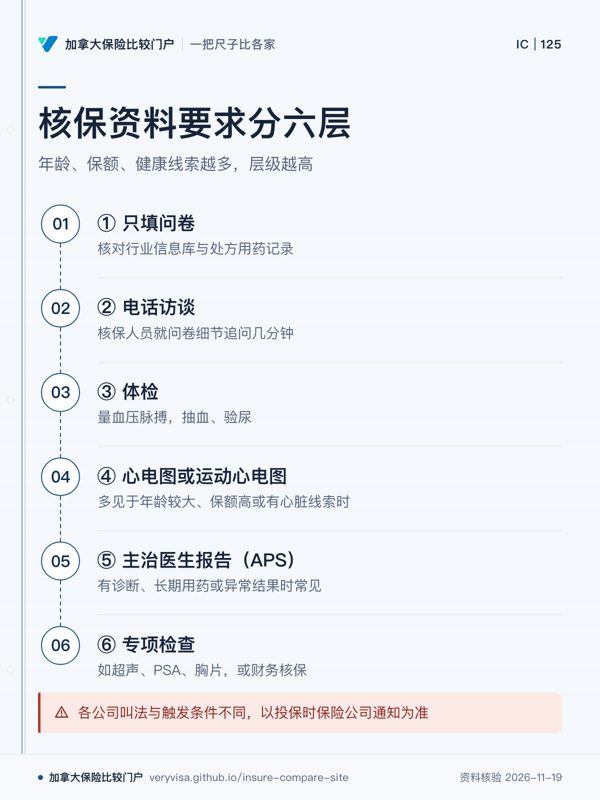
What an insurer asks for rises with three things together: older age, a larger amount, and more clues in your health answers (a diagnosis, a medicine, an unusual result). The reverse also holds: when you are young, the amount is modest and the answers are clean, a questionnaire plus database checks is often enough.
Requests fall roughly into six layers (names and triggers differ by insurer): 1 a questionnaire plus checks against industry and prescription databases; 2 a tele-interview; 3 a paramedical visit with height, weight, blood pressure, pulse, blood and urine; 4 an ECG or stress ECG; 5 an attending physician's statement; 6 special tests such as ultrasound or PSA, and, for very large amounts, financial underwriting.
No-exam routes and amounts (checked facts and disagreement)
Accelerated underwriting: for suitable healthy applicants, no blood or urine and no exam; a questionnaire plus data models decide. Munich Re Canada reports that the no-exam ceiling at issue age 45 rose from CAD 1 million in 2017 to 5 million in 2023, and by the end of 2024 held at 5 million up to issue age 50. No-exam cases rose from 29% of individual life amounts in 2017 to 54% in 2023. Random checks (about 10% of policies) and targeted checks (about 14%) remain; about 25% are fully automatic. [MR1]
Where the numbers disagree: one broker site (October 2024) gives guaranteed issue at CAD 25,000 to 50,000, simplified at about 250,000, accelerated up to about 500,000, with age limits mostly 50 to 60. [LIC] That is far more conservative than the reinsurer's data, perhaps because of different insurers and products. Conclusion: amounts and age lines must come from the current guide of the insurer you apply to. To be verified.
Whether critical illness cover shares the same no-exam amounts: no unified public figure was found; it is usually more cautious than life. To be verified.
What changed or is changing in 2026
Electronic health records: Bill S-5 (Connected Care for Canadians Act) was tabled in February 2026; Munich Re's 25 June 2026 article says it had cleared the Senate committee by April 2026 and not yet reached the House. A bill is not a licence for insurers to pull records: disclosure still depends on your consent, privacy law and provincial rules. [MR2]
Digital medical data: Munich Re Canada and ExamOne announced a partnership in 2026 on digital medical data for Canadian life underwriting; the exact date is unclear. To be verified. [MR3]
AI underwriting assistants: reports say some insurers launched assistants for advisors; the insurers and dates are to be verified. [ADV]
Cannabis: since 2016 some large insurers can treat cannabis users with no nicotine as non-smokers [CAN], but frequency and inhalation can still change the class; no new 2026 industry-wide rule was found, so the questionnaire asks frequency and method separately.
Weight-loss drugs and surgery: a new question was added. It follows advisor practice with no unified public rule found. To be verified.
How to prepare
Gather: a list of regular medicines with doses; the last one or two blood-pressure, A1c, cholesterol and liver-kidney results; for cancer or heart events, the diagnosis date, the date the last treatment ended and the pathology or discharge report; your family doctor's name and clinic.
If an exam is booked, the usual instructions are to fast 8 to 12 hours (water is fine), avoid hard exercise and alcohol the day before, take prescribed medicine as usual and bring photo ID. Follow the insurer's notice.
If you are unsure whether something affects cover, the advisor can ask an insurer anonymously first: no name is given and the insurer gives a general view. This is common practice; whether an insurer accepts it varies.
Things to remember
These forms prepare you and your advisor for the meeting; they are not an application. At application the insurer asks again and you sign. Untrue answers can affect a later claim.
Outcomes usually fall into five kinds: standard, rated (surcharge), exclusion, postponed, declined. Insurers can differ on the same fact, so one result is not a reason to give up.
This is general information, not medical advice and not a prediction of your own result.
Sources
Underwriting differs by insurer; the insurer’s decision is final. General information only, not personal medical or insurance advice; condition and medication descriptions cite official sources.