🃏 Flashcards · 3 闪卡 · 3 张 🖼 Slides · 2 幻灯 · 2 页 ✍️ Questions · 14 刷题 · 14 道
地方政府法与不动产税 gov-tax P2 稳住 P2 Hold steady
ZH EN ZH + EN
先看这一章怎么考 First, how this chapter is tested
工具时态题:题干同时给出官方社区规划的地图指定和仍在生效的分区,问今天能不能按规划上的用途施工。真正考的是规划管未来的政策、分区管现在的规则,不符规划要先改规划。 Tool-tense questions give both the official community plan map designation and the zoning that is still in force, and ask whether construction can proceed today for the use on the plan. What they test is that the plan is policy for the future and zoning is the rule for the present, and that a use which does not match the plan must amend the plan first. 数字门槛题:合法非合规使用空置了一段时间,或建筑物损毁到某个比例,问旧用途还在不在。真正考的是全省连续停用六个月、地基以上价值百分之七十五;把温哥华的九十天和百分之六十套到全省就会选错。 Number-threshold questions set a legal non-conforming use vacant for a period, or a building damaged to some percentage, and ask whether the old use is still there. What they test is six continuous months of discontinuance province-wide and 75 percent of the value above the foundation. Applying Vancouver's 90 days and 60 percent to the whole province picks the wrong answer. 权限边界题:申请人想改用途或提高楼面积比,却去找开发变通许可或变通委员会。真正考的是这两条路都不得变更用途或密度,临时使用许可也不能把用途做成永久。 Authority-boundary questions have an applicant who wants to change the use or raise the floor space ratio, but who goes to a development variance permit or the board of variance. What they test is that neither route may change use or density, and that a temporary use permit cannot make the use permanent. 最常丢分的陷阱(看到题干信号就警觉) Traps that cost the most marks (watch for the signal in the stem)
OCP写成现在能建 Treating the OCP as what can be built now 题干同时出现官方社区规划的指定和仍在生效的分区,两者不一致,选项却说按规划就能施工。 The stem gives both an official community plan designation and zoning that is still in force, the two do not match, and an option says construction can proceed under the plan. 变通改得了用途 Thinking a variance can change the use 申请人想增加户数、改成公寓或提高楼面积比,选项却写成变通许可或委员会命令可以批。 The applicant wants to add dwellings, change to an apartment, or raise the floor space ratio, and an option says a variance permit or a board order can approve it. 用现行法答考卷 Using current law as the exam answer 题干写明按课程手册或按执照考试作答,选项里出现禁止听证、省定户数,或二零二四年六月三十日已经全部终止。 The stem says to answer from the course manual or for the licensing exam, and an option shows a ban on a hearing, a provincially set unit count, or that all of them had already ended on 30 June 2024. 本章考点页:导图、要点表、7 道带逐项解析的练习 →
核实日期:2026-09-05。 法条侧回读的是 BC Laws 现行文本:《Local Government Act》Part 14
与《Community Charter》标注 current to 2026-09-01 ,《Vancouver Charter》标注 current to 2026-08-25 。
政策侧回读的是省住房与市政事务厅的现行页(各页自标的最后更新日写在文末源表里)。
这一章教的是土地能拿来干什么 ——谁说了算、在哪一层说、你在柜台上去哪儿问。
它也是整本考试口径里结构最完好、内容最过时 的一章。分区、OCP、许可、非合规使用这套骨架 2026 年照样成立;
但考试口径反复强调的那句底层判断——「密度和住宅形态由地方政府自己通过分区决定」——在 2023 年被省级立法整体推翻了 。
2023 年秋季会期通过的三个法案(Bill 44 / 46 / 47),加上 2024 年的 Bill 16 与 2025 年的 Bill 25,
把「小型多户住宅必须允许」「捷运站周边最低密度」「符合社区规划的住宅改分区不许开公众听证」这些强制条款
写进了《Local Government Act》。考试口径定稿于 2020 年,一条都没有。
✕
这一章说错话的代价是最直接的
客户问「这块独立屋地能不能盖三户」,你按考试口径答「要看市里的分区,通常不行」——
2026 年在多数城市这个答案是错的,而客户可能因此少出价、或者放弃一块本可以加密度的地。
反过来,你答「省里现在都允许了」也是错的:有一整张豁免清单,还有申请延期的市镇。
正确的动作永远是:查这块地所在市镇的现行分区图和最新的分区 bylaw,不是背一条省级规则。
一、制度地位:地方政府的权力是借来的 本节回答 This section answers 市政府的权力从哪来 Where a municipality's powers come from 本章考题 4 Question 4
加拿大宪法只分了两级:联邦与省。市政府不是宪法主体 ,它是省立法机关创造出来的法人,
权力全部来自省法的授权(enabling legislation),省里改法就能收回或扩大——这不是理论上的可能,2023 年真的发生了。
BC 的授权法有三部:
《Local Government Act》创造了三层地方政府:
区域局(regional district) ——全省除西北角一小块外全部划入,下分选区(electoral area)。
在没有市镇的非建制地区,区域局承担本该由市政府做的事。市镇(municipality) ——村(village)、镇(town)、市(city)、区市(district municipality),
形态按人口定,但规划与土地利用的权力几乎完全相同 ,都由民选市长加四至八名市议员治理,任期四年。改良区(improvement district) ——省里应居民申请设立,通常只管供水、排污、排水、配电这类公用设施,由选出的受托人(trustees)治理,不设市长议会。
三者的地理范围会重叠:同一栋房子可能同时在一个区域局、一个市镇和一个改良区之内。
ℹ️
一条对客户很硬的规则:改分区不赔钱
《Local Government Act》s.458 明写:采纳 OCP、通过分区 bylaw、发出土地利用许可、终止土地使用契约
而造成的地价下跌或损失,一律不予补偿。 唯一的例外是把土地限定为公共用途的 bylaw。
所以「市里把我这块地从商业改成住宅,害我亏了钱,能索赔吗」——不能。这条 2020 年和 2026 年一样。
节末检索小测 · 先别往回翻,凭记忆作答 Quick recall check: answer from memory before scrolling back
A licensee tells a client that a city council holds its planning powers under the constitution, in the same way the province does, so the province cannot take zoning power back. Which statement matches the course?
持牌人对客户说,市议会的规划权和省一样来自宪法,所以省里不能把分区权收回去。哪一项符合课程?
a The licensee is right. A municipality is a third order of government, and its zoning power does not depend on a provincial statute. ✗ 错误。陷阱是把市当成宪法上的第三级。宪法只分联邦和省,市政府不是宪法主体。 Wrong. The trap is treating the municipality as a third order under the constitution. The constitution divides only the federal government and the province. A municipality is not a constitutional body.
b The licensee is right for cities only. Villages and regional districts are created by statute, but cities are not. ✗ 错误。陷阱是按市镇形态拆权力。村、镇、市、区市的规划与土地利用权力几乎完全相同,都来自省法,不是只有村才靠制定法。 Wrong. The trap is splitting the power by the form of the municipality. Villages, towns, cities, and district municipalities have almost exactly the same planning and land use powers. All of them come from provincial statutes. It is not only villages that depend on a statute.
c The licensee is wrong. A municipality is created by the province, and its powers come from statutes the province can amend. ✓ 正确。市政府的权力来自省的授权立法(enabling legislation),省改法就能收回或扩大。土地利用规划主要在《地方政府法》,市镇的核心授权在《社区宪章》,《温哥华宪章》只管温哥华市。 Correct. A municipality's powers come from provincial enabling legislation. The province can take them back or enlarge them by amending the statute. Land use planning is mainly in the Local Government Act. The core enabling statute for municipalities is the Community Charter. The Vancouver Charter applies only to the City of Vancouver.
d The licensee is wrong only about payment. Planning powers are constitutional, but any drop in land value must still be compensated. ✗ 错误。陷阱是把权力来源和赔偿绑在一起。规划权来自省法,不是宪法。一般的改分区跌价也不赔,例外只是限定公共用途的 bylaw。 Wrong. The trap is tying the source of the power to compensation. Planning powers come from provincial statutes, not from the constitution. An ordinary drop from rezoning is not compensated either. The exception is only a bylaw that limits the land to a public use.
看答案与每个选项的解析 Show the answer and why each option is right or wrong 答案 Answer :c
二、规划工具箱:六件工具,管的不是同一件事 本节回答 This section answers 楼面积比怎么算总面积 How floor space ratio works out the total area 本章考题 1 Question 1
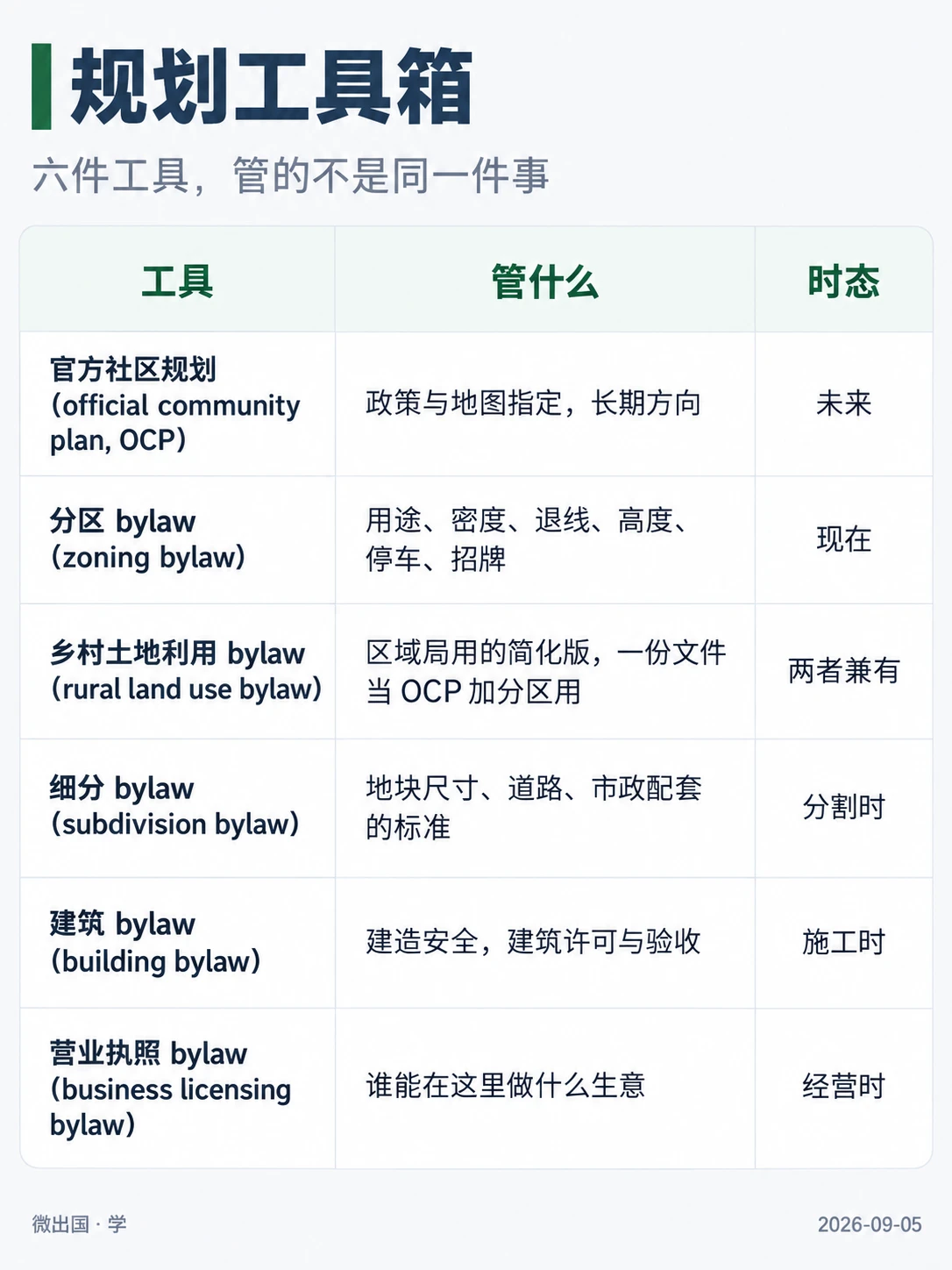
图:规划工具箱——六件工具,管的不是同一件事
OCP 与分区 bylaw 最容易被混成一件事。 分法很简单:OCP 是政策 ,分区 bylaw 是规则 。
OCP 可能把一条街指定为「未来高密度住宅」,分区 bylaw 才规定这条街上现在的楼不得超过 12 米、
覆盖率不得超过 45%、离路边不得少于 4 米。OCP 采纳之后,此后所有的 bylaw、许可与工程必须与它一致 ;
想把地改成与 OCP 不符的用途,得先改 OCP 。
⚠️
「这块地在 OCP 里是住宅」不等于「现在能盖住宅」
OCP 的地图指定的是打算怎么用 ,分区 bylaw 管的是现在能怎么用 。
一块 OCP 指定为未来高密度、分区仍是单户住宅的地,今天只能盖单户住宅;
它的价值在于改分区有指望 (而且 2023 年以后这条路顺畅了很多,见第四节)。
给客户看图时,两张图都要看:OCP 图与官方分区图,而且分区图必须以市里认证的那一份为准 ——
网上挂的版本未必反映最近一次修订。
分区 bylaw 通常有三块 :官方分区图、通用释义与管理条款、各分区自己的规定。
分区代号没有全省统一标准,但实务上相当一致:A 农业、R 住宅(RS 单户、RM 多户,后面再加数字分档)、
I 机构、M 工业、CD 综合开发区(针对某一块地单独定的)。分区界线一般跟着地界或路巷中线走。
除了用途,分区 bylaw 还常规定:一块地上建筑数量(近年多数城市允许加建巷屋 laneway house 或马车屋 coach house)、
退线与庭院(set-back / yard)、高度、密度(最常用楼面积比 floor space ratio ,
0.5 的 FSR 用在 1,000 平方米地块上就是总楼面积 500 平方米,与层数无关)、
家庭办公(home occupation)、场外停车与装卸、招牌。
节末检索小测 · 先别往回翻,凭记忆作答 Quick recall check: answer from memory before scrolling back
A zoning bylaw sets a floor space ratio of 0.5 on a lot of 1,000 square metres. The owner asks how much floor area that allows, and whether a second storey increases the total. Which statement matches the course?
分区 bylaw 把一块1000平方米的地的楼面积比定为0.5。业主问这允许多少楼面积,加盖第二层会不会把总量再加大。哪一项符合课程?
a The ratio allows 500 square metres on each storey, so two storeys allow 1,000 square metres of floor area. ✗ 错误。陷阱是把总楼面积当成每一层的面积。0.5给的是全部楼层加在一起的500平方米,不是每层500平方米。 Wrong. The trap is treating the total floor area as the area of each storey. The 0.5 gives 500 square metres for all storeys added together, not 500 square metres on each storey.
b The ratio allows 500 square metres of total floor area. Adding a storey does not increase that total. ✓ 正确。楼面积比(floor space ratio)是总楼面积除以地块面积,与层数无关。0.5用在1000平方米的地块上,总楼面积就是500平方米。 Correct. Floor space ratio is total floor area divided by lot area, and it does not depend on the number of storeys. A ratio of 0.5 on a 1,000 square metre lot means 500 square metres of total floor area.
c The ratio is a site-coverage rule. It lets the building cover 500 square metres of ground, with no cap on floor area. ✗ 错误。陷阱是把楼面积比写成覆盖率。覆盖率管建筑物占地面的比例,楼面积比管的是总楼面积。 Wrong. The trap is writing floor space ratio as site coverage. Site coverage governs the share of the ground the building occupies. Floor space ratio governs total floor area.
d The ratio counts only after the official community plan repeats the same 0.5 figure. Zoning alone sets no floor area. ✗ 错误。陷阱是把现行规则推给规划。楼面积比写在分区 bylaw 里,分区 bylaw 自己就是现在的规则,不必等规划把同一个数字再抄一遍。 Wrong. The trap is pushing the present rule onto the plan. The floor space ratio is written in the zoning bylaw. The zoning bylaw is itself the present rule. It does not have to wait for the plan to copy the same figure again.
看答案与每个选项的解析 Show the answer and why each option is right or wrong 答案 Answer :b
三、考试口径 vs 2026 现行:八条错位 本节回答 This section answers 考试里便利设施费怎么收 How the amenity charge is collected on the exam
下表是这一章的核心。左列是 ©2020 考试口径教的,右列是 2026 年现行法。
考场按左列答,柜台按右列做 ——这是两码事,混起来两个方向都会出错。
🔧
这张表怎么用
正式考试按注册课程现行考纲及官方更新准备。
实务 :跟真客户讲话时按右列,而且要落到「这块地在哪个市镇、那个市镇的分区 bylaw 改完了没有」。
两个口径不冲突的地方(OCP 与分区的关系、非合规使用的原理、许可的种类)考试口径照样能用。
节末检索小测 · 先别往回翻,凭记忆作答 Quick recall check: answer from memory before scrolling back
A licensing-exam item asks whether, under the course manual, a local government may impose a community amenity contribution on its own as a condition of rezoning. Which statement is the exam answer?
一道执照考试题问:按课程手册,地方政府能不能单方面把社区便利设施捐助定为改分区的条件?哪一项是考试答案?
a Yes. The course lets council set that contribution in a bylaw and collect it when the building permit is issued. ✗ 错误。陷阱是用现行法答考卷。由 bylaw 单方设定、在细分获批或建筑许可签发时征收的,是现行的便利设施费,不是考试口径里的捐助。 Wrong. The trap is using current law as the exam answer. What a bylaw sets unilaterally, and what is collected when subdivision is approved or a building permit is issued, is the current amenity cost charge, not the contribution in the exam standard.
b Yes. The course treats the contribution as a development cost charge for fire halls, policing and recycling plants. ✗ 错误。陷阱是把两笔钱并成一笔。消防、警察和回收是现行开发成本费扩围后的用途,不是考试口径对社区便利设施捐助的定性。 Wrong. The trap is merging the two payments into one. Fire, police, and recycling are uses after the current expansion of development cost charges. They are not how the exam standard characterizes a community amenity contribution.
c No. The course says the local government has no power to impose that contribution by itself. It can only be negotiated. ✓ 正确。考试口径写明,地方政府无权单方面把社区便利设施捐助(community amenity contribution)当作改分区条件,只能协商。现行法改为可由 bylaw 设定便利设施费,在细分获批或建筑许可签发时征收。 Correct. The exam standard states that a local government has no power to impose a community amenity contribution by itself as a condition of rezoning. It can only be negotiated. Current law allows a bylaw to set an amenity cost charge, collected when subdivision is approved or a building permit is issued.
d No. The course says amenity payments were abolished, so neither a negotiation nor a bylaw charge is taught. ✗ 错误。陷阱是把不能单方强制写成了制度已经取消。考试口径保留这件事,规则是只能谈,不是不能存在。 Wrong. The trap is writing the inability to impose it unilaterally as if the device had been abolished. The exam standard keeps it. The rule is that it can only be negotiated, not that it cannot exist.
看答案与每个选项的解析 Show the answer and why each option is right or wrong 答案 Answer :c
四、小型多户住宅(SSMUH):考试口径那条底层判断被推翻的地方 本节回答 This section answers 加户是不是市里自己定 Whether adding a dwelling is decided by the municipality
《Local Government Act》s.481.3 是 2023 年 Bill 44 加进去的。它不是给地方政府一项权力,
而是给地方政府一项义务 :分区 bylaw 必须允许下面这些用途和密度,不允许就是违法 。
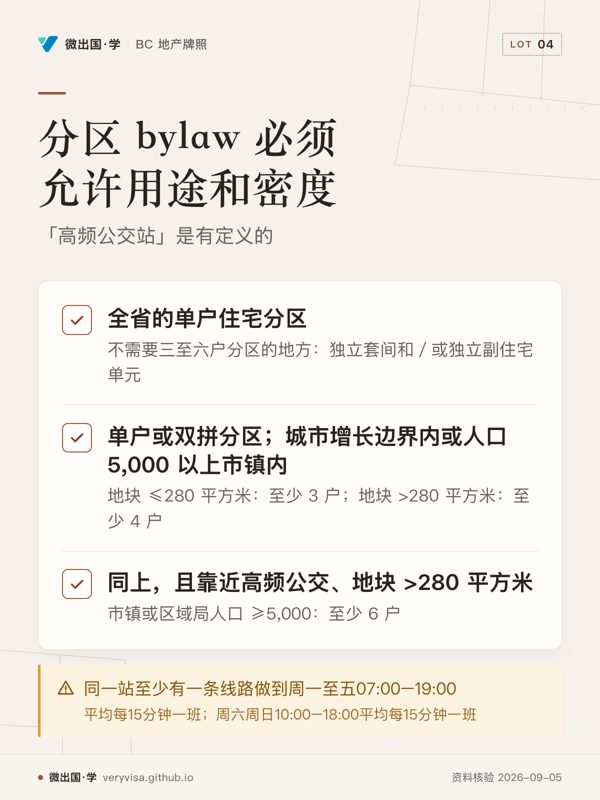
省住房与市政事务厅现行页(2026-01-20 更新)给的门槛是 :
「高频公交站」是有定义的:同一站至少有一条线路做到周一至五 07:00–19:00 平均每 15 分钟一班,
周六周日 10:00–18:00 平均每 15 分钟一班 。
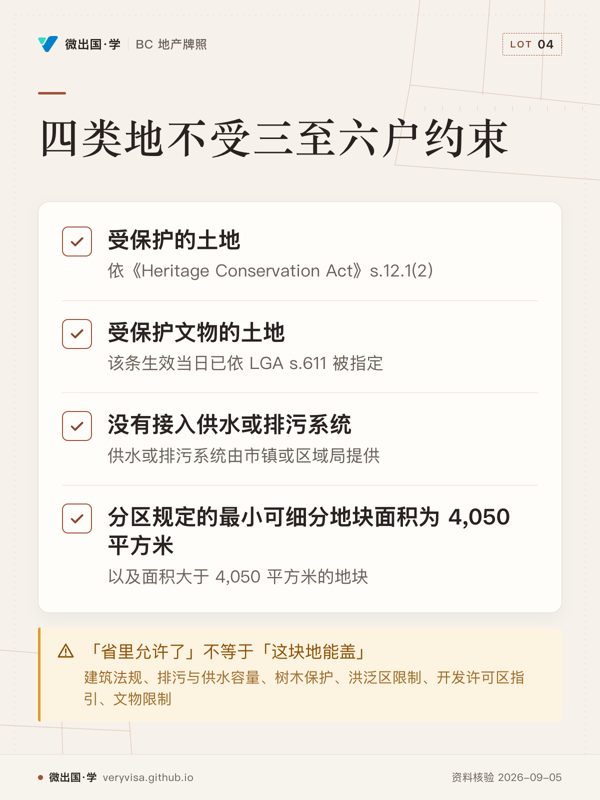
豁免(LGA s.481.4(1))——这四类地不受三至六户那一档约束 :
依《Heritage Conservation Act》s.12.1(2) 受保护的土地;
该条生效当日已依 LGA s.611 被指定为受保护文物的土地;
没有接入市镇或区域局提供的供水或排污系统 的土地;分区规定的最小可细分地块面积为 4,050 平方米 的分区内的土地,以及面积大于 4,050 平方米的地块 。
⚠️
「省里允许了」不等于「这块地能盖」
SSMUH 只解决分区允不允许 这一层。真要盖,还要过建筑法规、排污与供水容量、树木保护、
洪泛区限制、开发许可区(DP area)指引、文物限制 这些独立的门。
一块靠山靠溪、落在自然环境保护型 DP 区里的地,分区上允许四户,实际能不能建四户是另一回事。
给客户的话术只能到「分区这一层现在允许,能不能落地要向市里的规划与建筑部门确认」。
日期这一格要特别小心,因为它换过一次。 Bill 44 原定的分区改造截止日是 2024-06-30 ;
2025 年的 Bill 25(《Housing and Municipal Affairs Statutes Amendment Act, 2025》,
2025-10-09 提出、2025-11-27 通过 )扩大了「受限分区(restricted zone)」的定义、
补上了可由省里规定的场地标准(可建面积、建筑数量、住宅形态、停车要求),
并把新要求的合规截止日定在 2026-06-30 (LGA s.481.3(2),温哥华宪章 s.565.03(2) 同日)。
已申请延期的市镇例外。
停车也被动过:LGA s.525.2(1) 规定,自 2024-06-30 起,市议会不得 对「6 户档」那些必须允许的住宅单元
要求场外停车位或装卸位。
节末检索小测 · 先别往回翻,凭记忆作答 Quick recall check: answer from memory before scrolling back
For the licensing exam, a candidate is asked who decides whether a detached-house zone may add another dwelling or a secondary suite. Which statement is the exam answer?
执照考试问:独立屋分区能不能再加一户,或能不能有独立套间,由谁决定?哪一项是考试答案?
a The province decides. Every detached-house lot must allow at least four dwellings, and a lot near frequent transit must allow six. ✗ 错误。陷阱是用现行法答考卷。四户、六户是现行省定档次,还要看人口、增长边界、地块面积和是不是靠近高频公交,不是考试手册的统一答案。 Wrong. The trap is using current law as the exam answer. Four dwellings and six dwellings are the current provincial tiers. They also depend on population, the growth boundary, lot area, and whether the lot is near frequent transit. They are not one uniform answer in the exam manual.
b The province decides. A lot of 280 square metres or less must allow three dwellings, and every zoning bylaw had to be amended by 30 June 2024. ✗ 错误。陷阱是用现行门槛,还把截止日期记成了原先的2024-06-30。现行合规截止日一般是2026-06-30,已申请延期的市镇例外。考试不考这组强制户数。 Wrong. The trap is using the current threshold, and also remembering the deadline as the original 2024-06-30. The current compliance deadline is generally 2026-06-30, except for a municipality that has applied for an extension. The exam does not test this mandatory unit count.
c The local government decides, through its zoning power. The course does not impose a provincial unit count on detached-house zones. ✓ 正确。考试口径是独立屋区能不能加户、能不能有独立套间,由地方政府用分区权自己决定。现行省法要求许多单户和双拼分区允许小型多户住宅(small-scale, multi-unit housing):人口五千以上或在城市增长边界内时,不大于280平方米至少三户、大于280平方米至少四户,靠近高频公交且符合人口条件的大于280平方米至少六户。 Correct. The exam standard is that whether a detached-house zone may add a dwelling, or may have a secondary suite, is decided by the local government through its own zoning power. Current provincial law requires many single-detached and duplex zones to allow small-scale, multi-unit housing: where the population is 5,000 or more, or the area is inside an urban growth boundary, a lot of 280 square metres or less must allow at least three dwellings and a lot larger than 280 square metres must allow at least four; a lot larger than 280 square metres that is near frequent transit and meets the population conditions must allow at least six.
d The owner decides. A secondary suite is always a legal non-conforming use and does not depend on zoning or on the province. ✗ 错误。陷阱是把独立套间当成当然的合法非合规使用。考试口径把它交给分区。没有许可和验收的套间,也不能靠一直住着变成合法。 Wrong. The trap is treating a secondary suite as automatically a legal non-conforming use. The exam standard leaves it to zoning. A suite without a permit and an inspection cannot become legal merely because someone keeps living in it.
看答案与每个选项的解析 Show the answer and why each option is right or wrong 答案 Answer :c
五、捷运导向区(TOA):考试口径零内容的一整套制度 本节回答 This section answers 考试有没有捷运密度区 Whether the exam has a transit density area
Bill 47(2023)在《Local Government Act》里加了 Division 23,并配 s.481.01:
在捷运导向区(transit-oriented area)内、且分区允许住宅用途的地,地方政府不得用分区权
去禁止或压低省里规定的密度、建筑体量与尺寸。
省现行页(2026-07-22 更新 )给的口径:
范围 :快速公交站(如天车站)周边 800 米 、公交换乘中心与西岸快车(West Coast Express)站周边 400 米 ;数量 :全省 104 个 TOA,分布在 31 个 市镇,逐个列在 OIC 678-2023 里;市镇必须以 bylaw 逐个划定 TOA(LGA s.585.52);市镇不划或划得不合规,
省督会同行政局可以直接下令代为划定(s.585.53);停车 :LGA s.525.1 规定,TOA 内地方政府不得要求 场外住宅停车位,
无障碍停车位除外 ;商业用途停车与装卸位仍可要求。
ℹ️
TOA 与 SSMUH 是两套独立制度,别叠着背
SSMUH 管的是独立屋与双拼分区 里最低允许几户,全省铺开;
TOA 管的是特定 104 个点位周边 的最低密度与停车,只在 31 个市镇里存在。
一块地可能两者都落进去,也可能只落进一个。判断顺序 :先看这块地在哪个市镇、
是不是在某个 TOA 的 800/400 米范围内(要查那个市镇自己的 TOA bylaw 地图),再看它现在的分区。
节末检索小测 · 先别往回翻,凭记忆作答 Quick recall check: answer from memory before scrolling back
A candidate studies a rule that, near a rapid-transit station, a municipality must not use zoning to cut a provincial minimum density and must not require residential off-street parking. The candidate asks whether the course manual contains that system. Which statement is the exam answer?
考生读到一条规则:快速公交站附近,市镇不得用分区压低省定最低密度,也不得要求住宅的场外停车。考生问课程手册里有没有这套制度。哪一项是考试答案?
a Yes. The course sets the distance at 800 metres from every bus stop and still requires one residential parking space for each dwelling. ✗ 错误。陷阱是用现行距离答考卷,还把停车规则写反。800米是现行快速公交站的范围,不是每一个普通公交站;现行是不得要求场外住宅停车,无障碍车位除外。 Wrong. The trap is using the current distance as the exam answer, and it also reverses the parking rule. Eight hundred metres is the current area around a rapid-transit station, not around every ordinary bus stop. The current rule is that off-street residential parking must not be required, except accessible spaces.
b Yes. The course names 104 areas and teaches that commercial parking and loading may not be required either. ✗ 错误。陷阱是把现行省令写进考试手册。104个点位、31个市镇是现行数字。现行法下商业停车和装卸位仍可要求,不是一并禁止。 Wrong. The trap is writing the current provincial order into the exam manual. One hundred and four locations and 31 municipalities are current figures. Under current law, commercial parking and loading spaces may still be required. They are not banned together with the residential requirement.
c No. The course manual has no transit-oriented area rules. It leaves density and residential parking to the local zoning bylaw. ✓ 正确。考试口径对捷运导向区(transit-oriented area)是零内容,密度和住宅停车都留给地方分区。现行规则是快速公交站周边800米、公交换乘中心和西岸快车站周边400米,地方政府不得压低省定密度,也不得要求场外住宅停车,无障碍车位除外。 Correct. The exam standard has no content on a transit-oriented area. Density and residential parking are both left to the local zoning bylaw. The current rule is 800 metres around a rapid-transit station, and 400 metres around a bus exchange and a West Coast Express station. The local government must not push the provincial density down, and must not require off-street residential parking, except accessible spaces.
d No. The course bans housing near transit stations, so a minimum density in those areas never arises. ✗ 错误。陷阱是把零内容写成了禁止住宅。考试手册没有捷运站附近禁住的规则。现行制度恰恰适用在分区已经允许住宅的地块上。 Wrong. The trap is writing the absence of content as a ban on housing. The exam manual has no rule forbidding housing near a transit station. The current system applies precisely on lots where zoning already allows residential use.
看答案与每个选项的解析 Show the answer and why each option is right or wrong 答案 Answer :c
六、公众听证:从「几乎总要开」变成「有些情况禁止开」 本节回答 This section answers 三读和采纳能不能同天 Whether third reading and adoption can be on the same day 本章考题 5 Question 5
考试口径写的流程是:申请 → 员工审核 → 一读 →(多数地方政府要求)公众听证 → 二读 → 三读 → 满足条件 → 采纳。
程序骨架没变。bylaw 的表决次数 :《Community Charter》s.135(1) 要求 bylaw 在采纳前须经三读 ,
s.135(3) 要求三读与采纳之间至少隔一天 ——所以议员一共要投四次票,考试口径说的「四次表决」就是这个意思。
《Local Government Act》s.465(1) 规定:公众听证必须在一读之后、三读之前 举行。
变的是听证还开不开。 LGA s.464 现在分成四档:
注意后两档用的词是「must not hold 」——不是「可以不开」,是不许开 。
不开听证时另有通知义务:LGA s.467 要求就一读发出书面通知,通知内容与送达范围照 s.466 的规则走。
✕
「邻居会在听证会上反对」这句话现在可能是错的
客户买一块打算加密度的地,最担心的往往是「邻居会不会闹到听证会把项目搅黄」。
2026 年,如果这个项目与 OCP 一致且住宅占比过半,根本不会有那场听证会 。
公众参与被前移到了 OCP 的编制与更新——那时候要开听证,而且五年一轮。
这一条既是买方的机会,也是卖方(比如担心街对面盖楼的自住客户)该被提前告知的风险。
节末检索小测 · 先别往回翻,凭记忆作答 Quick recall check: answer from memory before scrolling back
A new councillor says that four votes on a zoning bylaw means four readings, and that third reading and adoption may be completed in one motion on the same day. Which statement matches the course?
新议员说,分区 bylaw 投四次票就是四读,三读和采纳可以在同一天的同一个动议里完成。哪一项符合课程?
a The councillor is right. Adoption is the fourth reading, and no gap is required between the last two votes. ✗ 错误。陷阱是把四次表决当成四读。采纳不是第四读,而且不能和三读放在同一天。 Wrong. The trap is treating four votes as four readings. Adoption is not a fourth reading, and it cannot be placed on the same day as third reading.
b The councillor is right about the same-day vote whenever a public hearing has been prohibited for that bylaw. ✗ 错误。陷阱是用禁止听证取消间隔。现行法下有的住宅改分区不许开听证,但三读和采纳仍然至少要隔一天。 Wrong. The trap is using a ban on hearings to cancel the gap. Under current law some residential rezonings must not hold a hearing, but third reading and adoption must still be at least one day apart.
c The councillor is wrong. The bylaw needs three readings. Third reading and adoption are separate votes, and at least one day must pass between them. ✓ 正确。bylaw 在采纳前须经三读(three readings),三读和采纳之间至少隔一天,所以议员一共投四次票,读的次数仍是三次。这个程序骨架,考试口径和现行法一样。 Correct. Before adoption, a bylaw must have three readings. At least one day must pass between third reading and adoption, so councillors cast four votes in all, and the number of readings is still three. This procedural frame is the same on the exam standard and under current law.
d The councillor is wrong because a zoning bylaw needs only one reading when it matches the official community plan. ✗ 错误。陷阱是用规划一致取消读会。与官方社区规划一致,在现行法下可能影响听证开不开,不影响三读。考试口径也没有一致就可以只读一次。 Wrong. The trap is using consistency with the plan to cancel the readings. Consistency with the official community plan may, under current law, affect whether a hearing is held. It does not affect the three readings. The exam standard also has no rule that consistency allows only one reading.
看答案与每个选项的解析 Show the answer and why each option is right or wrong 答案 Answer :c
七、主动式规划:住房需求报告 → OCP → 分区,三级绑定 本节回答 This section answers 住宅需求考试写几年 How many years of housing need the exam writes
Bill 44 的另一半是把「先算需求、再改规划、再改分区」变成法定动作。省现行页(2025-09-19 更新 )给的时间表:
法条侧:HNR 必须同时给出未来 5 年 与未来 20 年 所需住宅单元总数(LGA s.585.3(c));
OCP 的住宅指定必须至少覆盖 HNR 里那个 20 年总数 (s.473.1(3));
分区 bylaw 也必须允许足以容纳那个 20 年总数的用途与密度(s.481.7(1))。
考试口径写的「至少五年」在 s.473(1)(a) 里已经改成「至少 20 年」。
另有一条考试口径完全没有的省级杠杆:《Housing Supply Act 》2023-05-31 起 生效,
省里可以对需求最迫切、人口增长最快的市镇下达住房目标令(housing target order) 。
被下令的市镇须每期结束后 45 天内 上报进度;进度不佳时,部长可指派顾问审查并下指令 ,
要求市镇制定或修改 bylaw、批准或否决某项许可;市镇仍不遵守的,省里可发省督令代为执行。
省方预期每财政年度对 16–20 个 市镇下达目标令。
节末检索小测 · 先别往回翻,凭记忆作答 Quick recall check: answer from memory before scrolling back
A licensing-exam item asks how far ahead the course manual says an official community plan must address the need for housing. Which statement is the exam answer?
一道执照考试题问:课程手册要求官方社区规划把住宅需求写到未来多远?哪一项是考试答案?
a At least the next five years. The course does not require a 20-year total taken from a housing needs report. ✓ 正确。考试口径要求官方社区规划写出至少未来五年的住宅需求。现行法改为至少20年,住宅指定必须至少覆盖住房需求报告(housing needs report)里的那个20年总数,分区也必须容得下这个总数。 Correct. The exam standard requires an official community plan to state housing need for at least the next five years. Current law changes that to at least 20 years. The residential designation must cover at least that 20-year total in the housing needs report, and zoning must also be able to accommodate that total.
b At least the next 20 years, and the number must be taken from the latest housing needs report. ✗ 错误。陷阱是用现行法答考卷。至少20年并与最新住房需求报告绑定,是现在的条文。考试手册写的是至少五年。 Wrong. The trap is using current law as the exam answer. At least 20 years, tied to the latest housing needs report, is the present text. The exam manual writes at least five years.
c At least 20 years in the plan, while the zoning bylaw only has to match the five-year total. ✗ 错误。陷阱是把两个年期拆开用。现行住房需求报告要同时给出5年和20年的单元总数,分区必须允许足以容纳那个20年总数的用途和密度。考试答案仍是五年。 Wrong. The trap is splitting the two periods and using them apart. A current housing needs report must give both the 5-year and the 20-year unit totals. Zoning must allow uses and density sufficient to accommodate that 20-year total. The exam answer is still five years.
d One year only. The plan is rewritten after every annual housing-target report sent to the minister. ✗ 错误。陷阱是把现行的住房目标令写成了规划年限。考试口径没有这个制度。现行《住房供应法》自2023-05-31起可以下令,被下令的市镇在每期结束后45天内上报,那不是规划只有效一年。 Wrong. The trap is writing the current housing-target order as the planning period. The exam standard has no such system. Under the current Housing Supply Act, orders may be made from 2023-05-31. A municipality under an order must report within 45 days after the end of each period. That does not mean the plan is valid for only one year.
看答案与每个选项的解析 Show the answer and why each option is right or wrong 答案 Answer :a
八、开发融资:DCC 扩围,CAC 被 ACC 取代 本节回答 This section answers 考试里开发成本费付什么 What development cost charges pay for on the exam
开发成本费(development cost charges, DCC) 的触发点没变:细分获批、或取得授权建造/改建/扩建的建筑许可
(LGA s.559(1)),并在获批或发证当时 缴纳(s.559(4))。
变的是钱能用来干什么。 考试口径列的是给排水、排污、排水工程、主干道、社区公园。
s.559(2)(a) 现在的清单是:排污、供水、排水、消防、警察、公路、固体废物与回收设施 (场外停车设施除外),
外加公园用地的提供与改善(s.559(2)(b));s.559(2.1) 另允许把 DCC 用于省市成本共担的公路设施
(如立交、出入口匝道),但市镇能收的部分不得超过它自己要承担的那部分成本(s.559(2.2))。
在温哥华,这套东西叫开发成本征费(development cost levy, DCL) 。
社区便利设施捐助(community amenity contribution, CAC)这一节要整段改。
考试口径说得很准确——在 2020 年,地方政府没有法律权力单方面 把 CAC 作为改分区的条件,只能谈。
2023 年的 Bill 46 在《Local Government Act》里新设了 Division 19.1「便利设施成本回收」:
便利设施费(amenity cost charges, ACC) 由 bylaw 设定,与 DCC 一样在细分获批或建筑许可签发时 强制征收(s.570.2(1)(4));用途是便利设施 的资本成本——社区中心、康乐中心、托儿所、图书馆这一类,
且必须惠及该开发本身以及它带来的新增居住或工作人口(s.570.2(2));
便利设施须由市镇或区域局拥有 ,或由与其签有合作协议的主体拥有或运营(s.570.2(3));
立 ACC bylaw 之前必须与公众及受影响方咨询 (s.570.3)。
Bill 16(2024,2024-04-25 御准)又补了两件考试口径没有的工具:包容性分区(inclusionary zoning) ——
市镇可以要求新住宅开发中的一部分单元用作可负担住房,可收现金代缴、也可经协议异地提供;
以及密度奖励(density bonus) 规则的重写,要求市镇在立法或改法时做咨询与财务可行性分析。
现有的密度奖励 bylaw 须在 2026-06-30 前改到合规。
🔧
这一节对代理人的实际意义
你不会替开发商算 DCC 或 ACC。你要做的是别把「谈得下来」当成默认 :
2020 年 CAC 是谈的,2026 年 ACC 是按 bylaw 收的。给做小型开发的买方客户报预算时,
「向市里问清楚适用哪几项收费、按什么单位计、有没有豁免」是必须留下的一句提醒,
数字本身回市政厅拿,不引任何二手表格。
节末检索小测 · 先别往回翻,凭记忆作答 Quick recall check: answer from memory before scrolling back
For the licensing exam, which statement matches the course manual on the facilities that development cost charges may fund?
按执照考试,课程手册允许开发成本费用来支付哪些设施?哪一项是考试答案?
a The course lists water, sewer, drainage, major roads and community parks. It does not list fire, police or solid-waste facilities. ✓ 正确。考试口径列出的是给排水、排污、排水工程、主干道和社区公园。现行清单已扩到消防、警察、固体废物与回收,以及省市成本共担的公路,市镇收取的共担部分不得超过它自己承担的成本。触发时点两边相同,都在细分获批或建筑许可签发当时缴纳。 Correct. The exam standard lists water, sewer, drainage, major roads, and community parks. The current list has expanded to fire, police, solid waste and recycling, and highways whose cost is shared by the province and the municipality. The shared portion a municipality collects must not exceed the cost it bears itself. The trigger is the same on both sides: payment when subdivision is approved or a building permit is issued.
b The course lists fire, police, solid waste and highways shared with the province as the original uses of the charge. ✗ 错误。陷阱是用现行法答考卷。消防、警察、固废回收和省市共担公路是扩大之后的用途,不是考试手册那张清单。 Wrong. The trap is using current law as the exam answer. Fire, police, solid waste and recycling, and highways shared by the province and the municipality, are uses after the expansion. They are not the list in the exam manual.
c The course lists community centres, daycares and libraries, and collects those costs as development cost charges. ✗ 错误。陷阱是把便利设施和开发成本费混成一种收费。社区中心、托儿所和图书馆是现行便利设施费的例子。考试口径里的捐助只能协商,不能当成开发成本费单方收取。 Wrong. The trap is mixing amenities and development cost charges into one levy. Community centres, daycares, and libraries are examples of the current amenity cost charge. The contribution in the exam standard can only be negotiated. It cannot be collected unilaterally as a development cost charge.
d The course lists only parking on the site. Off-site roads, water and parks cannot be funded by this charge. ✗ 错误。陷阱是把收费对象写成了地块内停车。考试口径的开发成本费针对场外的给排水、道路和社区公园。现行条文还把场外停车设施排除在可收费用途之外。 Wrong. The trap is writing the thing charged for as parking on the lot. Development cost charges on the exam standard are aimed at off-site water supply and drainage, roads, and community parks. The current text also excludes off-site parking facilities from the uses that may be charged for.
看答案与每个选项的解析 Show the answer and why each option is right or wrong 答案 Answer :a
九、非合规使用:原理不变,两套数字要分开记 本节回答 This section answers 楼内用途能不能扩到全楼 Whether a use inside the building can extend through the whole building 本章考题 2 Question 2
分区 bylaw 没有溯及力 。一块地在新 bylaw 通过时正在合法使用,而这个使用不符合新 bylaw,
它就成为合法非合规使用(legal non-conforming use) ,俗称 grandfathered。
可以是用途上的非合规(住宅区里的废车场),也可以是退线、体量上的非合规
(二十年前按 2 米侧退线合法建的房子,现在的 bylaw 要求 3 米)。
《Local Government Act》口径(全省,温哥华除外) :
《Vancouver Charter》口径(只管温哥华市) :
⚠️
考试口径那句「不值得特别说明」在温哥华会让你算错价
考试口径正文只给了全省的 6 个月与 75%,括号里带了一句「温哥华 90 天」,
然后在讲温哥华宪章时说两法差异「不值得在本章特别说明」。
但 BC 的地产从业者大多在大温工作:90 天 vs 6 个月 决定了一个空置的非合规商铺还剩多少缓冲,
60% vs 75% 直接改变一栋非合规老楼的火险重建预期与买家出价。
正式考试按注册课程现行考纲及官方更新准备;柜台上先问一句「这处物业在不在温哥华市界内」。
给买家的动作:卖一处有既存用途的物业,代理人有责任分清它是合规 、合法非合规 、还是违法使用 。
合法非合规的物业,很多保险公司会限制承保额度;打算重建或加建的买家尤其要被告知上面那两条门槛。
节末检索小测 · 先别往回翻,凭记忆作答 Quick recall check: answer from memory before scrolling back
A legal non-conforming repair shop occupies the ground floor only. The owner wants to use the vacant upper floor for the same repair business, without adding floor area or altering the structure. The owner also wants to store dismantled vehicles on a larger part of the lot than was used when the bylaw passed. The shop is outside Vancouver and has not been closed. Which statement matches the course?
合法非合规的修理店只用了底层。业主想把空着的楼上也用来做同一修理业务,不增加楼面积,也不做结构性改建。业主还想在比 bylaw 通过时更大的一块地上堆放拆解车辆。店铺在温哥华以外,也没有停业。哪一项符合课程?
a Both extensions are allowed. A non-conforming use may spread through the whole building and over any part of the lot. ✗ 错误。陷阱是两套数字记串了这一组里的扩大规则。建筑内部可以扩,土地上的非合规使用不得扩大范围,不是两处都能铺开。 Wrong. The trap is mixing up the extension rule in this set of numbers. The use may extend inside the building. A non-conforming use of land may not be extended over a larger area. It is not that both places may spread.
b The shop may extend through the whole building. The non-conforming use of the land may not be extended over a larger area. ✓ 正确。合法非合规使用(legal non-conforming use)只占建筑一部分的,可以扩展到整栋建筑;土地上的非合规使用不得扩大范围。结构性改建或加建仍然另有限制。 Correct. A legal non-conforming use that occupies only part of a building may extend through the whole building. A non-conforming use of land may not be extended over a larger area. A structural alteration or an addition still has its own limits.
c Neither extension is allowed. The use is frozen on the exact floor and the exact patch of land that were in use. ✗ 错误。陷阱是把使用冻在原来那一层。占建筑一部分的非合规使用可以扩到整栋。不能扩大的是土地范围。 Wrong. The trap is freezing the use on the original floor. A non-conforming use that occupies part of a building may extend through the whole building. What may not be extended is the area of land.
d The outdoor storage may expand, but the shop may not move upstairs. Only a use of land is allowed to grow. ✗ 错误。陷阱是把建筑和土地的规则说反了。可以扩大到整栋的是建筑里的使用,不可以扩大范围的是土地上的使用。 Wrong. The trap is reversing the building rule and the land rule. What may extend through the whole building is the use inside the building. What may not be extended over a larger area is the use of the land.
看答案与每个选项的解析 Show the answer and why each option is right or wrong 答案 Answer :b
十、四种许可与变通委员会:谁能变什么 本节回答 This section answers 临时用途许可能续几次 How many times a temporary use permit may be renewed 本章考题 3 Question 3
DP 区必须先在 OCP 里划定 ,且只能出于法定目的(LGA s.488(1)):自然环境保护、危险条件防护、农业保护、
商业区更新、密集住宅/商业工业多户住宅/度假区的形态与特征、节能、节水、减排——
以及 2024 年 Bill 16 新加的 s.488(1)(k):减轻重建导致租户被迫搬迁的影响。 考试口径那张清单里没有这最后一项。
一旦划为 DP 区,未取得开发许可不得细分、不得开工建造或改建 (s.489)。开发许可通常是建筑许可的前置条件。
许可会在地契上留法律注记(legal notation),注记本身不含内容,要拿到许可全文必须去找地方政府 。
变通委员会不是可选项 :LGA s.536(1) 规定,凡采纳了分区 bylaw 的地方政府必须 以 bylaw 设立变通委员会;
委员不得是议员、规划咨询委员会成员或该地方政府的官员雇员,任期三年。
委员会要下命令,须先听取申请人与被通知的邻居意见,认定遵守 bylaw 会造成不当困难(undue hardship) ,
且认定该变通不会造成场地不当开发、不损害自然环境、不实质影响邻地的使用与享用、
不变更用途与密度、不违背 bylaw 本意(s.542(1)(c)(iv)、(v))。
ℹ️
DVP 与变通委员会:客户可以选路
两者能达到相似的结果,差别在谁批 和能变多宽 。DVP 由民选议会签发,能变的 bylaw 种类广得多
(分区、施工、活动房屋、停车、招牌、绿化遮挡、径流控制、细分配套、最小地块面积);
变通委员会由独立委员组成,只能就分区 bylaw 的位置、体量、尺寸作微小 变通。
两条路都不保证成功——议会完全可以拒绝,要求申请人走完整的改分区程序。
节末检索小测 · 先别往回翻,凭记忆作答 Quick recall check: answer from memory before scrolling back
A landowner wants a temporary use permit for a seasonal equipment yard, asks for a six-year term, and asks to renew it twice after that. Which statement matches the course?
土地所有人想用临时使用许可经营季节性的设备堆场,要求六年期限,之后再续期两次。哪一项符合课程?
a The permit can be issued for six years, and council may renew it twice. ✗ 错误。陷阱是把期限和续期次数都放大。课程没有六年期限,也没有两次续期。 Wrong. The trap is enlarging both the term and the number of renewals. The course has neither a six-year term nor two renewals.
b The permit can run for at most three years, and it may be renewed only once. ✓ 正确。临时使用许可(temporary use permit)期限最长3年,只能续期一次。许可可以要求拆除、复原和保证金,续期不会把它变成永久的分区用途。 Correct. A temporary use permit runs for at most three years and may be renewed only once. The permit may require removal, restoration, and security. A renewal does not turn it into a permanent zoning use.
c The three-year term and one renewal are available only if the permit also raises the zoning density. ✗ 错误。陷阱是变通改得了用途。临时使用许可不能用来提高分区密度。三年和只能续一次,也不以改密度为前提。 Wrong. The trap is thinking a variance can change the use. A temporary use permit cannot be used to raise zoning density. The three-year term and the single renewal do not depend on a change of density.
d A renewal makes the use permanent. After the renewal, the yard is a permitted use under the zoning bylaw. ✗ 错误。陷阱是把续期当成改分区。续一次之后仍然是临时许可,不会自动变成分区允许的永久用途。 Wrong. The trap is treating the renewal as a rezoning. After the one renewal it is still a temporary permit. It does not automatically become a permanent use allowed by the zoning bylaw.
看答案与每个选项的解析 Show the answer and why each option is right or wrong 答案 Answer :b
十一、土地使用契约:一个已经关闭的历史章节 本节回答 This section answers 七八停签后还能新签吗 Whether a new contract can still be signed after the 1978 stop
1971 至 1978 年间,《Municipal Act》允许地方政府与土地所有人签土地使用契约(land use contract, LUC) ——
一份写明这块地能盖什么的合同,登记为地契上的限制性契约,效力优先于分区 bylaw。
1978 年起不再签发新的。
考试口径(©2020)说这些旧契约「多半仍然有效,除非双方同意终止」,并提到 2014 年修法要求 2024 年前全部终止。
2026 年的事实是:这件事已经完成了。 LGA s.547(1):所有土地使用契约于 2024-06-30 终止 ;
s.547(2) 要求相关地方政府必须在 2022-06-30 前采纳一份将在 2024-06-30 生效于该地块的分区 bylaw。
提前终止的 bylaw 也不得在 2022-06-30 之后采纳(s.548(3)(a))。终止不予补偿 (s.458(1)(d))。
留下来的尾巴是有的 :LUC 终止时该地正在合法使用的,那个使用作为非合规使用 继续(s.533);
因提前终止而遭受困难的,可向变通委员会申请豁免(s.543)。旧地契上仍会留着 LUC 的登记注记。
🔧
看到地契上有 LUC 注记怎么办
这条注记本身仍会出现在旧物业的地契上,但它现在不再是有效的土地利用规则 ——
管这块地的是 2024-06-30 起生效的那份分区 bylaw。
柜台上的动作:把注记查出来,告诉客户「这是已终止的历史契约,现行规则以市里的分区 bylaw 为准」,
并建议客户就该物业的现状使用是否构成合法非合规使用去咨询律师 ——判断这个不是代理人的活。
节末检索小测 · 先别往回翻,凭记忆作答 Quick recall check: answer from memory before scrolling back
An owner asks the municipality to sign a new land use contract instead of amending the zoning bylaw, and says the old contract system is still open for new sites. Which statement matches the course?
业主要求市镇新签一份土地使用契约来代替改分区,并说这套旧制度对新地块仍然开放。哪一项符合课程?
a New contracts may still be signed. The closure applies only to contracts that were not registered before 1971. ✗ 错误。陷阱是把开始年份当成截止年份。1971年是可以开始签的年份。1978年起不再签发新的。 Wrong. The trap is treating the start year as the closing year. 1971 is the year when signing could begin. From 1978, no new contracts were issued.
b New contracts may still be signed until 30 June 2024. After that date both new and old contracts end. ✗ 错误。陷阱是用现行法答考卷。2024-06-30是现行法里旧契约的终止日,不是新契约的最后签发日。新契约在1978年就已经停签。 Wrong. The trap is using current law as the exam answer. 2024-06-30 is the termination date of the old contracts under current law, not the last day for issuing a new contract. New contracts had already stopped in 1978.
c No new land use contract has been issued since 1978. Those contracts ran from 1971 to 1978 and ranked ahead of zoning. ✓ 正确。1978年起不再签发新的土地使用契约(land use contract);这种1971至1978年间的契约登记后效力优先于分区 bylaw。考试口径认为尚未经双方终止的旧契约多半仍有效,现行法则是全部已于2024-06-30终止且不予补偿。 Correct. From 1978, no new land use contract has been issued. Once registered, a contract of this kind from 1971 to 1978 ranks ahead of the zoning bylaw. The exam standard treats an old contract that the two parties have not ended as mostly still in effect. Current law is that all of them ended on 2024-06-30 with no compensation.
d No new contract is needed. Adopting an official community plan renews every old land use contract for another ten years. ✗ 错误。陷阱是用规划给旧契约续命。采纳官方社区规划不会把土地使用契约自动延长十年,也不能重新打开签订。 Wrong. The trap is using the plan to keep an old contract alive. Adopting an official community plan does not automatically extend a land use contract by ten years, and it cannot reopen signing.
看答案与每个选项的解析 Show the answer and why each option is right or wrong 答案 Answer :c
十二、细分、建筑与营业执照:三道容易被漏掉的门 本节回答 This section answers 公园用地最多拿百分之几 What percentage of park land may be taken at most
细分 由《Land Title Act》与《Local Government Act》共同管。批准官(approving officer)由市议会任命,
通常是市政工程师或规划师;他依《Land Title Act》s.85(3) 可以以「有违公共利益」为由拒批 ,
而法院复核这类决定的空间极窄——只在恶意、意图歧视某业主、或依据「站不住脚且完全不充分的事实基础」时才干预。
细分还会触发公园用地义务 (LGA s.510):业主自行选择 无偿提供公园用地、或按该用地市值付款;
数量上限为拟细分土地的 5% (s.510(5));
下列情形不适用:新增地块少于 3 块、最小新地块大于 2 公顷、既有地块合并(s.510(3))——
但若被细分的地块本身是过去 5 年内 由细分产生的,「少于 3 块」这一条豁免不成立(s.510(4))。
建筑 bylaw 的目的是公共健康与安全,通过两件事落地:建造、改建、修缮、移动、拆除,
或安装电气、管道、供暖设备,一律需建筑许可 ;建筑检查员负责查工程是否符合获批图纸。
复杂建筑(多户住宅、较大商业与工业建筑、机构建筑)按 BC 建筑规范要求由业主聘注册专业人士
(工程师、建筑师)出具符合性证明并做现场审查,检查员只作抽查——
后果是:房子出问题时,业主的救济对象通常是那位注册专业人士,不是地方政府。
违反建筑 bylaw 的后果不止罚款:地方政府可以下令拆除、清除、整改或停工;
《Community Charter》s.57 允许在地契上加注 建筑法规违规注记。
注记的触发有两类(s.57(1)):检查员发现某个状况导致建筑不安全或无法在正常寿命内按预期用途使用;
或者发现某项本该取得许可、通过验收的工程没有取得许可或没有通过验收 。
程序上要先书面通知登记业主、给建筑检查员与业主陈述机会,再由议会决议指示公司事务官去土地登记处备案。
✕
s.57 注记是这一章最直接的成交风险
地契上出现「BYLAW CONTRAVENTION NOTICE, COMMUNITY CHARTER, SECTION 57」这行字,
意味着市里的建筑检查员已经认定这处物业的施工不合规。
代理人的动作是三步:查出来 → 告诉买方 → 建议买方就该注记对其权利的影响取得法律意见。
光看地契还不够——不是所有整改令都会上地契,每一处挂盘和每一处拟购物业都该去市政厅记录里查一遍 。
营业执照 bylaw 是最常被漏掉的一道门。《Community Charter》s.8(6) 授权议会以 bylaw 规管商业;
s.60 规定执照申请不得被不合理地拒绝 ,拒绝时须应要求给出书面理由,
吊销或暂停前须通知持照人并给其陈述机会。
市镇一般不直接禁止某类生意,但可以用极高的执照费、或用执照 bylaw 里的具体禁止条款达到同样效果。
⚠️
分区允许 ≠ 能开这门生意
这是考试口径举的那个例子的骨架:客户想开宠物店,代理人查了分区 bylaw,
确认该地块允许零售,于是建议买下;买下后申请营业执照,
才发现该市的营业执照 bylaw 明文禁止宠物店销售猫狗。地买了,生意开不成。
做商业物业时,分区 bylaw 与营业执照 bylaw 是两份要分别查的文件。
节末检索小测 · 先别往回翻,凭记忆作答 Quick recall check: answer from memory before scrolling back
An owner is dividing one parcel into two lots. The smaller lot is well under two hectares, and this is not a consolidation. The parcel itself was created by a subdivision four years ago. Which statement matches the course on the park obligation?
业主把一块地分成两块。较小的那块远不到两公顷,这也不是地块合并。这块地本身是四年前一次细分产生的。关于公园用地义务,哪一项符合课程?
a Nothing is due. Creating fewer than three new lots is always exempt, whatever the history of the parent parcel. ✗ 错误。陷阱是只记住少于三块,忘了例外的例外。少于三块通常可以不适用,但这块地是过去五年内由细分产生的,这条豁免不成立。 Wrong. The trap is remembering only fewer than three lots and forgetting the exception to the exception. Fewer than three lots can usually take the provision out of application, but this parcel was created by a subdivision within the past five years, so that exemption does not hold.
b Nothing is due. A new lot under two hectares is the exemption, and the five-year history does not matter. ✗ 错误。陷阱是把两公顷的方向记反。最小新地块大于两公顷,才是可以不适用的情形之一。小于两公顷不能用来免掉义务。 Wrong. The trap is reversing the direction of the two hectares. One case where the provision may not apply is when the smallest new lot is larger than two hectares. A lot smaller than two hectares cannot be used to escape the obligation.
c Park land must be given in kind at 5 percent. Cash is allowed only when every new lot is larger than two hectares. ✗ 错误。陷阱是取消业主的选择权。业主自行选择无偿供地或按该用地市值付款。大于两公顷是豁免条件,不是改成只能付款或只能供地的开关。 Wrong. The trap is taking away the owner's choice. The owner chooses between providing the land without compensation and paying the market value of that land. Larger than two hectares is a condition of exemption. It is not a switch that allows only cash or only a land dedication.
d The owner chooses land or cash, capped at 5 percent. The under-three-lot exemption fails because the parcel was subdivided within five years. ✓ 正确。公园用地义务由业主在无偿供地和按市值付款之间选择,上限是拟细分土地的5%。新增少于三块、最小新地块大于两公顷、既有地块合并,一般不适用;地块本身若是过去五年内由细分产生的,不能再用少于三块这条豁免。 Correct. The park obligation is the owner's choice between providing the land without compensation and paying market value, capped at 5 percent of the land proposed to be subdivided. Creating fewer than three new lots, a smallest new lot larger than two hectares, and a consolidation of existing parcels generally take the provision out of application. If the parcel itself was created by a subdivision within the past five years, the fewer-than-three-lots exemption cannot be used again.
看答案与每个选项的解析 Show the answer and why each option is right or wrong 答案 Answer :d
十三、柜台上怎么做:一份挂盘/看房前的清单 本节回答 This section answers 套间合法能不能只看披露 Whether suite legality can rest on the disclosure alone
确定管辖层级 :这块地在哪个市镇?还是在区域局的选区里?在不在温哥华市界内(第九节那两个数字不同)?两张图都要 :OCP 的土地利用指定图,以及市里认证的官方分区图 。网上版本未必最新,
涉及交易的以规划部门给出的书面回复为准。调分区条文 :允许用途、密度/FSR、高度、退线、每块地允许的建筑数量、场外停车。问 SSMUH 与 TOA 两句话 :这块地所在分区是否属于必须允许小型多户住宅的受限分区?
这块地在不在该市镇已划定的某个 TOA 内?——这两个问题只有市里能给出确定答案。地契上的四类注记 :土地利用许可(DP/DVP/TUP)、已终止的土地使用契约、
s.219 限制性契约、以及《Community Charter》s.57 建筑法规违规注记。注记只给线索,全文要去市政厅调 。既存用途定性 :合规/合法非合规/违法。涉及独立套间的,
要独立向地方政府核实其合法性,不能只依赖物业披露声明(Property Disclosure Statement)上的勾选。商业物业加一步 :营业执照 bylaw。书面提问、书面存档 。市政窗口习惯于回答持牌人的询问;把问题和回复留成文字,是日后唯一站得住的记录。
ℹ️
独立套间与短租:两处交给别章的接口
未取得建筑许可与验收的独立套间,在现行执业规则下属于「缺少适当的市政建筑及其他许可 」,
落入重大潜在缺陷(material latent defect) 的定义,挂盘方须向交易各方披露;
把这种套间当作「按揭助手」去做广告,也会踩到禁止虚假误导广告的条文。
监管机构与规则条号的现行版本在牌照与执业那一章讲。
短租另有一层:考试口径写的是「地方政府用分区 bylaw 禁止 30 天以下的短租」,
2026 年这上面还叠了一部省法与一套省级登记制度,省法会覆盖市镇 bylaw 的一部分 ,细节在租赁那一章。
节末检索小测 · 先别往回翻,凭记忆作答 Quick recall check: answer from memory before scrolling back
A listing says a secondary suite is legal because the owner ticked yes on the property disclosure statement. No municipal approval is on file. The licensee is about to repeat that claim in the advertising. Which statement matches the course?
挂盘资料说独立套间是合法的,依据是业主在物业披露声明上勾了是。市政档案里没有批准文件。持牌人正准备在广告里重复这个说法。哪一项符合课程?
a The tick is enough. The disclosure statement is the official zoning record, and the suite may be advertised as a mortgage helper. ✗ 错误。陷阱是用披露勾选代替市政许可。披露声明不是分区或建筑许可的官方记录。把没有许可的套间广告成按揭助手,会落到禁止虚假误导广告的规则上。 Wrong. The trap is using a disclosure tick in place of a municipal permit. The disclosure statement is not the official record of zoning or of a building permit. Advertising an unpermitted suite as a mortgage helper falls under the rule against false or misleading advertising.
b The tick is enough if the suite is occupied. Six months of occupancy makes an unpermitted suite a legal non-conforming use. ✗ 错误。陷阱是把六个月用反。连续停用满六个月会使已经合法的非合规使用丧失。没有许可的套间,不会因为住了六个月就变成合法非合规使用。 Wrong. The trap is using the six months the wrong way around. Six continuous months of discontinuance ends a use that is already a legal non-conforming use. An unpermitted suite does not become a legal non-conforming use because someone lived in it for six months.
c The tick is not enough. Legality must be confirmed with the municipality. An unpermitted suite is a material latent defect. ✓ 正确。独立套间是否合法,要向地方政府核实,不能只看物业披露声明(Property Disclosure Statement)。未取得建筑许可和验收的套间,属于缺少适当的市政许可,落入重大潜在缺陷(material latent defect),挂盘方须披露。 Correct. Whether a secondary suite is legal must be confirmed with the local government. It cannot rest on the Property Disclosure Statement alone. A suite without a building permit and a final inspection lacks a proper municipal approval, falls within a material latent defect, and the listing side must disclose it.
d The tick is not enough only inside Vancouver. Elsewhere the disclosure statement stands in for the building permit. ✗ 错误。陷阱是两套数字记串了。温哥华和非温哥华的差别在非合规使用的停用天数和损毁比例,不在披露声明能不能代替建筑许可。 Wrong. The trap is mixing up the two sets of numbers. The difference between Vancouver and places outside Vancouver is the number of days of discontinuance and the damage percentage for a non-conforming use. It is not whether a disclosure statement can stand in for a building permit.
看答案与每个选项的解析 Show the answer and why each option is right or wrong 答案 Answer :c
十四、三个情景 本节回答 This section answers 温哥华空置商铺还能不能再租 Whether a vacant Vancouver shop can still be leased
情景一:地块能不能加户。
李女士在某人口约 4 万的市镇看中一块 320 平方米的独立屋地,问能不能拆了盖四户联排。
代理人的正确回答不是「省里现在允许 3–4 户,可以」,也不是「要看市里,多半不行」,而是:
「按省里 2023 年以来的规则,人口 5,000 以上市镇的城市增长边界内、面积大于 280 平方米的单户地块,
分区上至少要允许 4 户 ,市镇的分区 bylaw 须在 2026-06-30 前改到位;
但有一张豁免清单,也有申请延期的市镇。我去跟规划部门核实这块地现在的分区允许几户,并把回复给你书面。 」
——注意第三句才是代理人真正的动作。前两句只是让客户知道值得去问。
情景二:邻居的反对不会发生。
陈先生打算买入一块 OCP 指定为多户住宅、现分区仍为单户的地,最担心「改分区时邻居闹起来」。
按 2026 年的 LGA s.464(3),如果拟议的分区 bylaw 与 OCP 一致、唯一目的是允许一项住宅开发、
且住宅部分占拟建总楼面积一半以上,地方政府不得 就此举行公众听证。
风险因此从「听证会被否」转移到了「这个方案到底算不算与 OCP 一致」——
而这是规划部门与开发方律师之间的判断,代理人的动作是把这个判断点指出来,并建议客户取得法律与规划专业意见 。
情景三:温哥华的一处空置非合规商铺。
王先生在温哥华市界内持有一处地面层商铺,所在分区多年前改为纯住宅,该商业用途属合法非合规。
店铺去年 10 月退租至今空置。他问「还能不能再租给一家新的店」。
温哥华宪章 s.568(3) 的口径是:非合规使用停用 90 天 即丧失身份,
变通委员会可将这 90 天延长至最多 180 天 ——不是全省那个 6 个月。
代理人的动作:把这条时限提示出来,让客户立即去查停用起算日并向市里/变通委员会确认,
不替客户算准确天数、不替客户判断该用途是否已经失效 ——这是律师与市政窗口的事。
同一处物业若日后遭火灾,重建门槛也是温哥华的 60%,不是全省的 75%。
节末检索小测 · 先别往回翻,凭记忆作答 Quick recall check: answer from memory before scrolling back
An owner holds a ground-floor shop inside the City of Vancouver. Its commercial use is legal non-conforming, and the shop has been empty for about four months. He asks his licensee whether it can still be leased to a new store. Which response matches the course?
业主在温哥华市界内持有一处地面层商铺,其商业用途属合法非合规,已经空置约四个月。他问持牌人还能不能租给一家新店。哪一种回应符合课程?
a Yes. Like every other municipality, Vancouver allows six continuous months of vacancy, so four months still leaves time to find a tenant. ✗ 错误。陷阱是两套数字记串了。连续停用6个月是《地方政府法》的全省口径,温哥华市界内不适用;《温哥华宪章》是停用90天即丧失身份。 Wrong. The trap is mixing up the two sets of numbers. Six continuous months of discontinuance is the province-wide standard in the Local Government Act, and it does not apply inside the City of Vancouver. Under the Vancouver Charter, the status is lost after 90 days of discontinuance.
b Flag the Vancouver rule: the status ends after 90 days unless the board of variance extends it, to 180 at most, and have him confirm with the city. ✓ 正确。《温哥华宪章》s.568(3):非合规使用停用90天即丧失身份,变通委员会可以把这90天延长至最多180天。约四个月已过90天、未过180天,结果取决于有没有获得延长。代理人的动作是提示时限、让客户立即向市里或变通委员会确认,不替客户判断该用途是否已经失效。 Correct. Vancouver Charter section 568(3): a non-conforming use loses its status after 90 days of discontinuance, and the board of variance may extend those 90 days to 180 days at most. About four months is past 90 days and short of 180 days, so the result depends on whether an extension was obtained. The licensee's step is to flag the time limit and have the client confirm at once with the city or the board of variance, and not to decide for the client whether the use has already lapsed.
c No. In Vancouver a long vacancy is treated as damage past the 60 percent line, so the old commercial use can never be resumed. ✗ 错误。陷阱是把空置当成损毁。60%是温哥华的火损重建门槛,按地基以上价值、由建筑检查员认定,与空置多久无关。 Wrong. The trap is treating vacancy as damage. Sixty percent is Vancouver's fire-damage threshold for rebuilding, measured on the value above the foundation and determined by the building inspector. It has nothing to do with how long the shop has been vacant.
d No. The licensee should count the days himself, tell the owner the use has lapsed, and relist the shop as residential space only. ✗ 错误。时限要提示,但停用起算日和用途是否已经失效,要由客户向市里或变通委员会确认,必要时取得律师意见。课程明确:代理人不替客户算准确天数,也不替客户下这个结论。 Wrong. The time limit should be flagged, but the date discontinuance started, and whether the use has already lapsed, must be confirmed by the client with the city or the board of variance, with a lawyer's opinion if needed. The course is explicit: the licensee does not count the exact days for the client and does not reach that conclusion for the client.
看答案与每个选项的解析 Show the answer and why each option is right or wrong 答案 Answer :b
术语双语对照
源表(本篇判据)
本篇不给数值的几处 :
各市镇自己的分区数值 (退线、高度、FSR、允许户数)——逐个市镇不同,且随时在改,
本篇一律不给具体数值,只给该去哪里查。SSMUH 场地标准的省级规定值 (可建面积、建筑数量、停车位上限)——Bill 25 授权省里可以规定,
本篇只写「省里可以规定」,未核到已生效的具体数值前不给数字。DCC 与 ACC 的费率 ——完全由各市镇的 bylaw 决定,无省级统一值,只能回市政厅取当期费率表。申请延期 SSMUH 合规的市镇名单 与各自的延期到期日——须逐个市镇核。考试口径举例中的市镇具体 bylaw 编号与费额 ——不转引,本篇只保留该例子的制度骨架。
本页知识卡 不看正文也能拿到这一节的核心内容:先看导读,再看图。点图放大,左右翻页。
放大 ⤢ 最低允许密度取决于区位、地块面积与人口条件。 先看 先按所在地与地块条件定位适用档,再读对应下限。易漏 高频公交不是口语概念,还限定周一至五、周六周日的时段和班次。下一步 去练习按情形判档;项目能否落地另找市里确认。详情与分享 → 放大 ⤢ 豁免的是三至六户档,不是全部建设限制。 先看 先判断地块是否落入四类豁免之一,再谈三至六户那一档。易漏 豁免只针对三至六户那一档,不代表建设条件已经满足。下一步 去讲解核对分区以外限制,落地问题向规划与建筑部门确认。详情与分享 → 本站依据官方原文自撰 · 出处见正文链接