🃏 Flashcards · 3 闪卡 · 3 张 🖼 Slides · 2 幻灯 · 2 页 ✍️ Questions · 9 刷题 · 9 道
按揭金融 mortgage-finance P2 稳住 P2 Hold steady
ZH EN ZH + EN
先看这一章怎么考 First, how this chapter is tested
概念配对题:给就业、居住、收入比率或征信里的一段材料,问它落在五个C的哪一个。真正考的是品格问会不会还、还款能力问还得起,两件事不能互相代替。 Concept-matching questions give a passage on employment, residence, an income ratio, or the credit report, and ask which of the Five Cs it falls under. What they test is that character asks whether the person will pay and capacity asks whether the person can pay, and that the two cannot stand in for each other. 词语辨析题:同一套房同时写出成交价、购置成本、市场价值和贷款价值,问贷款价值比乘的是哪一个。真正考的是贷款人取市场价值与贷款价值中较低者,买贵的那一段不认。 Term-distinction questions state the purchase price, the purchase cost, the market value, and the lending value of the same house, and ask which figure the loan-to-value ratio multiplies. What they test is that the lender takes the lower of market value and lending value, and does not recognize the part paid above that figure. 两尺取小题:题干让收入能支撑的额度高于或低于八成上限,问这笔贷款卡在哪里、该动首付还是该动其他债务。真正考的是先看哪一把尺卡住,再选对应的解法。 Two-ruler questions set the amount income can support above or below the 80% ceiling, and ask where the loan is stuck and whether to move the down payment or the other debt. What they test is to see which ruler binds first, then choose the matching adjustment. 最常丢分的陷阱(看到题干信号就警觉) Traps that cost the most marks (watch for the signal in the stem)
品格与能力记混 Mixing up character and capacity 题干一边给就业或居住稳不稳定,另一边给收入比率够不够,选项把两件事写成同一个C。 The stem gives employment or residence stability on one side and whether the income ratios fit on the other, and an option writes the two as the same C. 出价当成贷款价值 Treating the offer price as lending value 题干写买方出价高于估价,或同时出现成交价、市场价值和贷款价值,选项仍按成交价或购置成本乘贷款价值比。 The stem says the buyer's offer is above the appraisal, or states the purchase price, market value, and lending value together, and an option still multiplies the loan-to-value ratio by the purchase price or the purchase cost. 解法用错那把尺 Using the fix for the wrong ruler 题干已经说明八成上限低于收入能支撑的贷款额,选项却说还掉其他债务或拉长摊还能提高这笔放款。 The stem already says the 80% ceiling is below the loan the income can support, and an option says paying off other debt or lengthening the amortization will raise this advance. 本章考点页:导图、要点表、7 道带逐项解析的练习 →
核实日期:2026-09-05 (OSFI、加拿大财政部、CMHC、Sagen、BC Laws、BCFSA 当天逐页回读)。出处见文末源表。
这一章是整本考试口径里数字过期最密 的一章:考试口径定稿于 2020 年,而按揭核贷的每一道硬门槛
——压力测试利率、保险按揭房价上限、摊还年限、偿债比阈值——在 2021 到 2025 年间全部换过一遍 。
长青的是逻辑(两把尺子取小者),过期的是数字。本篇把两者分开写。
一、这一章在制度里的位置:三层规则,各管一段 本节回答 This section answers 贷款人真正要的是什么 What the lender actually wants
买家问「我能借多少」,答案不是一个人定的。2026 年在 BC 买房,一笔住宅按揭同时受三层规则约束:
底层逻辑:贷款人真正想要的不是房子,是那一串按时到账的还款。 考试口径那一章反复讲的一句话至今成立——
取消赎回权(foreclosure)是最后手段,不是目标。所以核贷的重心永远在借款人还不还得起、会不会还 ,
抵押物只是第二道防线。理解了这一点,后面所有的门槛都能推出来:LTV 那把尺守的是第二道防线,
偿债比那把尺守的是第一道。
地产持牌人在这一格的法定位置 :你既不是贷款人,也不是按揭经纪。你的动作只有三个——
把客户送去做预批、把交易条件讲清楚、按规则披露你从这条转介里拿到的钱。
✕
转介按揭经纪拿到的钱,必须及时披露
《地产服务规则》(Real Estate Services Rules, B.C. Reg. 209/2021) s. 56(1)(b)(i) 现行点名的是
「a home inspector, notary public, lawyer or savings institution or a licensee under the Mortgage Services Act」
(2026-10-13 起由 B.C. Reg. 84/2026 把原来的「mortgage broker」改成按揭服务法下的持牌人):持牌人因推荐或转介
按揭经纪、验房师、公证人、律师、储蓄机构而直接或间接收到的报酬(不是客户直接付给你的那部分),
必须及时向客户披露 ,且披露内容要含 s. 56(2) 列的三件事:报酬来源、金额(金额未定时给可能金额或计算方法)、
其他相关事实。
更硬的一条在按揭法这一侧:2026-10-13 起生效的《按揭服务法》s. 3(2) 规定,个人为直接或间接报酬
提供按揭服务(替他人撮合、谈判或安排按揭,向贷款人提供借款人资料,替贷款人评估借款人等,见 s. 1
「dealing in mortgages」定义),必须持牌,除非落进法定豁免。旧《按揭经纪法》「一年内收费 $1,000 以上
才算按揭经纪」那条数量门槛已随旧法废止,不能再拿来判断。与地产持牌人最相关的两条豁免在
《Mortgage Services Regulation》(B.C. Reg. 109/2025):s. 4 ——地产持牌人在地产交易中安排卖方回按(VTB),
只要不对外自称提供其他按揭服务,免牌;s. 10 ——只做转介、只提供对方姓名与联系方式、且不以转介为业的个人,免牌。
违反 s. 3 属犯罪,依 s. 67(2),个人首次定罪最高罚 $1.25 million 或监禁两年,或两者并罚 。
注意 s. 6:未持牌不会 让那笔按揭本身无效、可撤销或不可执行——受罚的是人,不是合同。这两件事考试和实务都常被合并成一句错话。
节末检索小测 · 先别往回翻,凭记忆作答 Quick recall check: answer from memory before scrolling back
A new licensee says underwriting is mainly a check on whether the house can be sold for the loan balance, because taking the property is how the lender is meant to be repaid. Which statement matches the course?
一名新持牌人说,核贷主要是看房子能不能卖到贷款余额,因为贷款人本来就打算靠收房来收回贷款。哪一项符合课程?
a That is the course view. The loan-to-value ratio is the first line of defence, and the payment record matters only after default. ✗ 错误。陷阱是把第二道防线当成第一道。贷款价值比守的是抵押物这第二道;第一道是借款人还不还得起、会不会还。取消赎回权(foreclosure)是最后手段。 Wrong. The trap is treating the second line of defence as the first. The loan-to-value ratio guards the collateral, which is the second line. The first line is whether the borrower can pay and will pay. Foreclosure is the last resort.
b That is the course view. Federal, insurer and provincial rules each have to approve the same dollar amount before a loan can be funded. ✗ 错误。三层规则各管一段:联邦审慎监管管受监管机构怎么核贷,保险人规则管高成数贷款能不能做,省级规则管谁可以提供按揭服务。它们不是对同一额度的三道批准。 Wrong. The three layers each govern a different stretch. Federal prudential supervision governs how regulated institutions underwrite. Insurer rules govern whether a high-ratio loan can be made. Provincial rules govern who may provide mortgage services. They are not three approvals of the same dollar amount.
c That is not the course view. The lender wants the stream of payments. Foreclosure is the last resort, and the property is the second line of defence. ✓ 正确。贷款人真正要的是按时到账的还款。取消赎回权(foreclosure)是最后手段。抵押物是第二道防线,偿债比守的是第一道。 Correct. What the lender actually wants is the payments arriving on time. Foreclosure is the last resort. The property is the second line of defence, and the debt-service ratios guard the first.
d That is not the course view. Registration of the mortgage cancels the borrower's promise and leaves the lender with only the house. ✗ 错误。借款人的还款承诺正是贷款人要的东西。未持牌提供按揭服务也不会让按揭本身无效、可撤销或不可执行,受罚的是人,不是合同。这个选项把承诺和合同都取消了。 Wrong. The borrower's promise to pay is exactly what the lender wants. Providing mortgage services without a licence does not make the mortgage itself void, voidable, or unenforceable. The person is penalized, not the contract. This option cancels both the promise and the contract.
看答案与每个选项的解析 Show the answer and why each option is right or wrong 答案 Answer :c
二、贷款人看什么:五个 C 与信用分析 本节回答 This section answers 预批是不是已经答应放款 Whether a pre-approval is already a promise to advance 本章考题 1 Question 1
这一节是本章的长青层,2020 年怎么教,2026 年还怎么用 ,也是卷面上出题密度最高的一节。
信用五要素(Five Cs of Credit) ,考卷会要求你按英文名认出来:
Character 与 Capacity 是两件事 ,这是最容易混的一对:前者问「会不会」(行为预测),后者问「能不能」(财务测算)。
考试口径那句话说得准确——核贷同时是一次财务预测和一次行为预测。
征信 :加拿大两家征信局是 Equifax 与 TransUnion ,分数区间 300 到 900 。
报告上还有分项代码:循环信贷(信用卡)用 R1 到 R9,R1 表示按时还,R9 表示已进催收;
分期贷款(银行贷款)用 I1 到 I9,含义相同。分数只是报告的一部分 ,破产、消费者提案、查询次数都要单独看,
而且报告反映的只是过去,不含解释性情况——所以贷款人应当就报告上的记录与申请人当面谈一次。
总收入(gross income)的定义各家不同 ,这一条至今成立而且很要紧:有的贷款人只认主要收入者的工资,
有的认主要收入者 100% 加次要收入者 50% 到 100%,有的还加计一部分投资收入。
资金宽松时定义放宽、资金紧张时定义收紧——这是一种不改利率的「非价格配给」。
验证靠雇主证明信、T4、工资单或财务报表。
自雇收入 :考试口径在这里有一条明确的错 (见第十节对照表)。2026 现行做法是——CMHC 有专门的自雇产品,
最高可做到 95% 的贷款价值比、且不额外收费 ;建议有 24 个月经营或同业经验,但对刚自雇不久的人有弹性
(收购已有生意、现金储备充足、收入可预测、既往培训与用信记录都可作为补充因素)。
独资或合伙的自雇收入在核算时可上浮 15% ,或用「加回」(add back) 可抵扣项的方式还原。
验证材料是税务评估通知书(NOA)配 T1 General、T2125 营业表。
租金收入 要分情况,考试口径那一段的口径已经不能照搬。2026 CMHC 的做法按「是否自住」「是否本次申请的标的物」分叉:
自住且是本次申请标的物的 2 个单元 物业,可按最高 100% 的毛租金收入 加进总收入;
3 到 4 个单元 的,用最高 50% 毛租金收入法,或者净租金收入法;非自住的按 50% 毛租金法或净租金法。
用毛租金法时,标的物的地税与取暖费可以不再单列。
预批(pre-approved mortgage) :考试口径是预批会锁定利率 60 到 120 天 ,期间利率上升按锁定价、
下降通常给低的那个——这一条是行业惯例,至今大体成立。
⚠️
预批不是承诺放款
预批算的是「按你当下 的财务状况,最多能借多少」,而且它必须以令贷款人满意的估价为条件 。
最终额度按买到的那套房的贷款价值 (不是成交价)重算。给客户讲这一格时的正确说法是
「预批告诉你价格区间,不告诉你这套房一定批得下来」。持牌人把预批说成「银行已经同意贷你这么多」,
是这一格最常见的错误陈述。
节末检索小测 · 先别往回翻,凭记忆作答 Quick recall check: answer from memory before scrolling back
A buyer with a pre-approval says the bank has already agreed to lend that amount on any house, so the offer can be written at that price. Which statement matches the course?
已有预批的买方说,银行已经同意按这个额度贷给任何一套房,所以可以按这个价出价。哪一项符合课程?
a The buyer is right. A pre-approval is a commitment to advance the stated sum, and the appraisal is only a formality after completion. ✗ 错误。这是这一格最常见的错误陈述。预批(pre-approved mortgage)不是放款承诺,必须以令贷款人满意的估价为条件。 Wrong. This is the most common wrong statement in this cell. A pre-approved mortgage is not a commitment to advance, and it must be conditional on an appraisal the lender accepts.
b The buyer is wrong. The figure uses today's finances and depends on an appraisal the lender accepts. The final loan is recalculated on the lending value of the house actually bought. ✓ 正确。预批按当下财务状况估算最多能借多少,并以令贷款人满意的估价为条件。最终额度按买到的那套房的贷款价值(lending value)重算,不是按成交价。它告诉你价格区间,不保证这套房一定批得下来。 Correct. A pre-approval estimates the most that can be borrowed on today's finances, and it is conditional on an appraisal the lender accepts. The final amount is recalculated on the lending value of the house actually bought, not on the purchase price. It gives a price range. It does not guarantee that this house will be approved.
c The buyer is right if the rate is still inside the lock period. During that lock the lender must fund the stated sum at the locked rate. ✗ 错误。行业惯例是预批锁定利率60到120天:利率上升按锁定价,下降通常给较低的那个。锁的是利率,不是对任何一套房按写明的额度放款的承诺。 Wrong. Industry practice locks a pre-approval rate for 60 to 120 days. If rates rise, the locked rate is used. If rates fall, the lower rate is usually given. What is locked is the rate, not a commitment to advance the stated amount on any house.
d The buyer is wrong because a pre-approval fixes the contract price as the lending value, so a higher offer does not change the loan. ✗ 错误。陷阱是出价当成贷款价值。预批没有把成交价定成贷款价值。买贵的那一段,贷款人不按成交价认。 Wrong. The trap is treating the offer price as the lending value. A pre-approval does not fix the purchase price as the lending value. The lender does not recognize the overpaid portion at the purchase price.
看答案与每个选项的解析 Show the answer and why each option is right or wrong 答案 Answer :b
三、两把尺子:抵押物那把与收入那把 本节回答 This section answers 无保险按揭越过八成行不行 Whether an uninsured mortgage may go past 80% 本章考题 2 Question 2 本章考题 3 Question 3
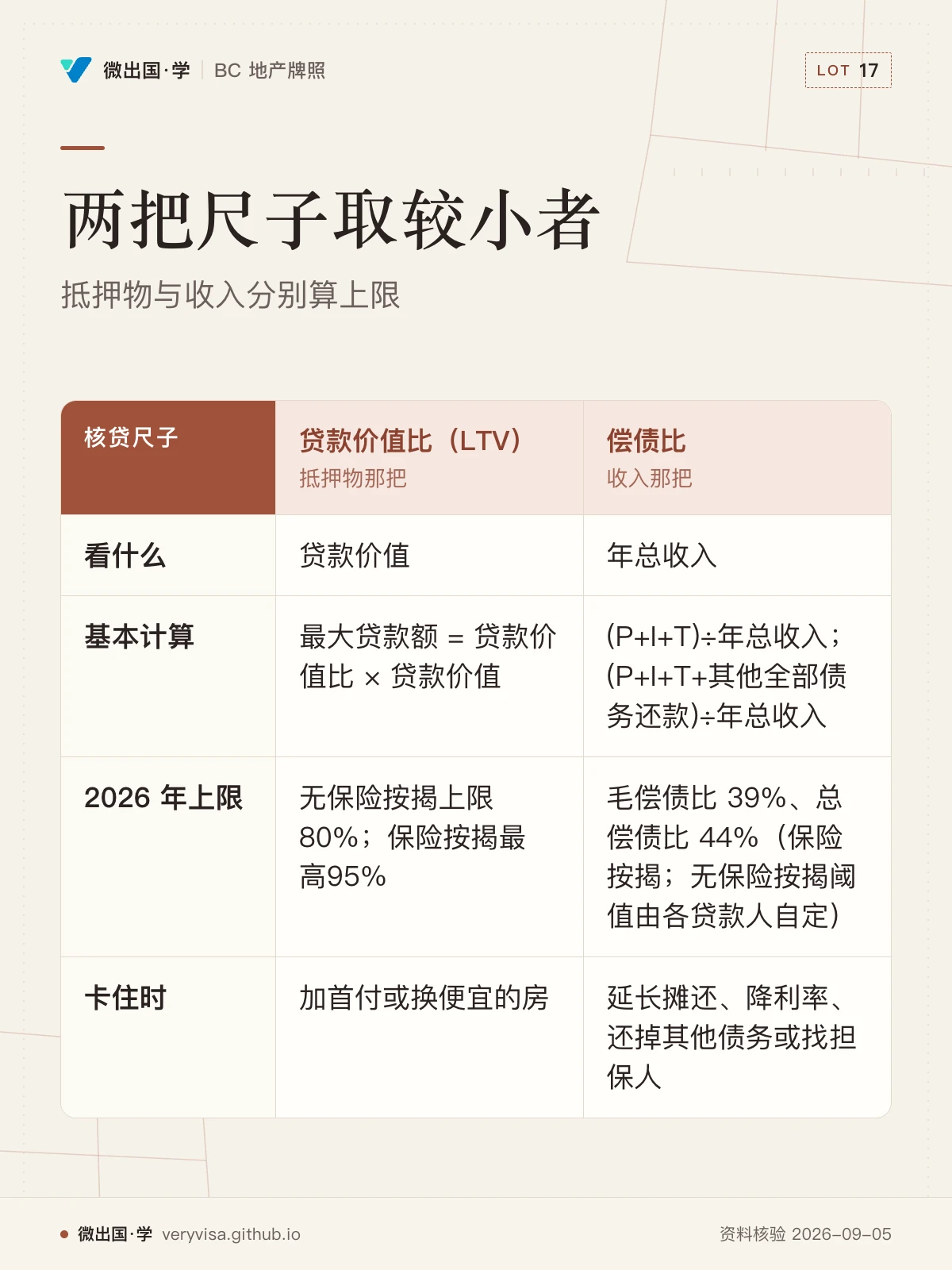
这是全章最长青、也最常考的骨架:贷款人分别算两个上限,然后取较小的那一个。
图:两把尺子取较小者——抵押物与收入分别算上限
尺子一:贷款价值比(Loan-to-Value Ratio, LTV)
最大贷款额 = 贷款价值比 × 贷款价值
这里的贷款价值(lending value) 不是成交价,也不是市场价值,卷面上这三个词的分辨是必考点:
贷款人按市场价值与贷款价值中较低的那个来审 ;同一处住宅两份估价相差 3% 到 5% 时,取低的那份。
所以「我出价 $800,000 银行就按 $800,000 的八成贷给我」是错的——买贵了的那部分,银行不认。
80% 那条线 是法定的:联邦特许金融机构做无保险 按揭,贷款价值比上限就是 80% ;
这种只有借款人个人承诺加房产作保的贷款叫常规按揭(conventional mortgage) 。
超过 80% 的必须投保,叫高成数/保险按揭(high-ratio / insured mortgage) ,可做到 95%。
私人贷款人不受这条约束,实务中通常在 75% 到 90% 之间。
尺子二:偿债比(debt service ratios)
考试口径用两条简化式说明计算结构(本站计算题会在题干写明省略了哪些项目):
毛偿债比 GDSR = (P + I + T) ÷ 年总收入
总偿债比 TDSR = (P + I + T + 其他全部债务还款) ÷ 年总收入
其中 P + I 是年度本息还款,T 是地税。记住变形式 ,因为题目通常反着问:
P + I = (GDSR × 年总收入) − T
但现行法与保险人的实际口径比这两条式子宽一格,也严一格 :2026 年 CMHC 的毛偿债比算的是
P.I.T.H. ——本金、利息、地税、取暖费 ,再加共管物业管理费的 50% (租赁地产权的年地租也算进去);
总偿债比在此基础上加全部其他债务。给客户讲的时候必须用后一套口径 ,因为取暖费和一半管理费
在温哥华的共管公寓上足以吃掉几万块的贷款额度;本站计算题按题干明确给出的成本与假设算 ,不能把旧版省略项当成现行统一口径。
阈值也全换过 (详见第十节)。2026 年 CMHC 的上限是 毛偿债比 39%、总偿债比 44% ,
这是保险按揭的硬门槛;无保险按揭的阈值由各贷款人自定,B-20 不给数字,只要求「算得保守、按压力情形测算」。
两把尺子取较小者 ——这是本章唯一一条永远不会过期的结论。抵押物那把尺卡住时,
解法是加首付或换便宜的房;收入那把尺卡住时,解法是延长摊还、降利率、还掉其他债务或找担保人。
节末检索小测 · 先别往回翻,凭记忆作答 Quick recall check: answer from memory before scrolling back
A federally chartered lender is asked for a mortgage with no default insurance, secured only by the borrower's promise and the house, at 90% of lending value. Which statement matches the course?
一家联邦特许贷款机构被要求做一笔没有违约保险、只靠借款人承诺和房子作保、贷款价值比90%的按揭。哪一项符合课程?
a The loan can proceed uninsured. Ninety percent sits inside the range private lenders use, so a federal lender may use that same range. ✗ 错误。私人贷款人不受80%约束,实务中通常在75%到90%之间。这家是联邦特许机构,无保险按揭的法定上限仍是80%。不能把私人贷款人的区间挪到联邦机构上。 Wrong. A private lender is not bound by 80%, and in practice usually lends between 75% and 90%. This lender is a federally chartered institution, so the statutory ceiling on an uninsured mortgage is still 80%. The private-lender range cannot be moved onto a federal institution.
b The loan is high-ratio, but insurance can be skipped when at least one borrower has a credit score of 600. ✗ 错误。600分是保险按揭的最低信用分门槛,至少一名借款人或担保人要达到。它不是免去投保的开关。超过80%必须投保。 Wrong. A score of 600 is the minimum credit-score threshold on an insured mortgage, and at least one borrower or a guarantor must reach it. It is not a switch that removes the need to insure. Above 80%, the loan must be insured.
c Private lenders are the ones capped at 80%. Federally chartered institutions may lend to 95% of lending value with no insurance. ✗ 错误。80%这条法定线套在联邦特许机构的无保险按揭上。做到95%的是高成数保险按揭(high-ratio mortgage),不是无保险贷款。私人贷款人不受80%这条线约束。 Wrong. The statutory line of 80% applies to an uninsured mortgage from a federally chartered institution. What can go to 95% is a high-ratio mortgage, which is insured, not an uninsured loan. A private lender is not bound by that 80% line.
d An uninsured mortgage from a federally chartered institution stops at 80% of lending value. A loan above 80% has to be insured. ✓ 正确。联邦特许机构的无保险按揭,贷款价值比上限是80%。只靠个人承诺加房产作保的叫常规按揭(conventional mortgage)。超过80%必须投保,称为高成数或保险按揭,可做到95%。 Correct. An uninsured mortgage from a federally chartered institution is capped at a loan-to-value ratio of 80%. A loan secured only by the personal promise plus the property is a conventional mortgage. Above 80% it must be insured. That loan is called a high-ratio or insured mortgage, and it can go to 95%.
看答案与每个选项的解析 Show the answer and why each option is right or wrong 答案 Answer :d
四、压力测试:2026 年的口径只剩一句话 本节回答 This section answers 考试里两侧是否各一套口径 Whether the exam gives each of the two sides its own standard 本章考题 5 Question 5
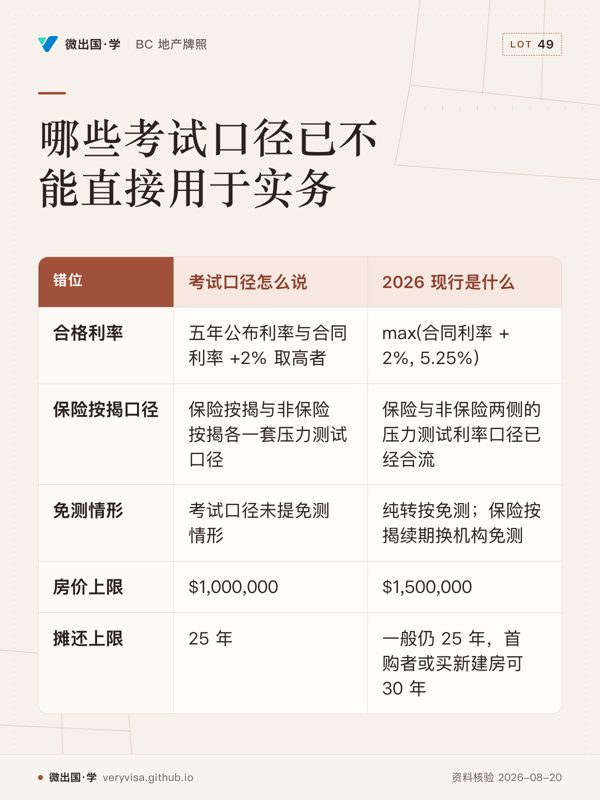
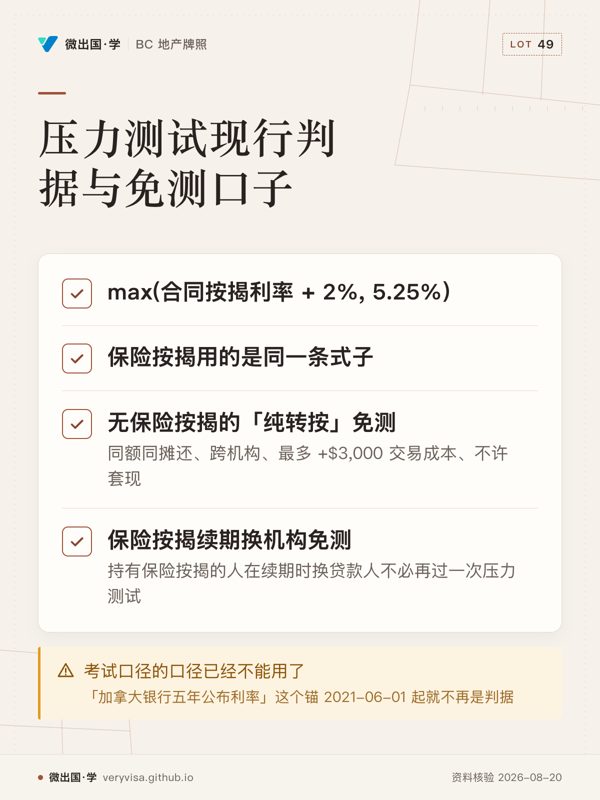
考试口径的口径已经不能用了。 考试口径说合格利率取「加拿大银行五年公布利率」与「合同利率 +2%」两者中的高者——
「加拿大银行五年公布利率」这个锚 2021-06-01 起就不再是判据 。
2026 年的现行口径(OSFI 官网 2026-01-29 更新) :
最低合格利率 MQR = max(合同按揭利率 + 2%, 5.25%)
OSFI 把它拆成两个部件:缓冲(buffer)现为 2% ,下限(floor)现为 5.25% 。
两者由监管专员设定、至少每年复核一次 ,B-20 正文本身不写死数字,只写「取合同利率加缓冲与下限中的较高者」。
所以复查这条规则时,要复查的是 OSFI 那一页上的两个部件,而不是考试口径上的那句话。
保险按揭用的是同一条式子 。CMHC 现行产品页把它写进了核贷条件:偿债比必须按
「合同利率 +2% 与 5.25% 中的较高者」计算。也就是说 2026 年保险与非保险两侧的压力测试利率口径已经合流 ,
考试口径里「保险按揭一套、非保险按揭另一套」的叙述是 2016 到 2020 年的历史。
两个免测的口子 ,都是考试口径定稿之后开的:
无保险按揭的「纯转按」(straight switch) :2024-11-21 起 ,OSFI 不再要求对这种情形套用规定的最低合格利率。
条件很窄——转的必须是一笔独立的 无保险按揭,从一家联邦受监管金融机构转到另一家 ,
剩余摊还期不加长、贷款金额不增加 (未偿本金只允许增加最多 $3,000 用于罚金手续费一类的交易成本,不许套现 )。
免的只是「监管规定的那个合格利率」,不免尽职调查 :新机构仍须按 B-20 当作一笔新贷款审,
偿债比仍要算得保守、按更高利率与收入下降的情形测算。保险按揭续期换机构 :强化版《加拿大按揭约章》(Canadian Mortgage Charter) 之下,
持有保险按揭的人在续期时换贷款人不必再过一次压力测试 。
同一时期收紧的一条 :OSFI 对各机构无保险按揭组合 引入了贷款收入比(loan-to-income, LTI)上限 ,
自各机构 2025 财年第一季度起执行。这一条约束的是机构的组合,不是单个借款人或单笔交易 ——
客户问「我的贷款收入比超了会不会被拒」,答案是这条限额不落在他头上,但它会影响某家银行在某个季度还愿不愿意做他这一类的单子。
ℹ️
压力测试不是在预测利率会涨到 5.25% 以上
它是一道安全边际 :用一个比合同利率高的数去算你的还款能力,为的是续期时利率上行、
或收入下降时你仍还得起。给客户讲这一格的正确说法是「银行按 6.5% 算你的还款能力,
但你实际按 4.5% 还款」——不是「你的利率是 6.5%」。这句话说反了,客户会以为自己被加了息。
节末检索小测 · 先别往回翻,凭记忆作答 Quick recall check: answer from memory before scrolling back
A candidate asks what the course manual, which this licensing exam follows, says about stress-testing insured mortgages as against uninsured mortgages. Which statement is the exam answer?
考生问:本执照考试所依据的课程手册,对保险按揭和无保险按揭的压力测试是怎样写的?哪一项是考试答案?
a Both are tested at the higher of the contract rate plus 2% and 5.25%. The manual uses that one rate for every residential loan. ✗ 错误。陷阱是用现行数字作考试答案。合同利率加2%与5.25%取高者,是2026年两侧合流之后的最低合格利率,不是课程手册那一句。 Wrong. The trap is using current figures as the exam answer. The higher of the contract rate plus 2% and 5.25% is the minimum qualifying rate after the two sides converged in 2026. It is not the sentence in the course manual.
b The manual exempts a straight switch from the prescribed qualifying rate when the loan amount and the remaining amortization do not increase. ✗ 错误。考试口径没有写免测。现行自2024-11-21起,一笔独立的无保险按揭转到另一家联邦受监管机构,剩余摊还期不延长、贷款金额不增加、不许套现,未偿本金最多增加$3,000用于交易成本,才免套用规定的最低合格利率,而且不免尽职调查。 Wrong. The exam standard does not state an exemption from the test. Currently, from 2024-11-21, a standalone uninsured mortgage transferred to another federally regulated institution is exempt from the prescribed minimum qualifying rate only when the remaining amortization is not extended, the loan amount does not increase, and no cash-out is allowed, and the outstanding principal increases by at most $3,000 for transaction costs. Due diligence is not exempt.
c The manual gives insured mortgages one stress-test regime and uninsured mortgages another. ✓ 正确。考试口径写的是保险按揭与非保险按揭各一套压力测试口径。现行两侧已经合流,偿债比都按合同利率加2%与5.25%中的较高者计算。 Correct. The exam standard gives insured mortgages one stress-test regime and uninsured mortgages another. The two sides have now converged, and both debt-service ratios are calculated at the higher of the contract rate plus 2% and 5.25%.
d The manual sets no stress test. Both an insured loan and an uninsured loan are qualified at the contract rate the borrower pays. ✗ 错误。考试口径有压力测试。合格利率取加拿大银行五年公布利率与合同利率加2%的较高者,这个测算利率不是借款人实际支付的合同利率。 Wrong. The exam standard does include a stress test. The qualifying rate is the higher of the Bank of Canada five-year posted rate and the contract rate plus 2%. That test rate is not the contract rate the borrower actually pays.
看答案与每个选项的解析 Show the answer and why each option is right or wrong 答案 Answer :c
五、按揭违约保险:2026 年的四道硬门槛 本节回答 This section answers 保险按揭信用分卡在哪里 Where the credit-score rule sits on an insured mortgage 本章考题 4 Question 4
首付不足 20% 时必须投保,保的是贷款人 不是借款人:借款人违约、房子卖掉仍不够还,
保险人补贷款人的差额,然后接手对借款人的个人追索权。保费由贷款人交、成本转嫁给借款人。
三家保险人 :CMHC (联邦官方住房机构)、Sagen 、Canada Guaranty 。
考试口径里的 "Genworth Financial Canada" 已更名为 Sagen (Sagen 官网自述 previously known as Genworth Canada),这个名字在 2026 年的现行文件里不会再出现。
门槛一:房价上限 $1,500,000。 2024-09-16 联邦财政部宣布把保险按揭的房价上限从 $1,000,000 提到
$1,500,000 ,2024-12-15 生效 (这个上限自 2012 年起就没动过)。CMHC 现行页的写法是
「购价/贷款价值须低于 $1,500,000」——注意是低于,不是等于。小型出租物业贷款的上限是 $1,000,000。
房价到了 $1,500,000 或以上,就只有 20% 首付这一条路 ,这是持牌人在温哥华报价区间最常用到的一条。
门槛二:首付分段。
3 到 4 个单元的自住物业最低权益 10%(贷款价值比上限 90%);1 到 2 个单元可到 95%。
门槛三:摊还年限。 保险按揭的一般上限仍是 25 年 ;但 2024-12-15 起 ,
首次购房者 或购买从未有人住过的新建房 的买家可做到 30 年 ——CMHC 把它做成了一个单独产品线
(其「首次购房者」的定义是:从未在加拿大买过房;或本年及前四个日历年内未自住过本人或配偶名下的房;
或因婚姻/同居关系破裂分居满 90 天且分居始于本年或前四个日历年内)。
更早一步是 2024-08-01 ,当时 30 年摊还只开给「首次购房者买新建房」,2024-12-15 才扩到全部首购者与全部新建房买家。
门槛四:最低信用分 600。 至少一名借款人(或担保人)的信用分要到 600 ;无信用记录的可走替代认定方式。
这个数是考试口径那一章里少数没有变过的数字 。
2026 年保费表 (占贷款额的百分比,一次性收取,可加进贷款):
摊还超过 25 年的,一律加收 0.20% 的保费附加 ——这一条是 30 年摊还新政的直接产物,考试口径定稿时不存在。
Sagen 的现行费率表与上表相同,同样注明「摊还超过 25 年(最高 30 年)另加 0.20%」。
三条计算规则 ,考卷上年年考:
保费加进贷款额 时,不计入贷款价值比 的计算;
但计入偿债比 ——因为你要按含保费的面值还款;
续期或期末不再另收保费,保险覆盖整个摊还期。
省销售税 :安大略、魁北克、萨斯喀彻温三省对保费征省销售税,且税款不能加进贷款额 。
BC 不在这三个省之列 ——给 BC 客户算首期现金时,这一格是零。
一个 2026 年才有的口子 :CMHC 有一条专门用于加建二级套房 的再融资产品——
连同现有单元最多 4 个单元、贷款价值比最高 90% 、改造后物业价值须低于 $2,000,000 、摊还最长 30 年 ;
资金只能 用于该二级套房的建造(不许套现 ),且建成的套房不得用作短租 (不得出租任何少于 90 个连续日 的期间)。
这一条与 BC 省的加密(gentle densification)政策和短租限制是同一套逻辑,客户问「加个套房怎么融资」时用得上。
节末检索小测 · 先别往回翻,凭记忆作答 Quick recall check: answer from memory before scrolling back
An insured mortgage is being qualified. One applicant has a thin file and no score. The other applicant has a score of 600. Which statement matches the course?
一笔保险按揭正在核贷。一名申请人几乎没有信贷档案、没有分数,另一名申请人的分数是600。哪一项符合课程?
a Every applicant must have a score of at least 600. A guarantor cannot fill a gap, and a missing score fails the file. ✗ 错误。门槛是至少一名借款人或担保人达到600,不是每一名申请人都要有分。没有信用记录的,可以走替代认定。 Wrong. The threshold is that at least one borrower or a guarantor reaches 600, not that every applicant has a score. A person with no credit record may be assessed another way.
b The file fails. A score of 600 is the bottom of the credit scale, so a person with no score is below every insured-mortgage rule. ✗ 错误。征信分数区间是300到900,300不是保险按揭的合格线。保险按揭的最低信用分是600,无信用记录可以走替代认定,不能把没有分数直接当成拒贷。 Wrong. The credit-score range is 300 to 900. 300 is not the qualifying line for an insured mortgage. The minimum credit score on an insured mortgage is 600. A person with no credit record may be assessed another way. The absence of a score cannot be treated as an automatic decline.
c The file can meet the score rule. At least one borrower or a guarantor must reach 600, and a person with no credit record may be assessed another way. ✓ 正确。至少一名借款人或担保人的信用分要到600。没有信用记录的可以走替代认定。这个600分是考试口径里少数没有变过的数字,现行门槛仍是600。 Correct. At least one borrower or a guarantor must have a credit score of 600. A person with no credit record may be assessed another way. This score of 600 is one of the few figures in the exam standard that has not changed, and the current threshold is still 600.
d Any reported score is enough. The insured-mortgage floor is 300, which is the bottom of the scale used by the credit bureaus. ✗ 错误。300是分数区间的下端,不是投保门槛。保险按揭要求至少一名借款人或担保人达到600。 Wrong. 300 is the bottom of the score range, not the threshold for insurance. An insured mortgage requires at least one borrower or a guarantor to reach 600.
看答案与每个选项的解析 Show the answer and why each option is right or wrong 答案 Answer :c
六、把两把尺子真算一遍(2026 示例) 本节回答 This section answers 出租楼拿谁的收入来核 Whose income is used to qualify a rental building
下面三个情景的数字都是为教学自设的整数,利率按加拿大惯例的半年计息 (j₂)报出。
情景一:首付不足 20%(保险按揭),收入那把尺卡住
某买家看中素里一套挂牌 $800,000 的独立屋,手上现金 $55,000 ,家庭年总收入 $150,000 ,
该房年地税 $3,600 、年取暖费 $1,200 ,无共管管理费。银行给的合同利率 4.5% ,摊还 25 年,按月还款。
第一步,首付够不够?
最低首付 = 5% × $500,000 + 10% × $300,000 = $25,000 + $30,000 = $55,000
刚好够。贷款额 $800,000 − $55,000 = $745,000 ,贷款价值比 93.125%,落进 90.01%–95% 档,
保费 4.00% = $29,800,加进贷款后面值 $774,800 。
第二步,抵押物那把尺 :这笔是保险按揭,上限 95% × $800,000 = $760,000,本例受首付限制在 $745,000。
第三步,收入那把尺(必须按压力测试利率算) :
合格利率 = max(4.5% + 2%, 5.25%) = 6.5%
可用于房屋支出 = 39% × $150,000 = $58,500
年度本息 P+I = $58,500 − $3,600 − $1,200 = $53,700
月还款上限 = $53,700 ÷ 12 = $4,475
月供 $4,475、25 年摊还、j₂ = 6.5% 反算贷款面值上限 $668,086 ;面值含 4% 保费,
所以真正到手的贷款是 $668,086 ÷ 1.04 = $642,391 。
第四步,取较小者 :$745,000 与 $642,391 取小 → $642,391 。
结论 :这位买家能承担的房价不是 $800,000,而是约 $642,391 + $55,000 ≈ $697,000 。
差了整整十万——而买家自己算的时候只算了首付,没算压力测试。
同一位买家如果符合首购或买新建房 ,可走 30 年摊还:月供上限不变($4,475),
30 年、6.5% 反算面值上限 $714,397 ,保费改按 4.20% ,到手贷款 $714,397 ÷ 1.042 ≈ $685,602 ,
可承担房价升到约 $740,000 。30 年摊还这一条,对这位买家值约 $43,000 的购买力。
情景二:20% 首付(无保险按揭),抵押物那把尺卡住
另一位买家买本拿比一套 $900,000 的联排,首付 $180,000 (20%),贷款 $720,000 。
家庭年总收入 $180,000 ,年地税 $4,200 、年取暖 $1,500 ,另有车贷月供 $600 、
信用卡最低还款月 $200 。合同利率 4.6% ,贷款人政策为毛偿债比 39%、总偿债比 44%,摊还 30 年。
合格利率 = max(4.6% + 2%, 5.25%) = 6.6%
毛偿债比允许的年度本息 = 39% × $180,000 − $4,200 − $1,500 = $64,500  → 月 $5,375
总偿债比允许的年度本息 = 44% × $180,000 − $4,200 − $1,500 − $7,200 − $2,400 = $63,900  → 月 $5,325
总偿债比更紧 (车贷与信用卡把它压下来了),取月供上限 $5,325;
30 年、j₂ = 6.6% 反算最大贷款 $841,506 。抵押物那把尺是 80% × $900,000 = $720,000 。
两者取小 → $720,000 ,这一笔是抵押物那把尺卡住 ,收入还有富余。
🔧
「先还掉车贷再买房」不一定值
上例里若车贷已结清,总偿债比允许的月供升到 $5,925,但毛偿债比接手成为约束 ,月供上限只能到 $5,375,
最大贷款从 $841,506 升到 $849,407——只多约 $7,901 。而本例的真正约束是抵押物那把尺,
多出来的额度一分钱都用不上。先问哪把尺卡住,再决定动哪个变量 ,这是持牌人在这一格能提供的最实在的价值。
反过来,情景一里收入卡住时,还掉一笔车贷才是真正有效的动作。
情景三:商业物业,换一把尺子
住宅自住房本身不产生收入,所以看借款人的工资;收益性物业看物业自己的净营运收入(NOI) 。
考试口径把「非自住的住宅物业」也归进商业核贷,这一条至今成立——买出租楼的客户不适用第三节那套算法。
某小型公寓楼净营运收入 $180,000 ,贷款人评定的贷款价值 $2,400,000 ,
在当前市况下只肯做 65% 的贷款价值比,利率 6%(j₂),摊还 25 年。
商业侧的收入约束有两种等价说法:
安全边际(safety margin) :年还款不得超过净营运收入的某个比例。安全边际 20%,即年还款 ≤ 80% × NOI。偿债覆盖率(debt coverage ratio, DCR) :净营运收入必须是年还款的若干倍。
两者可以互换:DCR = 1 ÷ (1 − 安全边际) 。安全边际 20% 等价于 DCR 1.25 ;DCR 1.30 等价于安全边际约 23.08%。
卷面上给哪一个都要能换算成另一个。
抵押物尺:65% × $2,400,000 = $1,560,000
安全边际 20%:年还款 = 80% × $180,000 = $144,000 → 月 $12,000 → 最大贷款 $1,875,567
偿债覆盖率 1.30:年还款 = $180,000 ÷ 1.30 = $138,462 → 月 $11,538 → 最大贷款 $1,803,430
三者取最小 → $1,560,000 ,抵押物那把尺卡住。考试口径给的经验区间(公寓楼常见 1.2,市况波动时 1.3 到 1.35,
仓库工业等非公寓类 1.4 到 1.5)是市场惯例不是法规 ,会随利率、空置率、物业类型和贷款人风险偏好浮动——
给客户报数之前回当时贷款人的条件清单确认,不要背这几个数当结论。
节末检索小测 · 先别往回翻,凭记忆作答 Quick recall check: answer from memory before scrolling back
A buyer is purchasing a small apartment building to rent out and asks the lender to qualify the loan on the buyer's salary with the residential gross-debt-service formula. Which statement matches the course?
买方购买一栋小型公寓楼用来出租,要求贷款人按买方工资、用住宅的毛偿债比公式来核这笔贷款。哪一项符合课程?
a Use the salary. A residential building keeps the residential ratios even when the buyer will not live there. ✗ 错误。住宅自住房看借款人的工资。非自住的住宅物业,考试口径归进商业核贷,这一条至今成立,不适用自住房那套偿债比。 Wrong. An owner-occupied home looks at the borrower's salary. The exam standard places a non-owner-occupied residential property under commercial underwriting. That point still holds, and the owner-occupied debt-service ratios do not apply.
b Use the building's net operating income. The course treats a non-owner-occupied residential property as commercial underwriting. ✓ 正确。收益性物业看物业自己的净营运收入(net operating income)。考试口径把非自住的住宅物业归进商业核贷,买出租楼不适用自住房那两把尺子的算法,这一条至今成立。 Correct. An income property is looked at through the property's own net operating income. The exam standard places a non-owner-occupied residential property under commercial underwriting. Buying a rental building does not use the two-ruler calculation for an owner-occupied home. That point still holds.
c Use whichever is higher, the salary or the gross rent, and then apply an 80% loan-to-value cap as the only test. ✗ 错误。出租楼不在工资和毛租金之间取高者,也不把八成贷款价值比当成唯一测试。商业侧同时看净营运收入约束和贷款人给出的贷款价值比,再取较小的贷款额。 Wrong. A rental building does not take the higher of salary and gross rent, and it does not treat an 80% loan-to-value ratio as the only test. The commercial side looks at the net-operating-income constraint and the loan-to-value ratio the lender states, then takes the smaller loan amount.
d Add 100% of the gross rent to the salary. Every rental property contributes all of its rent to the borrower's gross income. ✗ 错误。现行能按最高100%毛租金加进总收入的,是自住且为本次申请标的的两单元物业,不是一栋非自住的公寓楼。考试口径的租金抵扣是保险按揭100%、常规按揭最高90%,同样不能代替净营运收入核贷。 Wrong. What may currently be added to gross income, at up to 100% of gross rent, is an owner-occupied two-unit property that is the subject of this application, not a non-owner-occupied apartment building. On the exam standard, the rent offset is 100% on an insured mortgage and at most 90% on a conventional mortgage. That offset likewise cannot replace underwriting on net operating income.
看答案与每个选项的解析 Show the answer and why each option is right or wrong 答案 Answer :b
七、放款之后:三项财务承诺与利息调整 本节回答 This section answers 财产险只保贷款额够不够 Whether insuring only the loan amount is enough
拿到批复不等于结束。除了还本付息,借款人还有三项以保全抵押物价值为目的的承诺 ,这一节完全长青:
交地税。 政府的税费与征收无论是否登记,优先于按揭 成为物业上的负担。所以许多贷款人把地税
摊进月供、代收进税务账户代缴;由借款人自缴的,合同里必须写明这项承诺,贷款人每年核一次。
一旦欠税,贷款人往往要替借款人把税交了并计入本金,以免政府行使税务出售 权。上财产险,而且必须按「全部可保价值」投保,受益指向按揭权人。 考试口径那个例子的逻辑值得记住:
假设一处物业全部可保价值 $75,000、贷款 $37,500,若只按贷款额投保 $37,500,
而借款人另在别家为剩余的 $37,500 投了一份只赔自己的保单,那么一场 $30,000 的火损会由两家保险人分摊,
贷款人只拿到 $15,000;若借款人不把另外 $15,000 用来修复,物业价值可能低于贷款余额,
贷款人真的接手时还得自掏 $15,000 才卖得动。按贷款额投保是一个看起来省钱、实际把风险留给自己的做法。 维护物业。 承诺不得使抵押物价值跌到贷款余额以下。
利息调整期(interest adjustment period) :还款日通常定在每月 1 日或 15 日,而成交日多半不在这两天。
从放款当日 到第一个还款周期起点 之间这一段,贷款人按日息单独收一笔利息,
第一次正式月供在其后一个周期才到期。这一格考的是概念不是计算 ——理解「为什么成交日与首期供款日之间会多一笔钱」即可,
但给客户交底时必须提到它,否则客户看到成交日多扣一笔会以为算错了。
大麻与承保、放贷 :住宅内合法可种最多四株,但保险人可能拒保、加价,或把因种植大麻引起的损失除外;
贷款人也可能不愿为曾种过大麻的物业提供融资(霉变风险、为绕过电表改动线路的风险)。
持牌人的动作是主动问、并提示买家自行核实可保性与可贷性 ,而不是代为判断。
节末检索小测 · 先别往回翻,凭记忆作答 Quick recall check: answer from memory before scrolling back
A borrower wants to insure only the loan balance, with that policy payable to the mortgagee, and to place a second policy for the rest of the value payable only to the borrower. Which statement matches the course?
借款人只想按贷款余额投保,赔款付给按揭权人,其余价值另投一份只赔给自己的保单。哪一项符合课程?
a The split meets the covenant. The mortgagee is fully protected once one policy equals the unpaid loan. ✗ 错误。只按贷款额投保看起来省钱,实际把风险留给贷款人。损失会由两家保险人分摊,按揭权人拿不到整笔赔款。 Wrong. Insuring only the loan amount looks cheaper, and it leaves the risk with the lender. A loss is shared by the two insurers, and the mortgagee does not receive the whole of the proceeds.
b The borrower's own policy is enough. Naming the mortgagee would pay the lender more than the loan balance. ✗ 错误。承诺是按全部可保价值投保,并且受益指向按揭权人。只保给借款人自己,贷款人在损失里没有那一份赔款。 Wrong. The covenant is to insure for the full insurable value, with the proceeds payable to the mortgagee. Insurance payable only to the borrower leaves the lender without that share of the loss proceeds.
c Insurance can be waived when taxes are collected with the payment, because taxes already rank ahead of the mortgage. ✗ 错误。地税优先于按揭,这是另一项承诺,不能代替财产险。两项都要:税要交,险要按全部可保价值投保。 Wrong. Property taxes rank ahead of the mortgage. That is a separate covenant, and it cannot stand in for property insurance. Both are required. The taxes must be paid, and the insurance must be placed for the full insurable value.
d The two insurers can share a loss, so the mortgagee may receive only part of it. If the borrower does not repair, the lender can be left short of the loan balance. ✓ 正确。课程的例子里,全部可保价值只保了一半给按揭权人、另一半只赔借款人时,一场火灾的赔款由两家保险人分摊。借款人若不把自己那一份用来修复,物业价值可能低于贷款余额,贷款人接手时还得再掏钱才卖得动。 Correct. In the course example, when only half of the full insurable value is insured for the mortgagee and the other half pays only the borrower, the proceeds of a fire are shared by the two insurers. If the borrower does not use that share for repairs, the property value may fall below the loan balance, and the lender who takes it over must put in more money before it can be sold.
看答案与每个选项的解析 Show the answer and why each option is right or wrong 答案 Answer :d
八、柜台上怎么做 本节回答 This section answers 柜台能不能报出贷款数字 Whether a loan figure may be stated at the counter
看房之前先问预批。 没有预批的看房是在浪费所有人的时间;有预批的,问清楚它锁的是什么利率、锁到哪一天。报价区间先过一遍两把尺子。 客户报得出收入、地税、其他债务时,你能当场判断卡住他的是首付还是收入——
但只给框架,不给数字 :具体额度必须由持牌按揭经纪或贷款人出。$1,500,000 是一条会突然出现的墙。 报价从 $1,480,000 加到 $1,510,000,
首付要求可能从「5% + 10% 分段」跳到全额 20%。这一格是持牌人最容易帮到客户、也最容易漏掉的地方。首购或新建房,主动提 30 年摊还这条路 (并提醒它要多付 0.20% 的保费附加)。转介按揭经纪、公证人、律师、储蓄机构,只要你或你的经纪公司会因此收到钱,就照 s. 56 书面披露。 省法名称已经换了。 2026-10-13 起按揭中介适用《按揭服务法》,再写《按揭经纪法》就是旧口径;替客户撮合银行按揭并收费之前,先确认自己落不落在《Mortgage Services Regulation》的免牌豁免里。
节末检索小测 · 先别往回翻,凭记忆作答 Quick recall check: answer from memory before scrolling back
At an open house the buyer states household income, the property taxes and the other monthly debts, then asks the licensee for the maximum loan a bank will give. Which action matches the course?
开放日上,买方报出家庭收入、地税和其他月供债务,请持牌人说出银行会贷的最高额度。哪一个做法符合课程?
a Explain how the two rulers work, and leave the actual figure to a licensed mortgage broker or the lender. ✓ 正确。客户报得出收入、地税和其他债务时,可以判断卡住的是首付还是收入,但只给框架,不给数字。具体额度必须由持牌按揭经纪或贷款人出具。 Correct. When the client can state income, property taxes, and other debt, it is possible to judge whether the down payment or the income is what binds, but only the framework is given, not a figure. The actual amount must come from a licensed mortgage broker or the lender.
b Multiply the asking price by 80% and give that product as the amount the bank will advance on this house. ✗ 错误。陷阱是出价当成贷款价值,同时又报了不该报的数字。挂牌价不是贷款价值,持牌人也不能把算出来的额度说成银行会放的数。 Wrong. The trap is treating the offer price as the lending value, and stating a figure that should not be stated. The asking price is not the lending value, and the licensee cannot present a calculated amount as the amount the bank will advance.
c Multiply gross income by 39% and present the result as the approved loan, because a pre-approval is already a promise. ✗ 错误。39%是现行保险按揭的毛偿债比上限,用来限制房屋相关支出占收入的比例,不是贷款额本身。预批也不是放款承诺。考试口径的保险按揭毛偿债比是35%,同样不能直接乘成贷款额。 Wrong. 39% is the current gross debt service ceiling on an insured mortgage. It limits housing-related costs as a share of income. It is not the loan amount itself. A pre-approval is also not a commitment to advance. On the exam standard the gross debt service ratio on an insured mortgage is 35%, and that percentage likewise cannot be multiplied straight into a loan amount.
d Say nothing about borrowing. A trading-services licensee is not allowed to mention debt-service ratios or a pre-approval. ✗ 错误。持牌人既不是贷款人,也不是按揭经纪,但可以送客户去做预批、把条件讲清楚,并在报价区间用两把尺子给框架。完全不谈,不符合柜台上的做法。 Wrong. The licensee is neither the lender nor a mortgage broker, but the licensee can send the client for a pre-approval, explain the conditions, and use the two rulers to give a framework inside the price range. Saying nothing about borrowing does not match what is done at the counter.
看答案与每个选项的解析 Show the answer and why each option is right or wrong 答案 Answer :a
九、考试口径(©2020)vs 2026 现行:逐条对照 本节回答 This section answers 考试里的房价上限写多少 What price ceiling the exam writes
没有变的 (这些照考试口径学即可):五个 C、征信报告的读法与 300–900 分区间、
成交价/购置成本/市场价值/贷款价值四个概念的分辨、80% 那条法定线与常规/高成数的分界、
两把尺子取较小者、保费加进贷款不计入贷款价值比但计入偿债比、三项财务承诺、利息调整期的概念、
商业侧的净营运收入/安全边际/偿债覆盖率及其换算、最低信用分 600。
节末检索小测 · 先别往回翻,凭记忆作答 Quick recall check: answer from memory before scrolling back
A practice item asks for the purchase-price ceiling the course manual states for a mortgage insured because the down payment is under 20%. Which figure is the exam answer?
一道练习题问:课程手册为首付不足20%、因而要投保的按揭规定的房价上限是多少?哪一个数字是考试答案?
a $1,500,000. A purchase at that price can still be insured when the down payment on the portion above $500,000 is 10%. ✗ 错误。陷阱是用现行数字作考试答案。$1,500,000是2024-12-15起的现行门槛一带,而且现行写法是购价或贷款价值须低于$1,500,000,达到或超过就只能走至少20%首付,不能投保。 Wrong. The trap is using current figures as the exam answer. $1,500,000 is the current threshold band in force from 2024-12-15, and the current wording is that the purchase price or the lending value must be below $1,500,000. At or above that figure, the only path is a down payment of at least 20%, and the mortgage cannot be insured.
b $500,000. Insurance is available only on the part of the price that takes a minimum down payment of 5%. ✗ 错误。$500,000是首付分段的折点:该数及以下最低首付5%,超出部分10%。它不是保险按揭的房价上限。 Wrong. $500,000 is the break point in the down-payment steps. At that amount and below, the minimum down payment is 5%, and on the portion above it the minimum is 10%. It is not the price ceiling for an insured mortgage.
c $1,000,000. That is the insured-mortgage price ceiling stated in the course manual the exam follows. ✓ 正确。考试口径的保险按揭房价上限是$1,000,000。现行自2024-12-15起,购价或贷款价值须低于$1,500,000,达到或超过$1,500,000就只有至少20%首付这一条路。 Correct. On the exam standard, the price ceiling for an insured mortgage is $1,000,000. Currently, from 2024-12-15, the purchase price or the lending value must be below $1,500,000. At or above $1,500,000, the only path is a down payment of at least 20%.
d The manual sets no price ceiling. Insurance turns only on a credit score of 600 and a 25-year amortization. ✗ 错误。600分和一般25年摊还都是保险按揭的门槛,但手册同时写了房价上限。考试答案是$1,000,000,不是没有上限。 Wrong. A score of 600 and a usual amortization of 25 years are both thresholds for an insured mortgage, but the manual also states a price ceiling. The exam answer is $1,000,000, not the absence of a ceiling.
看答案与每个选项的解析 Show the answer and why each option is right or wrong 答案 Answer :c
术语双语对照
源表(本篇判据)
本篇不给的数字与未展开的点 :
Canada Guaranty 的现行保费表逐档值——正文不给它的数字,以该公司现行费率表为准。
2026 年各贷款人对无保险 按揭实际采用的毛/总偿债比阈值——监管不给数字,各家自定且不公开,
正文只写「由各贷款人自定」,示例里的 39% / 44% 是为教学假设的贷款人政策 ,不是法定值。
商业按揭偿债覆盖率的 2026 现行区间——考试口径给的 1.2 / 1.3–1.35 / 1.4–1.5 是市场惯例,以当时贷款人条件为准。
预批锁定利率的 60 到 120 天区间——各贷款人条款不同。
《Mortgage Services Rules》(B.C. Reg. 110/2025) 对转介费的记录要求——本篇只讲到 Regulation 的两条免牌豁免,未展开 Rules。
本页知识卡 不看正文也能拿到这一节的核心内容:先看导读,再看图。点图放大,左右翻页。
放大 ⤢ 考试口径那套式子的结构仍对,但锚变了 先看 先看金额与年限两行:这些变化会直接改写实务判断。易漏 免测条件很窄,而且不免尽职调查;续期换机构只写保险按揭。下一步 去讲义核对生效日,再按客户交易类型找持牌专业人士确认。详情与分享 → 放大 ⤢ 保险与非保险两侧的压力测试利率口径已经合流 先看 先看取高逻辑,不要把安全边际当成实际利率。易漏 纯转按条件很窄,且只免规定的合格利率;新机构仍要当新贷款审。下一步 去练习区分要测与免测,再带具体续期或转按情形找持牌专业人士。详情与分享 → 本站依据官方原文自撰 · 出处见正文链接