🃏 Flashcards · 3 闪卡 · 3 张 🖼 Slides · 2 幻灯 · 2 页 ✍️ Questions · 7 刷题 · 7 道
分离基金与年金 Segregated Funds & Annuities P1 必拿分 P1 Must score
ZH EN ZH + EN
先看这一章怎么考 First, how this chapter is tested
保证触发与结算金额计算题:给定初始存款、保证比例(如 75%/75% 或 75%/100%)和不同时点的市值,考察到期、身故或中途提前赎回时实际可领取的金额及保险公司补足款(top-up)。 Guarantee trigger and settlement calculation questions: Given initial deposit, guarantee percentages (such as 75%/75% or 75%/100%), and market values at different points in time, test the actual payout amount and insurer top-up upon maturity, death, or early partial or full surrender. 受益人指定与双重保护辨析题:通过客户希望规避遗嘱认证(probate)或防范债权人追索(creditor protection)的情景,测试非遗产受益人直接给付条件与 BC《Insurance Act》s.65(2) 家庭成员范围的区分。 Beneficiary designation and dual-protection analysis questions: Using scenarios where a client wishes to bypass probate or protect against creditor claims, test the distinction between direct payment conditions for a named non-estate beneficiary and the family member class under BC Insurance Act s. 65(2). 合同操作后果判断(分批注资、重置、提取与转换):考察按存款日逐笔起算 10 年到期日、重置(reset)锁高保证基数并顺延到期日、部分提取按比例永久下调保证基数,以及基金转换(switch)触发资本利得或损失。 Contract transaction consequence assessment questions (subsequent deposits, resets, withdrawals, and switches): Test deposit date-based 10-year maturity calculations, resets locking in higher guarantee bases and extending the maturity date, proportional permanent reductions of guarantee bases upon partial withdrawals, and capital gains or losses triggered by fund switches. 最常丢分的陷阱(看到题干信号就警觉) Traps that cost the most marks (watch for the signal in the stem)
到期保证与身故保证混淆 Confusing maturity guarantee with death benefit guarantee 题干出现两个斜杠数字(如 75/100)、受保人在合同未满 10 年时身故,或询问“担心自己活着时本金亏损”应看哪项保证。 The question stem displays two slash-separated figures (e.g., 75/100), the annuitant dies before the 10-year term matures, or the scenario asks which guarantee protects an investor who fears losing principal during their lifetime. 中途赎回误算保证补足 Erroneously applying guarantee top-ups to early redemptions 题干出现“第 6 年或第 7 年急需资金全部赎回”“到期前提前退保”且当时市值低于初始存款的 75%。 The question stem mentions an urgent need for funds requiring full surrender in year 6 or 7, or early redemption before maturity while market value is below 75% of the original deposit. 分批注资合并到期日 Consolidating maturity dates for subsequent deposits 题干描述客户在合同成立后连续数年分批追加存款(deposit date-based),询问第 2 笔或第 3 笔存款的到期时间与累计到期保证额。 The question stem describes a client making subsequent deposits in successive years under a deposit date-based contract, asking for the maturity date or cumulative maturity guarantee of the second or third deposit. 本章考点页:导图、要点表、7 道带逐项解析的练习 →
分离基金(segregated fund)是一种以保险合同承载投资与保证安排的产品,这个错位正是本章(考纲 c2,评估产品,占本模块 30% 权重)反复出题的地方。读完这一章,你要能做三件事:说清楚分离基金凭什么能提供共同基金完全没有的保证、遗嘱认证豁免与债权人保护;算对到期保证与身故保证在不同市值下各领多少钱;以及分清哪些数字考试口径还是 2022 年的旧值、现行答案已经变了。这三件事分别对应考场的三种题型,也是柜台工作里最容易说错话的三个地方。
一、制度设计与底层逻辑:为什么分离基金能有"保证" 本节回答 This section answers 分离基金与共同基金的法律形式、监管归属、费用及年龄限制差异 Differences between segregated funds and mutual funds regarding legal form, regulatory jurisdiction, fees, and age limits 本章考题 1 Question 1
分离基金的正式合同名称是 IVIC(Individual Variable Insurance Contract,个人可变保险合同)——这个名字本身就是全章的钥匙。它不是一份共同基金份额的买卖合同,而是一份保险合同,只是这份保险合同的赔付金额随着基金投资组合的市值浮动。这个"保险合同"的法律身份,决定了后面每一条独有优势的来源。
合同里有三个角色,持有人与受保人可以是同一人,也可依合同分开;身故受益人须在给付时具领取资格:持有人(policy owner)出资、做投资决策、有权申请赎回或到期领取;受保人(annuitant)是保证的锚点——他的存活到期或身故直接触发到期保证或身故保证;受益人(beneficiary)由持有人指定,在受保人身故时领取身故保证,且绕开遗嘱认证程序。如果在 RRSP/RRIF 一类注册账户内购买,受保人必须与持有人是同一人;非注册账户可在可保利益、同意、年龄及合同条件允许时另设受保人。
保证为什么能存在,而共同基金完全没有对应机制?答案在保险公司的资产负债表上:保险公司把"保证"计入自己的准备金负债,一旦市值不足以覆盖保证额,差额由保险公司自有资产补足(top-up),这本质是一份用保险机制包装的"投资本金保证保险"。共同基金的份额只代表你按比例持有的资产净值,基金公司没有、也没有法律义务用自己的钱去补差额——因此普通共同基金本身不含 IVIC 的保险保证;不能据此排除市场上另加第三方担保的不同产品结构。
免遗嘱认证与免于债权人追索这两项优势,同样建立在"保险合同 + 指定受益人"这个结构上,而不是"投资合同"结构:有效指定的受益人在身故时有权领取且不是遗产(estate)本身时,赔付款就直接付给受益人,法律上从未进入遗产总值,因此不需要经过遗嘱认证、不计入遗嘱认证费基数。非注册、单独持有的共同基金通常没有相同的保险受益人结构;若基金置于可指定受益人的注册计划或其他持有安排中,遗产处理须按该结构判断。
但这两项优势的受益人条件并不相同,讲解页与题库都要求分开记,不能合并成一条规则:
免遗嘱认证:须有有效、在身故时有权领取的非遗产受益人,且无其他使款项进入遗产的安排,不限受益人与被保险人的亲属关系(BC Insurance Act s.65(1):指定了受益人,保险金即不属于被保险人遗产);配偶、父母、子女、孙辈这一范围是下一条免执行保护的条件,不是免遗嘱认证的条件。
免于债权人追索:BC Insurance Act s.65(2) 对被保险生命之人的配偶、子女、孙辈或父母的有效指定,提供存续期间免执行或扣押保护,并未另要求同时不可撤销。不可撤销指定是另一条法律安排,须分开看;破产、欺诈性转移等仍要另核。BC Laws(King's Printer 官方合并本)
绕开遗嘱认证具体省了多少钱,用 BC 的现行遗嘱认证费率算一遍最直观:BC《Probate Fee Act》规定,遗产计费价值 $25,000 以下免征;$25,000–$50,000 部分每 $1,000 或不足 $1,000 的部分收 $6;超过 $50,000 的部分每 $1,000 或不足 $1,000 的部分收 $14。这是本课少见的"考试口径数字与现行法条文完全一致"的例子——BC Laws 官网原文核对后,$6/$14 的分档结构没有变化。举例:一份价值 $300,000 的遗产走遗嘱认证,认证费约为 $25,000×0 + $25,000×0.006 + $250,000×0.014 = $150 + $3,500 = 约 $3,650 ——这正是分离基金指定合格受益人所绕开的那笔成本。
除了《Probate Fee Act》按遗产计费价值分档的这笔费用,遗嘱认证还要另加一笔法院一般申请费——考试口径写 $208,回 BC《Supreme Court Civil Rules》附表 1(Schedule 1 to Appendix C)原文核实,现行金额是 $200,不是 $208 (遗产计费价值不超过 $25,000 免征此项申请费);这两笔费用是分开收的,要相加才是遗嘱认证的法院端总成本,不能只算其中一笔。所以上面 $300,000 遗产的例子,完整的法院端成本是 $3,650(分档认证费)+ $200(一般申请费)= 约 $3,850 ,若该合同是唯一须申请遗嘱认证的资产,才可能同时省去申请费;遗产另有资产仍须申请时,移出这笔投资不会再节省固定申请费,不含律师费与延误时间的隐性成本。
ℹ️
"分离"这个词分离的是什么
"分离基金"的"分离"指的是保险公司把这部分资产与自己的一般营运资产分开记账、单独持有,隔离投资资产与保证补足责任须分开理解;top-up 仍依赖保险人履约能力,保险人失败时另有 Assuris 保护范围,也是这个名字的字面来源,不是"和共同基金分离"的意思。
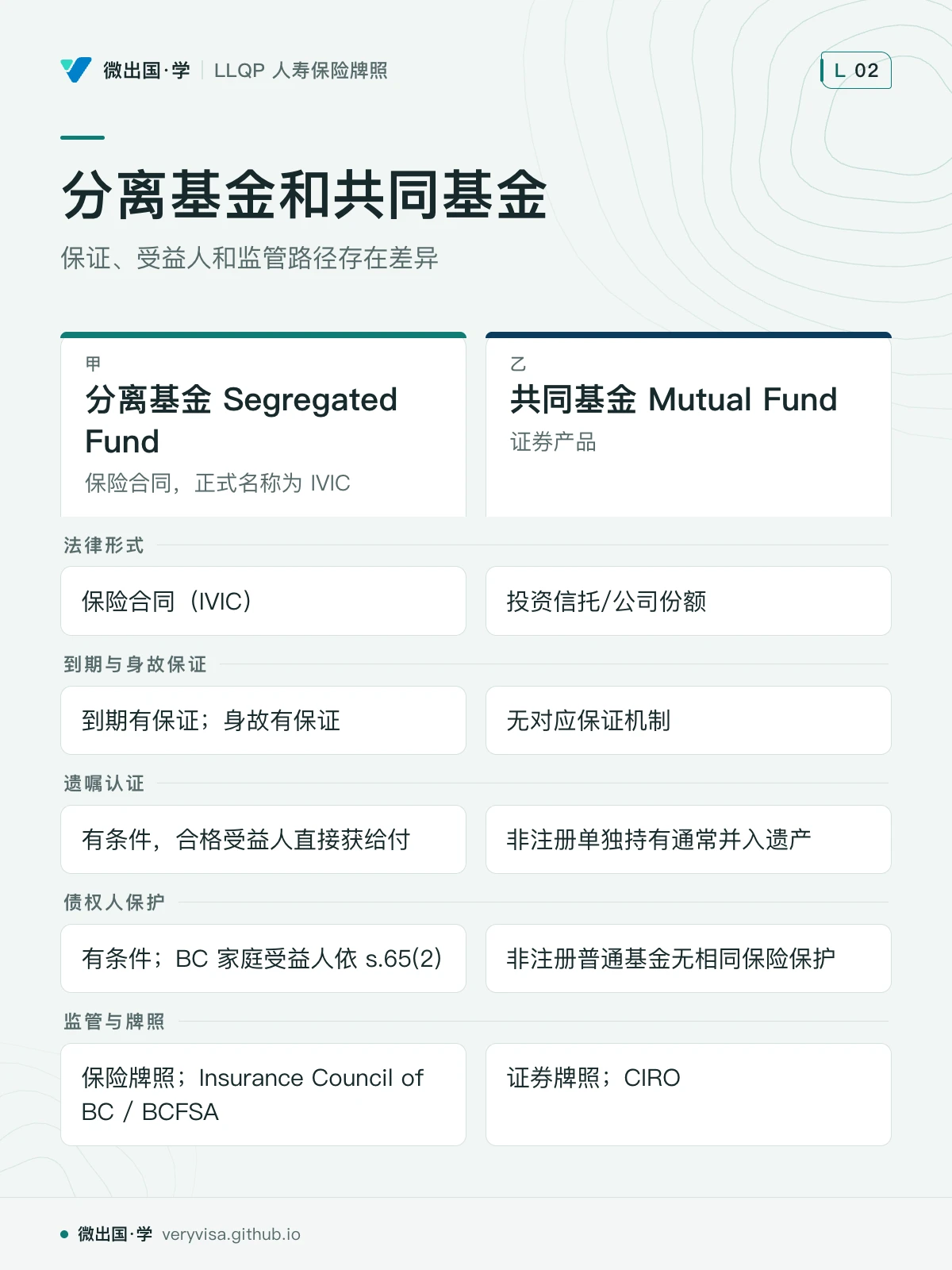
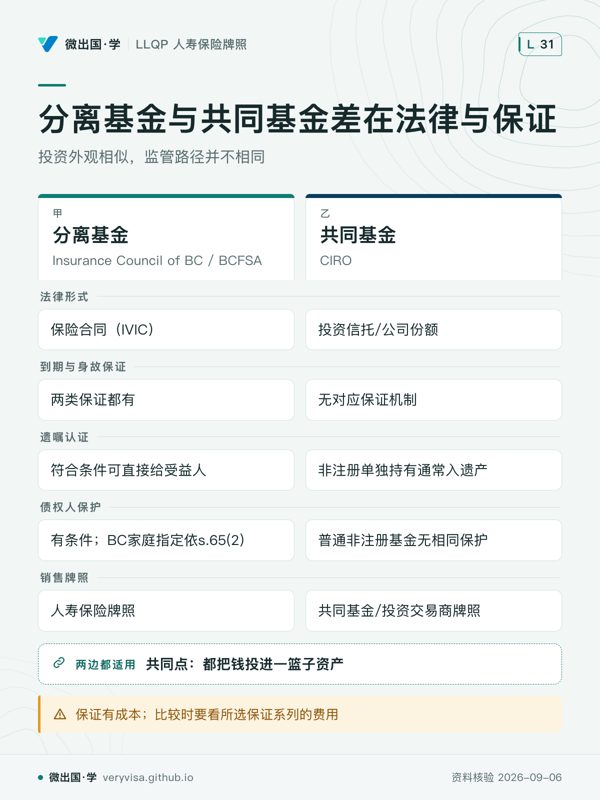
一张表说清楚:分离基金到底和共同基金差在哪
图:分离基金和共同基金——保证、受益人和监管路径存在差异
考试最爱在这张表的六个维度里挑一个出情景题——尤其是"监管归属"这一行,最容易被默认成"都归同一个机构管":
最后一行是本课容易被忽视的一条:分离基金销售完全不受 CIRO 管辖——CIRO 只管共同基金与证券交易商这条线;分离基金走的是保险代理人牌照与省级保险监管者这条完全独立的监管体系。两条产品外观相似(都是把钱投进一篮子资产),监管路径却完全不同。
基金构成与适当性:不是所有资产都装得进同一份保险合同
考纲把分离基金拆成两个能力子项:一是"分析可构成分离基金的投资类型",二是"分析分离基金相对其他投资的优势/局限"。第一项对应的是分离基金的底层资产分类——按 CIFSC(Canadian Investment Funds Standards Committee)的行业标准,分离基金底层投向可分为现金、固定收益、股权、商品、其他五大类,考试口径再用约 14 类子基金作教学归类;这不是已核实的 CIFSC 现行类别总数(如货币市场、加拿大固定收益、全球股权、平衡型等)。代理人向客户推荐哪一类子基金,必须回到公平对待客户原则(FTC)与适当性(suitability)——推荐的资产类别要与客户的投资目标、风险承受能力、投资期限相匹配,而不是"哪个佣金高推哪个"。这也是为什么分离基金的申请表环节需要先做投资者画像(investor profile),而不是先挑产品——产品适配是画像之后的第二步,顺序不能颠倒。
除了到期保证与身故保证这两种"一次性"保证,部分分离基金合同还提供收入型附加保证:GMWB(保证最低提取收益)保证投资人在约定期限内每年至少能提取某个金额;GLWB(保证终身提取收益)则把这个保证延伸到终身,即使基金市值提取到零,只要按约定比例提取,保险公司仍会继续支付到投资人身故为止。这两类附加保证通常需要额外收费(rider fee),本质是把"怕活得太久、钱花光"的长寿风险也转移给了保险公司——这是分离基金相对普通共同基金"专业管理、分散投资"之外,另一层共同基金完全没有的风险转移功能。
局限:分离基金不是没有代价
优势清单之外,考试口径同样列了五类局限,考试同样会考,且是"选出局限"型题目的主要素材:
本金风险仍然存在:保证只覆盖到期或身故这两个时间点,合同存续期间市值照样可能大幅波动,中途需要用钱的人承担的是全部市场下跌风险,不是"打折"的风险。
销售费结构的选择空间已经收窄:DSC 被禁售后,实际还需核前收费、chargeback及其他现行安排;没有赎回销售费不代表没有运营费用,也不能凭标签推断哪份MER更高。
MER 通常高于同类共同基金:多出的部分是维持保证所需的"保险费用",且不论基金涨跌都照收,会拉低净回报——若5%是假设费前回报、3%是假设年费用,可粗略估为2%费后回报;若公告表现已扣费用,不能再减一次MER。该减法只是简化示例。
提前退保或部分提取有代价:如前所述,提取会永久性下调保证计算基数,且部分合同对短期内的大额提取或转换收取额外费用。
年龄限制:非注册合同通常要求受保人在90 岁前 购买;注册账户(RRSP/LIRA)则受限于71 岁 必须转为 RRIF/LIF 的联邦税法规则——产品投保年龄按合同确认;RRSP一般须在满71岁当年年底前到期,可转RRIF、购年金或提款,不是所有账户一律必须转RRIF/LIF。
节末检索小测 · 先别往回翻,凭记忆作答 Quick recall check: answer from memory before scrolling back
Marcus holds a mutual fund dealing licence regulated by CIRO and wants to know how segregated funds differ from mutual funds in terms of licensing, fees, and age limits for non-registered accounts. Which statement accurately describes segregated funds?
Marcus 持有受 CIRO 监管的共同基金销售牌照,想了解在非注册账户的牌照要求、费用结构及投保年龄上限方面,分离基金与共同基金有何不同。下列哪项陈述准确描述了分离基金?
a They are regulated by CIRO and require a mutual fund licence because their market value fluctuates with the underlying investment portfolio every day. ✗ 错误。虽然分离基金的市值随底层资产波动,但它在法律上是个人可变保险合同(Individual Variable Insurance Contract, IVIC),销售须持人寿保险牌照并归省级保险监管机构(如 Insurance Council of BC / BCFSA)管辖,完全不受加拿大投资监管组织(Canadian Investment Regulatory Organization, CIRO)管辖;这是“双口径数字与监管归属错位”陷阱。 Incorrect. Although segregated fund values fluctuate with underlying assets, they are legally Individual Variable Insurance Contracts (IVICs); selling them requires a life insurance licence under provincial insurance regulators (such as Insurance Council of BC and BCFSA) and is completely outside CIRO jurisdiction; this falls into the trap of misaligning dual-benchmark figures with regulatory bodies.
b They are insurance contracts under provincial insurance regulators, usually carry a higher MER to pay for guarantees, and typically need a non-registered annuitant under 90. ✓ 正确。分离基金是受省级保险监管机构管辖的保险合同(IVIC),其管理费率(management expense ratio, MER)因包含维持保证所需的保险成本而通常高于同类共同基金,且非注册合同通常要求受保人(annuitant)在 90 岁前购买。 Correct. Segregated funds are insurance contracts (IVICs) governed by provincial insurance regulators; their management expense ratio (MER) is generally higher than that of comparable mutual funds because it includes the insurance cost to fund guarantees, and non-registered contracts typically require the annuitant to be under age 90 at issue.
c They must be converted to a RRIF or LIF by the end of the year the annuitant turns age 71, even when held in a non-registered account. ✗ 错误。满 71 岁当年年底前必须到期处理(如转入 RRIF/LIF、购买年金或提款)是针对注册账户(如 RRSP/LIRA)的联邦税法限制,而非注册分离基金合同通常允许受保人在 90 岁前购买。 Incorrect. Mandatory maturity settlement by the end of the year the annuitant turns age 71 (converting to a RRIF/LIF, purchasing an annuity, or deregistering) is a federal tax rule for registered plans (such as RRSPs/LIRAs), whereas non-registered segregated funds generally allow issue ages up to age 90.
d They charge the insurance cost for maturity and death benefit guarantees only in years when the underlying fund earns a positive return. ✗ 错误。分离基金较高的管理费率(MER)中包含维持保证所需的保险费用,不论底层基金当年涨跌都会照常按年化比例收取,从而拉低净回报。 Incorrect. The insurance fee embedded in a segregated fund's MER is charged continuously as an annualized percentage regardless of whether the fund earns a positive or negative return, reducing net returns.
看答案与每个选项的解析 Show the answer and why each option is right or wrong 答案 Answer :b
二、2026 现行政策与数字:考试口径写的和现在不一样的地方 本节回答 This section answers 非注册分离基金年度分配、ACB调增及基金转换的税务处理规则 Taxation rules for annual allocations, ACB step-ups, and internal fund switches in non-registered segregated funds 本章考题 2 Question 2
先说不会变的部分:到期保证最短 10 年 (从首笔存款起算,合同可设更长期限,甚至可延到持有人 100 岁),常见保证档位是 75%(到期)/75%(身故)或 75%/100% ,少数合同提供 100%/100%。这些数字涉及监管基准和具体合同条款,不能一概归为自愿惯例或永久不变;到期起算、年龄及不同保证档位须核现行信息折页。但保证之外,有两处数字考试口径写的是 2022 年的旧值,柜台与考场必须分清楚在答哪一版。
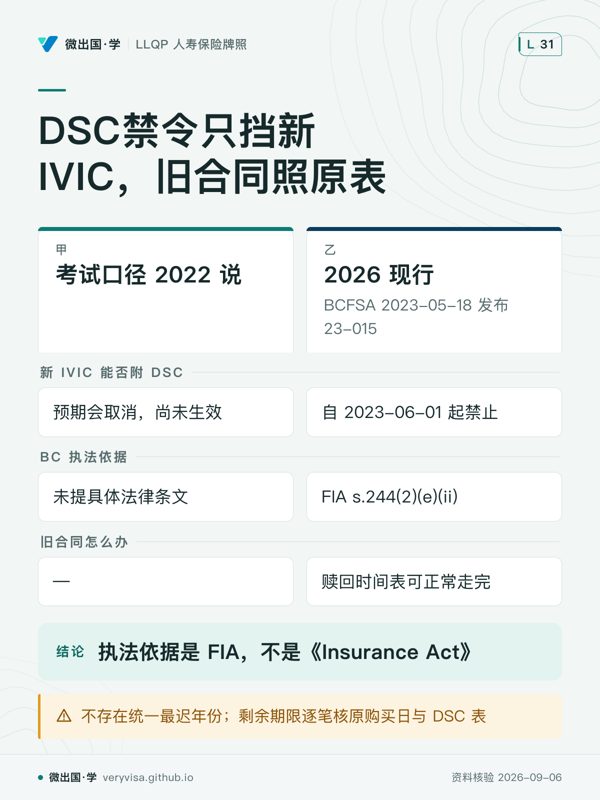
考场与现行对照表一:分离基金 DSC(递延销售费)禁令
✕
"禁止 DSC" 不等于"保险产品都归 Insurance Act 管"
这是本课第一个"用错法律部门名字"的陷阱:多数学员下意识认为"保险产品的一切规则都在 Insurance Act 里"。但 DSC 禁令管的是保险公司的市场行为(销售费结构是否合理),BCFSA 用来管市场行为的工具是 Financial Institutions Act;分离基金合同条款本身——谁是受益人、保证的法律性质、免于扣押的效力——才回归 Insurance Act,因为分离基金在法律上就是一份人寿保险合同,与普通寿险同源。两部法律分工不同,答错法律部门名字是这一考点唯一的陷阱。
考场与现行对照表二:Assuris 保障上限
Assuris 是加拿大人寿保险公司破产时的行业互助保障机制(不是政府机构,由全体人寿保险公司出资运营),考试口径举的例题用的是 2023-05-29 上调前的旧标准:
累积价值另列:考试口径 §3.1.5 写合同价值最多 $100,000 全额保障;现行改为 $100,000 或 90% 取高,并不超过原利益。同一道例题,用两套标准可能算出不同答案——这不是四舍五入误差,第六节案例会用一个完整例子重算给你看。这条纪律必须记住:CISRO 考试口径的版次改版周期慢于监管数字调整的速度,是这门课系统性的时间差,不止 Assuris 一处。
税务:存、分配、赎回、保证补足款怎么处理
分离基金的税务处理跟着账户类型走,机制长青、不随年份变化:
存款环节:现金投入非注册合同通常不抵税;为筹款先处置其他资产或以资产转入时,须另核处置税务;注册资金依所属计划规则处理:RRSP 在额度内可抵税,RRIF 不接受普通新供款,但可接受合资格直接转移。
分配(allocation)环节:非注册合同持有期间,基金内部实现的利息、股息、资本利得会每年分配给投资者(无论是否实际提取现金),投资者收到 T3 税表并计入当年应税收入;这笔已纳税的分配同时会调增你的调整成本基础(ACB),避免赎回时对同一笔收益重复征税。这一步几乎全部由保险公司代为追踪、自动生成税表,出错空间比共同基金投资者自己算 ACB 小得多。
赎回/switch 环节:赎回或转换基金时,按赎回价与 ACB 的差额计算资本利得或损失,并入当年应税所得(资本利得目前的应税比例是 50%);switch 在税务上视为一次处置,即使不收转换费也一样要计入当年报税。
保证补足款(top-up):到期或身故时保险公司用自有资金补足市值与保证额之间的差额,这部分性质上更接近保险公司履行合同保证的赔付,而不是投资本身产生的收益——但考试口径本章与本页研究均未展开 top-up 的具体税务定性细则,笔者不替代持牌税务顾问对具体案例作出判断,柜台遇到复杂案例应转介税务专业人士,不要凭直觉给客户一个确定的税务结论。
ℹ️
TCR(总成本披露):分离基金合同明确在覆盖范围内,原文已核实
2026 年起生效的 CSA/CCIR/CISRO/CIRO 联合总成本报告新规(TCR)要求投资产品年度对账单同时用百分比与实付加元两种口径披露费用,2027 年初投资者首次收到新格式报告。分离基金合同(IVIC)已被 CSA/CCIR 2023-04-20 联合指引明确纳入 TCR 框架,若保证成本未计入其他费用,须单列披露"保证成本合计($)"这一项(CSA(加拿大证券管理局)与 CCIR(加拿大保险监管者… 原文;BC 于 2025-12-10 采纳全国整合指引,Insurance Council of British…(论坛解读) )。柜台遇到客户问"我的分离基金年报格式会不会变",可以肯定地答"会,2027 年初起收到的年度对账单按新格式披露";具体科目以保司按监管原文出的对账单为准(已由此升级为已核实)。
节末检索小测 · 先别往回翻,凭记忆作答 Quick recall check: answer from memory before scrolling back
Nadia holds a non-registered segregated fund contract. This year, the underlying fund realized capital gains and interest, which were allocated to her contract without any cash withdrawal. She also switched units from an equity fund to a fixed-income fund within the contract. How are these events treated for tax purposes?
Nadia 持有一份非注册分离基金合同。今年,底层基金实现了资本利得和利息,在没有任何现金提取的情况下分配到了她的合同中。她还在合同内将份额从股权基金转换到了固定收益基金。这些事件在税务上如何处理?
a Allocated income is reported on a T3 slip and increases her adjusted cost base (ACB), while the fund switch is a taxable disposition that triggers a capital gain or loss. ✓ 正确。非注册分离基金存续期间实现的收益会每年分配(allocation)给投资者并开具 T3 税表计入当年应税收入,同时由保险公司调增其调整成本基础(adjusted cost base, ACB)以避免赎回时重复征税;而基金转换(switch)在税务上视为一次处置,须按赎回价与 ACB 的差额计算资本利得或损失(50% 计入应税所得)。 Correct. Realized earnings in non-registered segregated funds are allocated annually to investors and reported on a T3 slip as current-year taxable income, while the insurer increases the investor's adjusted cost base (ACB) to avoid double taxation upon eventual surrender; a fund switch is treated for tax purposes as a taxable disposition, triggering a capital gain or loss calculated as the difference between proceeds and ACB (50% included in taxable income).
b Because she made no cash withdrawal, neither the annual allocation nor the internal switch between funds within the same contract triggers any current-year tax reporting. ✗ 错误。非注册分离基金不是延税账户,即使投资者没有实际提取现金,年度分配仍须通过 T3 税表在当年纳税,且合同内转换基金(switch)在税务上视同处置。 Incorrect. Non-registered segregated funds are not tax-deferred shelters; even without cash withdrawals, annual allocations must be reported and taxed on a T3 slip, and an internal fund switch is treated as a taxable disposition.
c The allocated income is taxable in the current year on a T3 slip, but her ACB remains unchanged until she makes an additional cash deposit. ✗ 错误。已纳税的年度分配会自动调增投资者的调整成本基础(ACB),这样未来赎回时才不会对同一笔已税收益重复征收资本利得税。 Incorrect. Taxed annual allocations automatically increase the investor's adjusted cost base (ACB), ensuring that previously taxed earnings are not subjected to double taxation upon eventual redemption.
d The switch is tax-deferred as long as no conversion fee is charged, and only the final maturity top-up is taxed at a 50% inclusion rate. ✗ 错误。无论保险公司是否收取转换费,在非注册合同中转换基金(switch)都构成税务处置,必须计算资本利得或损失。 Incorrect. Regardless of whether the insurer charges a switch fee, switching funds within a non-registered contract constitutes a taxable disposition for which capital gains or losses must be calculated.
看答案与每个选项的解析 Show the answer and why each option is right or wrong 答案 Answer :a
三、实务流程:代理人在哪一步做什么 本节回答 This section answers 销售披露文件、2个营业日犹豫期解约权退款规则及到期自动结算 Disclosure documents, the two business day right of rescission refund rule, and automatic maturity settlement 本章考题 3 Question 3
销售阶段:代理人交付合同前必须给客户信息文件夹(information folder)与 Fund Facts,说明保证结构、费用构成(MER 里含多少是"保险费用")、以及销售费选项(新合同可有 FEL、no-load、chargeback 或适用的顾问收费安排;须按产品核实,DSC 新单禁令不等于只剩两种收费)。购买确认发出后,客户有通常 2 个营业日 的犹豫期解约权(right of rescission)——这是本页引用合同的具体权利,法律效力与起算须按法域和合同核对,不能因考试口径写“通常”就当成可忽略的惯例;行使解约权时,退款按"已投入金额"与"当日单位价值"两者中较低者计算,费用一并退回。
存续期间:如果客户分批注资(比如每年年初追加存款),须先核合同按逐笔存款日、合同日还是受保人年龄确定到期日;只有逐笔起算的合同才逐笔加 10 年 ——这是考试口径里最容易被出成计算题的一点,第六节会给出完整算例。代理人在客户提出转换基金(switch)或申请重置(reset)时,有明确的告知义务:switch 免费次数、90 天内短线交易费、switch 触发的税务处置后果都必须在操作前讲清楚;而根据分离基金合同法(第六章交叉知识点),完成购买、switch、reset、提款、终止合同这五类动作,保险公司都必须取得投资者的确认,口头指示与书面指示同样具有约束力。
理赔与到期阶段:到期提款指令由持有人或有效获授权者提出,不需要提供死亡证明;身故理赔由有权领取者申请,并按保险人要求提交充分死亡及领取资格证明,不能将原件死亡证书视为唯一法定证据。到期保证的结算是保险公司的契约义务,在到期日自动完成,不需要投资者主动申请理赔,也不要求投资者必须在到期日当天终止或提取合同——这一点在考试陷阱清单会单独展开。
🔧
客户最常在这一步问错问题
实务里最常见的柜台对话是"我提前把钱取出来一部分,保证会不会打折扣?"——答案是会,且这是永久性的:提取会按比例永久性下调保证计算所依赖的本金基数,保证比例本身不变,但基数变小了。很多客户以为"反正合同还没到期,提取不影响以后的保证",这句话是错的。
节末检索小测 · 先别往回翻,凭记忆作答 Quick recall check: answer from memory before scrolling back
Before delivering a segregated fund contract, an agent provides the client with the information folder and Fund Facts. Two business days after receiving the purchase confirmation, the client exercises the right of rescission after the market value of the units has dropped slightly below the initial deposit. How is the refund calculated?
在交付分离基金合同前,代理人向客户提供了信息文件夹和 Fund Facts。收到购买确认后的第 2 个营业日,由于基金单位市值略微跌破初始存款,客户行使了犹豫期解约权。退款金额应如何计算?
a The client receives 100% of the initial deposit because the rescission occurred within the two-business-day cooling-off period. ✗ 错误。行使犹豫期解约权(right of rescission)并不是无条件全额退还本金,而是退还“已投入金额”与“当日单位价值”两者中较低者(外加退回销售费用),期间市场下跌的风险由撤回合同的投资者承担。 Incorrect. Exercising the right of rescission does not grant an unconditional full refund of deposit; rather, the refund is the lesser of the amount invested and the unit value on the valuation date (plus any sales charges refunded), meaning the investor bears the risk of market declines during the period.
b The client receives 75% of the initial deposit based on the statutory minimum maturity guarantee. ✗ 错误。75% 到期保证(maturity guarantee)仅在合同满期(通常最短 10 年)时生效,与购买后 2 个营业日内的犹豫期解约权无关;这是混淆保证触发条件的陷阱。 Incorrect. The 75% maturity guarantee takes effect only when the contract matures (typically after a 10-year minimum term) and has no connection to the two-business-day right of rescission; this is a trap confusing guarantee triggers.
c The client receives the lesser of the amount invested and the value of the units on the valuation day, plus a refund of any sales charges paid. ✓ 正确。客户在购买确认发出后通常 2 个营业日内行使犹豫期解约权(right of rescission)时,退款按“已投入金额”与“当日单位价值(net asset value per unit, NAVPU)”两者中较低者计算,已付销售费用一并退回。 Correct. When a client exercises the right of rescission within two business days after receiving purchase confirmation, the refund is calculated as the lesser of the amount invested and the net asset value per unit (NAVPU) on the valuation date, with any sales charges paid also refunded.
d The client cannot rescind the contract once units are allocated unless they pay a 90-day short-term trading fee. ✗ 错误。90 天内短线交易费适用于存续期间频繁转换基金(switch)的情形,而购买确认后通常 2 个营业日内客户依法或依合同享有犹豫期解约权。 Incorrect. A 90-day short-term trading fee applies to frequent fund switches during the contract term, whereas clients have a statutory or contractual right of rescission within two business days of receiving the confirmation.
看答案与每个选项的解析 Show the answer and why each option is right or wrong 答案 Answer :c
四、2026 市场:保证系列、底层基金与费用要分别比较 本节回答 This section answers 保证档位、销售费系列与重置权在实务中的独立性及比较维度 Independence and comparative dimensions of guarantee tiers, sales charge load options, and reset rights
以下是 2026-09-04 回读官网确认的产品实例。各行说明它对应本章的哪个判断;实际销售资格和责任范围仍须核对具体合同。
三家真实合同同口径对照表(重置年龄/次数、提取影响、销售费)——直接回读三份官方信息折页/顾问指南原文核实:
这份样本显示重置权随系列而变:部分入门档没有重置,较高档可能增加重置;不能推出保证越高就越受限的通则——三家的「入门档」(RBC Invest/Series1、iA 75/75、Canada Life 75/75)都不提供重置,重置权只出现在更高保证档位(RBC Series 2、iA Series 75/100/Ecoflex 100/100、Canada Life 75/100/100/100)。但这份证据不能推广到每家保司的每个系列或每只基金:三份文件各自只覆盖各自品牌旗下对应的系列,且 iA/Canada Life 的信息折页本身涵盖多个销售费系列(Standard/Preferred/Partner/Constellation 等),保证档位(75/75、75/100、100/100)与销售费系列是两个独立的选择维度,不能把系列名称直接当成保证档位 ——具体某一份合同用的是哪一档保证、哪种销售费,仍须查客户实际持有的信息折页与基金说明书。
柜台上至少并排核对六项:合同与信息册版本、所选基金及风险等级、保证计算基数、到期及身故触发条件、提取或重置后怎样调整、客户实际承担的费用。保证表与 Fund Facts 应一起交付,产品宣传页不能替代合同。
特别留意「无赎回销售费」与「没有费用」的区别。基金运营及保证相关费用、短线交易费、顾问收费安排都要分别看;chargeback 还可能影响代理人的佣金追回,不能因此劝客户保留一份已不适当的投资。
这里的产品实例证明市场如何实现考试口径概念,不构成三家优劣排名。用钱日期早于保证日、缺乏应急金或无法承受中途亏损的客户,仍可能不适合该方案。
节末检索小测 · 先别往回翻,凭记忆作答 Quick recall check: answer from memory before scrolling back
An agent is comparing different segregated fund contract series for a client. One series offers a 75%/75% guarantee, while another offers a 75%/100% or 100%/100% guarantee on the same underlying investment fund lineup. Which principle applies when comparing series, guarantees, and fees?
代理人正在为客户比较不同的分离基金合同系列。在同一底层基金阵容下,某系列提供 75%/75% 保证,而另一系列提供 75%/100% 或 100%/100% 保证。在比较系列、保证与费用时,下列哪项原则正确?
a Choosing a higher guarantee series such as 75%/100% automatically reduces the daily market value volatility of the underlying investment fund. ✗ 错误。同一底层资产组合套用更高的保证档位(如 75%/100%),只提高到期或身故时点触发的保底比例,并不会降低日常单位资产净值(NAVPU)的波动。 Incorrect. Applying a higher guarantee tier (such as 75%/100%) to the same underlying portfolio only increases the floor percentage at maturity or death; it does not reduce the daily market value volatility of the underlying units (NAVPU).
b A contract with no redemption sales charge means the investor pays no management expense ratio (MER) or insurance guarantee cost. ✗ 错误。“无赎回销售费(no-load)”只代表赎回时不扣销售佣金,基金日常运营费用及维持保证所需的管理费率(MER)、短线交易费等仍照常收取。 Incorrect. A no-load option simply means no sales commission is charged upon redemption; ongoing operating expenses, the MER funding guarantees, and short-term trading fees are still charged.
c Every 75%/75% entry-level contract series automatically includes unlimited annual resets for both maturity and death benefit guarantees. ✗ 错误。重置权(reset)随具体合同系列而异,许多 75%/75% 入门系列并不提供重置选项,重置功能通常出现在较高保证系列且有年龄与次数限制。 Incorrect. Reset features vary by contract series; many basic 75%/75% series offer no reset options, and resets are typically restricted to higher guarantee series subject to age limits and frequency caps.
d Guarantee levels, sales charge options and reset rights are separate choices to verify in the contract and information folder, not to infer from a series name. ✓ 正确。保证档位(75/75、75/100、100/100)、销售费选项(前收费 front-end load、chargeback、免佣等)以及是否含重置权(reset)是各自独立的合同维度,代理人必须并排核对信息文件夹(information folder)与 Fund Facts,不能仅凭系列名称推断。 Correct. Guarantee tiers (75/75, 75/100, 100/100), sales charge options (front-end load, chargeback, no-load), and reset rights are distinct, independent contract dimensions; agents must cross-reference the information folder and Fund Facts side by side rather than assuming features from a series name.
看答案与每个选项的解析 Show the answer and why each option is right or wrong 答案 Answer :d
五、历史变革:为什么现在的规则跟考试口径不一样 本节回答 This section answers 分离基金DSC禁令的考试口径表述与BC省现行执法依据差异 Differences between the exam benchmark phrasing of the DSC ban and current BC enforcement authority
DSC 的退场是分两条腿走的。证券侧(共同基金)的 DSC 由 CSA(各省证监会)统一规则,已于 2022-06-01 全面禁售;保险侧(分离基金)的 DSC 走的是另一条路——CCIR(保险监管者理事会)与 CISRO 于 2022 年联合发声明,"敦促"保险公司停售,目标时点定在 2023-06-01,但这不是一部统一立法,而是各省保险监管者各自下发市场行为指令,BC 用 FIA、Ontario 修订自己的 UDAP Rule。考试口径写作于 2022 年中,DSC 禁令的联合声明已经发布但尚未到生效日,只能用"预期"这个措辞——这不是考试口径写错,是时间点卡在了"已宣布、未生效"的窗口里。
Assuris 上调保障水平也是同一类"考试口径写作时点卡在中间"的情况:考试口径给出的旧标准适用到 2023-05-29,之后全面上调且比例从 85% 改为 90%。旧体系下 $60,000 或 85% 的双轨设计,本质是较小的合同利益可获全额保留,较大利益按门槛或比例取高保护,不能超过原有利益;新标准把两个数字都上调,反映的是分离基金行业规模与客户平均持仓额随时间增长后,原上限已经不足以覆盖典型客户的实际风险敞口。
投资业自律机构的合并背景(与分离基金的销售渠道间接相关):IIROC 与 MFDA 已于 2023-01-01 合并运营,2023-04-24 定名为 CIRO,对应的两个投资者保护基金(CIPF 与 MFDA 会员的 IPC)也合并为单一 CIPF。这个合并解释了为什么 2026 年市场上"共同基金交易商"与"投资交易商"现在统一挂在同一个监管机构名下——但分离基金销售不受 CIRO 管辖,它走的是保险代理人牌照与 Insurance Council 这条完全独立的监管线,这正是下一节对照表要讲清楚的分野。
节末检索小测 · 先别往回翻,凭记忆作答 Quick recall check: answer from memory before scrolling back
According to the 2022 LLQP exam, what is the status of deferred sales charges (DSCs) on segregated fund contracts following the June 1, 2022 mutual fund DSC ban?
根据 2022 版 LLQP 考试口径,在 2022-06-01 共同基金全面禁售递延销售费(DSC)之后,分离基金合同上的 DSC 处于什么状态?
a Regulators were expected to phase out segregated fund DSCs as well, but no ban had taken effect yet. ✓ 正确。2022 版考试口径写作时正处于监管联合声明已发布但尚未到生效日的窗口期,因此考试口径表述为“预期分离基金的递延销售费(deferred sales charge, DSC)也将被取消”(注:BC 省现行自 2023-06-01 起已依据《Financial Institutions Act》s.244(2)(e)(ii) 正式禁止保险人发行含 DSC 的新分离基金合同)。 Correct. When the 2022 LLQP exam was drafted, regulators had issued a joint statement but the effective date had not yet arrived, so the exam benchmark describes DSCs on segregated funds as 'expected to be banned' (note: effective June 1, 2023, BC officially prohibited insurers from issuing new segregated fund contracts with DSCs under Financial Institutions Act s. 244(2)(e)(ii)).
b DSCs on segregated funds were banned nationwide by CIRO on June 1, 2022, under the same rule as mutual funds. ✗ 错误。2022-06-01 是各省证监会(CSA)禁止共同基金 DSC 的生效日,且加拿大投资监管组织(CIRO)并不管辖分离基金;这是“双口径数字与监管归属错位”陷阱。 Incorrect. June 1, 2022 was the effective date when provincial securities commissions (CSA) banned mutual fund DSCs, and CIRO does not regulate segregated funds; this falls into the trap of misaligning dual-benchmark figures with regulatory bodies.
c All existing pre-2023 segregated fund contracts with a DSC schedule must be forcibly redeemed or converted immediately. ✗ 错误。即便是 2023-06-01 新单禁令生效后,此前已售出的旧 DSC 合同仍可按原购买日及赎回时间表正常走完,不需要强制转出。 Incorrect. Even after the June 1, 2023 ban on new sales, pre-existing contracts sold with DSCs may run their course under their original purchase dates and redemption schedules without forced redemption.
d DSCs remain permanently unrestricted on segregated funds because sales charges are governed solely by s.65(2) of the BC Insurance Act. ✗ 错误。BC《Insurance Act》s.65(2) 管的是指定家庭成员受益人的免债权人扣押保护,而保险公司销售费结构的市场行为监管在 BC 走的是《Financial Institutions Act》(FIA)。 Incorrect. BC Insurance Act s. 65(2) governs creditor protection for named family beneficiaries, whereas market conduct regulation of insurer sales charge structures in BC falls under the Financial Institutions Act (FIA).
看答案与每个选项的解析 Show the answer and why each option is right or wrong 答案 Answer :a
六、案例(以下人物与数字均为示例,不对应真实客户) 本节回答 This section answers 到期、身故、中途赎回、重置顺延与分批注资的保证金实算规则 Calculation rules for maturity, death, early surrender, reset maturity extensions, and subsequent deposits 本章考题 4 Question 4
保证保护的边界:不会把原利益抬高
自拟算例:原合同保证$80,000。Assuris的$100,000门槛不把它变成$100,000,而是保留原$80,000;一般表达为 min(原保证,max($100,000,90%×原保证))。这衡量保险公司失败时保留的保证利益,不是日常跌价赔偿。assuris.ca
案例一:到期保证——李文的合同(列治文)
李文 2016 年向一家保险公司存入 $50,000,购买一份 10 年期、75% 到期保证的分离基金合同,到期日为 2026 年。四种情形下他能领到多少:
市值 $54,000 (高于保证额 $37,500)→ 领 $54,000 ,保证不起作用。市值 $30,000 (低于保证额)→ 领保证额 $37,500 ,其中 $7,500 是保险公司自有资金补足的 top-up。市值 $70,000 → 领 $70,000 。若李文在第 7 年(2023 年)因资金周转需要,提前把合同全部赎回,当时市值 $32,000 → 他只能领 $32,000 ,即使这个数字低于保证额 $37,500,也不享受到期保证的补足——因为保证只在到期日或身故当天生效,中途赎回一律按市值结算。
这是全章最容易考错的一步:学员常把"75% 保证"理解成"任何时候赎回都至少拿回本金的 75%",但保证的触发条件是"到期"或"身故"这两个具体事件,不是"任意时点"。
案例二:身故保证——陈太太持有的合同(素里)
陈先生的太太为他购买了一份分离基金合同,存入 $40,000,选择较高档的 100% 身故保证 (说明并非所有合同都停在 75%,部分合同提供更高档保证,费用相应更高),指定太太本人为受益人。陈先生在合同第 6 年身故:
市值 $36,500 (低于身故保证额 $40,000)→ 太太领取保证额 $40,000 ,含 top-up $3,500。若当时市值 $52,000 (高于保证额)→ 太太领取 $52,000 。
身故保证与到期保证的关键差别:身故保证从合同生效第一天起就适用,不需要等满期,只要受保人在合同存续期内任何时点身故即触发;而到期保证只在合同到期日那一天生效。这正是 CISRO 公开样题反复考察的混淆点——单身、担心自己活着看到投资亏损的客户,真正在意的是到期保证(保护他自己),不是身故保证(保护他的受益人)。
案例三:重置什么时候划算——温哥华一位 45 岁客户
这位客户 5 年前存入 $60,000,选择 75% 到期保证(保证额 $45,000)。5 年后市值涨到 $90,000,保险公司提出可以做一次重置:新的保证额将上调为 $90,000 × 75% = $67,500 ,但代价是到期日从原定的第 10 年顺延为"重置日起再加 10 年" ,即从 45 岁那年再顺延到第 15 年(客户 55 岁时到期,而不是原定的 50 岁)。
可以考虑的条件:新的保证额对客户有价值,延后的保证日仍匹配用钱计划,且客户理解费用与提取限制。
需要重新评估的条件:客户打算在原保证日附近提款,或无法承担延长期间的市值波动。是否重置不应依赖代理人预测市场还能涨多少。
此例45岁时重置,原到期年龄50岁,新到期年龄55岁。不同合同可分别重置身故或到期保证,不能把「永远延后同一到期日」当通则。
案例四:分批注资——每一笔存款各自起算保证期(本拿比)
黄先生在本拿比(Burnaby)购买了一份 10 年期、75% 到期保证的分离基金合同,此后连续三年每年年初追加存款 $10,000(含首笔共三笔)。这份合同采用考试口径所说"最常见"的按存款日逐笔起算(deposit date-based)方式计算保证,而不是"按合同签订日统一起算(contract date-based)":
第 10 年末 :第 1 笔存款到期,保证额 = $10,000 × 75% = $7,500 。第 11 年末 :第 2 笔存款到期,累计保证额 = 2 × $10,000 × 75% = $15,000 。第 12 年末 :第 3 笔存款到期,累计保证额 = 3 × $10,000 × 75% = $22,500 。
这是分批注资场景最常见的出题方式:题目会问"黄先生第二笔追加存款的到期日是哪一天",正确答案是从那一笔存款存入之日起再加 10 年 ,而不是"与首笔存款同一天到期"——很多学员默认整份合同只有一个到期日,忽略了每一笔存款是独立起算的。
节末检索小测 · 先别往回翻,凭记忆作答 Quick recall check: answer from memory before scrolling back
An investor holds a segregated fund contract with an original maturity guarantee of $80,000. Under the Assuris protection boundary principle min(original guarantee, max($100,000, 90% × original guarantee)), what is the maximum guaranteed amount retained if the insurer becomes insolvent, and does the $100,000 threshold raise the investor's benefit?
一位投资者持有一份原到期保证额为 $80,000 的分离基金合同。根据 Assuris 保证保护边界原则 min(原保证, max($100,000, 90% × 原保证)),若保险公司破产,保留的最高保证金额是多少?$100,000 的门槛会把投资者的原利益抬高吗?
a $100,000, because the $100,000 threshold automatically lifts any smaller contract guarantee up to that amount when an insurer becomes insolvent. ✗ 错误。人寿保单持有人保护组织(Assuris)的保障门槛不会把原利益抬高,原合同保证 $80,000 绝不会因为 $100,000 门槛而变成 $100,000。 Incorrect. Assuris protection thresholds do not elevate the original benefit; an original contract guarantee of $80,000 will never become $100,000 simply because of the $100,000 threshold.
b $80,000, because protection preserves the original $80,000 guarantee without raising the benefit above the original contract guarantee. ✓ 正确。Assuris 保障衡量的是保险公司破产时保留的原保证利益,公式 min(原保证, max($100,000, 90% × 原保证)) 下,原保证 $80,000 低于 $100,000 门槛,因此全额保留原保证 $80,000,而不会把原利益抬高到 $100,000(注:2022 考试口径旧标准为 $60,000 或 85% 取高,现行标准自 2023-05-29 起为 $100,000 或 90% 取高)。 Correct. Assuris protection measures the retained portion of the original guarantee upon insurer insolvency; under min(original guarantee, max($100,000, 90% * original guarantee)), the $80,000 original guarantee is below the $100,000 threshold and is retained in full at $80,000 without being inflated to $100,000 (note: the 2022 exam benchmark was $60,000 or 85%, whereas the current standard effective May 29, 2023 is $100,000 or 90%).
c $60,000, because any segregated fund guarantee is capped at a flat $60,000 regardless of the contract amount. ✗ 错误。即使在 2022 考试口径旧标准下,规则也是“$60,000 或 85% 取高”而非固定封顶 $60,000;现行标准则为“$100,000 或 90% 取高”。 Incorrect. Even under the 2022 exam benchmark, the formula was $60,000 or 85% whichever is higher, rather than a flat $60,000 cap; the current standard is $100,000 or 90% whichever is higher.
d $90,000, because Assuris adds a 10% bonus to the $80,000 guarantee when an insurer fails. ✗ 错误。Assuris 保障上限绝不超过原合同保证利益($80,000),不存在额外加计赔偿。 Incorrect. Assuris protection never exceeds the original contract guarantee ($80,000), and no extra bonus payout exists.
看答案与每个选项的解析 Show the answer and why each option is right or wrong 答案 Answer :b
七、考试陷阱与考场与现行对照清单 本节回答 This section answers 识别高频陷阱:保证对象、自动结算与75/100数字顺序 Identifying high-frequency traps: guarantee coverage scope, automatic settlement, and the 75/100 numerical order
"到期保证"与"身故保证"是两回事,别被"都叫保证"迷惑——到期保证保护投资人自己(他活着看到合同到期那天),身故保证保护受益人(受保人身故才触发)。识别方法:题干问的是"客户本人担心亏本"还是"客户想给家人留一笔钱",前者对应到期保证,后者对应身故保证。
中途赎回或部分提取一律不享受到期保证——这里仅讨论到期/身故保证,不包括另有 GMWB/GLWB 的给付,题目一旦出现"提前退保""合同未到期就赎回",应按赎回时单位价值扣适用费用,并核锁定或暂停交易等限制,无论市值是否低于保证额。
到期保证的结算是自动的,不需要投资者主动申请理赔——题目常设置"到期后没有联系保险公司也没有终止合同"的场景,诱导选"视为放弃/需要申请才能拿到 top-up",正确答案是"保证在到期日自动结算,无需申请"。
Assuris 保障须分考试口径与现行。考试口径例题按题干及指定考试口径版本的条件计算,实务按现行类别、原保证及保障上限计算;题目未写年份时,先核课程或考试方指定口径,不能只凭本页替正式考试断言一律采用现行值。
BC 分离基金 DSC 禁令的法律依据是 Financial Institutions Act,不是 BC Insurance Act——常见错误答案就是"Insurance Act",因为多数学员默认"保险产品的一切规则都在 Insurance Act",这正是本考点要打破的直觉。
受益人指定的两种保护分别判断:直接向有效受益人给付与存续期间免扣押不是同一条件。BC s.65(2)的家庭关系指定不以「同时不可撤销」为前提;不可撤销指定、注册计划及破产规则另核。
"75/75 vs 75/100 vs 100/100"要看清楚问的是到期档位还是身故档位 ——第一个数字永远对应到期保证比例,第二个数字对应身故保证比例,两者可以不对称(如 75% 到期、100% 身故),题目里把两个数字位置调换是常见干扰项写法。保证期限"最短 10 年"是长青合同惯例,不是每份合同都恰好 10 年 ——部分合同允许更长期限(15 年)或延至持有人 100 岁;题目问"分离基金到期保证最少要等多久",正确答案是"通常最短 10 年",而不是"固定 10 年"。分批注资时,每一笔存款各自独立起算 10 年保证期 ——题目问"追加存款的到期日",不能默认与首笔存款同一天到期,要看这份合同是按存款日逐笔起算(最常见)还是按合同签订日统一起算。
节末检索小测 · 先别往回翻,凭记忆作答 Quick recall check: answer from memory before scrolling back
Clara, a single investor with no dependents, is worried about losing her principal during her lifetime if markets crash before she retires in 10 years. She purchases a segregated fund contract with a 75%/100% guarantee structure and takes no action on the maturity date when the market value is below 75% of her deposit. Which statement is true?
Clara 是单身且无受抚养人的投资者,她担心在 10 年后退休前若市场崩盘,自己活着时会面临本金亏损。她购买了一份 75%/100% 保证结构的分离基金合同,且在到期日当天市值低于存款的 75% 时没有主动联系保险公司。下列哪项陈述正确?
a Her concern is addressed by the 100% guarantee because the second number in 75%/100% protects the living policy owner at maturity. ✗ 错误。在“75%/100%”表述中,第一个数字(75%)永远对应保护投资人自己的到期保证(maturity guarantee),第二个数字(100%)对应保护受益人的身故保证(death benefit guarantee);这是“到期保证与身故保证混淆”陷阱。 Incorrect. In the 75%/100% notation, the first number (75%) always represents the maturity guarantee protecting the living investor, while the second number (100%) represents the death benefit guarantee protecting the beneficiary; this is the trap of confusing maturity guarantee with death benefit guarantee.
b She forfeits the maturity top-up because she failed to submit a formal claim form on the exact maturity date. ✗ 错误。到期保证的结算和补足款(top-up)是保险公司的契约义务,在到期日自动完成,不需要投资者主动申请理赔或当天终止合同。 Incorrect. Maturity guarantee settlement and top-up payments are contractual obligations of the insurer performed automatically on the maturity date, requiring no claim filing or termination notice from the investor.
c The 75% maturity guarantee addresses her concern, and the insurer settles it automatically on the maturity date with no claim needed. ✓ 正确。单身且担心自己活着看到亏损的客户依靠的是到期保证(maturity guarantee,对应 75%/100% 中的第一个数字 75%),且到期保证在到期日由保险公司自动结算补足差额(top-up),无需客户主动申请理赔。 Correct. A single investor concerned about living to see investment losses relies on the maturity guarantee (represented by the first figure, 75%, in a 75%/100% structure), and the insurer automatically settles any top-up on the maturity date without requiring a claim.
d Every segregated fund contract in the market has a fixed maturity period of exactly 10 years and cannot be set for 15 years or to age 100. ✗ 错误。“最短 10 年”是行业常见惯例,并非所有合同都固定恰好 10 年,部分合同可设 15 年或延至持有人 100 岁。 Incorrect. A 10-year minimum is an industry standard practice, but not all contracts are fixed at exactly 10 years; some contracts offer 15-year terms or extend to age 100.
看答案与每个选项的解析 Show the answer and why each option is right or wrong 答案 Answer :c
术语双语表
下一步可阅读同模块的产品、合同与推荐专章,并按题目给定的年度和假设练习。
本页知识卡 不看正文也能拿到这一节的核心内容:先看导读,再看图。点图放大,左右翻页。
放大 ⤢ 禁令管新增销售费结构,不抹掉既有合同的原赎回安排。 先看 先看新增销售与既有安排是否被同一规则处理。易漏 市场行为禁令与保险合同条款分属不同法律。下一步 遇到法源题,先辨监管事项,再落到具体条文。详情与分享 → 放大 ⤢ 先按法律形式定监管,再判断保证、受益人与保护条件。 先看 先分清产品是保险合同还是证券持有。易漏 相似的投资外观,不代表相同牌照或监管线路。下一步 情景题若问传承或保护,再核指定与持有结构。详情与分享 → 本站依据官方原文自撰 · 出处见正文链接