🃏 Flashcards · 3 闪卡 · 3 张 🖼 Slides · 2 幻灯 · 2 页 ✍️ Questions · 8 刷题 · 8 道
人寿保险 Life Insurance P1 必拿分 P1 Must score
ZH EN ZH + EN
先看这一章怎么考 First, how this chapter is tested
情景净保额计算题:给出家庭月开支、政府遗属给付、房屋市值与按揭余额、既有团体险,考你用资本需求法(capital needs approach)算出最终建议新增保额,重点测验是否误用房价代替按揭余额、是否漏减既有保障。 Scenario net coverage calculation questions: The question stem provides household monthly expenses, government survivor benefits, property market value and mortgage balance, and existing group insurance, testing your ability to calculate the recommended new insurance amount using the capital needs approach, focusing on whether you mistakenly use property market value instead of mortgage balance and whether you omit deducting existing coverage. 收入替代法四步调整题:给出税后年收入、投资回报率、边际税率与通胀率,考你区分未调整、仅税后调整、仅通胀调整、税后加通胀双重调整四步的资本化价值(capitalized value)公式与结果差异。 Income replacement approach four-step adjustment questions: The question stem provides annual after-tax income, investment rate of return, marginal tax rate, and inflation rate, testing your ability to distinguish the capitalized value formulas and result differences across four steps: unadjusted, after-tax adjustment only, inflation adjustment only, and dual adjustment for both taxes and inflation. 资本保留法与资本耗尽法辨析题:给出有明确终止年限的抚养需求或终身配偶收入需求,考你判断何时该用资本耗尽法(capital drawdown method)、何时该用资本保留法(capital retention method),以及选错方法会导致保额如何失真。 Capital retention versus capital drawdown discrimination questions: The question stem provides dependency needs with a definite end date or permanent spousal income needs, testing your ability to determine when to use the capital drawdown method versus the capital retention method, and how choosing the wrong method distorts the required coverage amount. 最常丢分的陷阱(看到题干信号就警觉) Traps that cost the most marks (watch for the signal in the stem)
用房价代替按揭余额 Using property market value instead of mortgage balance 题干同时出现房屋市值(market value)与按揭余额(mortgage balance)两个数字。 The question stem lists both property market value and mortgage balance figures. 漏减可用既有保障 Omitting deduction of available existing coverage 题干末尾提到雇主提供的团体寿险(group life insurance)、既有个人保单或挂钩买卖协议的公司保单。 The end of the question stem mentions employer-provided group life insurance, existing personal policies, or corporate policies tied to buy-sell agreements. 不可变卖资产混入可用资产池 Mixing illiquid non-saleable assets into the available asset pool 题干出现配偶将继续居住(continue living in)、家人计划保留经营(retain and continue operating)或传给子女等限制变现的措辞。 The question stem includes wording restricting liquidation such as the spouse will continue living in, the family plans to retain and continue operating, or passing down to children. 本章考点页:导图、要点表、7 道带逐项解析的练习 →
核实日期:2026-09-06|本页现行数字的出处:CPP 遗属与身故给付 2026 现行值(Employment and Social Develo… )、终身资本利得豁免 LCGE 现行值(CRA )、2026 BPA 与LCGE年度指数表(canada.ca )。
复核周期:2026-10-01(先复核按季度调整的 OAS;CPP及WorkSafeBC年度数字在2027年初复核)。CPP 各项给付每年会调;OAS 遗属津贴、BC WorkSafeBC 工伤致死给付、BC PBSA 遗属年金比例三项已于 2026-09-05 回源,见第二节第4条与文末「来源」。
0. 这一篇解决什么问题
你要考的是 人寿保险模块 ,本篇对应 CISRO 能力组件 c1「评估客户需求与处境」,占本模块 35% ——是整个 Life 牌照考纲里单一权重最大的一块,比第二大的 c2「分析可用产品」(30%)还要重。
这一篇讲的不是「寿险有哪些种类」,而是一个具体的人,到底该买多少保额 ——这个数字从哪里来,用哪种方法算,算出来的候选答案为什么可以相差三倍以上。需求分析(needs analysis)是整个销售流程里唯一一步先算清楚再谈产品的环节:算错这一步,后面推荐得再漂亮的产品组合也是建在错的地基上。
这一篇帮你做到三件事:① 用一张清单把客户处境完整问一遍,不漏掉前配偶赡养费、企业股权、注册账户展期这类容易被忽略的项目;② 分别用两种方法算出保额建议,并说清楚数字为什么不一样;③ 识别「用房价代替按揭余额」「忘了减既有保障」这类最常见的算数陷阱。
一、制度设计与底层逻辑:为什么需求分析必须先于产品推荐 本节回答 This section answers 解释需求分析为何独立于产品推荐及企业主与离异家庭的隐性责任 Explaining why needs analysis is independent of product recommendations and uncovering hidden liabilities for business owners and blended families. 本章考题 3 Question 3
1. 它解决的不是「要不要买保险」,是「买多少」
本模块前九讲讲的都是产品——定期险、终身寿险、万能寿险、附加险各自的机制。但一份保单最容易出问题的地方,往往不是产品条款,而是保额定错了 :保额定低了,家庭在真正需要钱的那一刻缺口打开;保额定高了,客户为用不上的保障年复一年多缴保费。需求分析法(needs analysis approach)存在的唯一理由,就是把「买多少」这个问题从代理人的直觉,变成一套客户能看懂、能核对、能签字确认的计算过程。
由此产生本章第一条底层逻辑:需求分析不是产品销售的前奏,是一份独立的、客户应该拿到手的财务分析文件 。它的产出不是「该买哪张保单」,是「这个家庭如果现在少了这份收入,缺口是多少」——产品配置是下一步的事。
2. 谁与谁在博弈:代理人的执业风险 vs 客户的信息不对称
需求分析的执业风险集中在代理人有没有问全 。客户不会主动提起「我和前任还有一份调解协议里的抚养费义务」「我的合伙企业权益身故时要视同处置」——只问「你一年赚多少」就报保额,遗漏的部分不会自动消失,只会在理赔发生、家庭最脆弱的那一刻才暴露出来。
反过来,代理人也有把需求分析做得过于粗糙以卖出更大保额 的诱因——收入替代法在某些假设下会比资本需求法算出更大数字,若只用前者又不做假设说明,客户很容易在不知情的情况下买下超出实际需要、保费也更贵的保单。这正是为什么代理人必须能对客户讲清楚假设是什么,而不是只报一个数字。
3. 法律后果:法院判令与调解协议里的「投保义务」
需求分析不只是财务算术,还牵涉家庭法。在 BC,Family Law Act s.170(e) 可针对供养方已有的寿险要求指定配偶或子女并维持缴费;不能把这项规定直接改写成一律命令购买新险,以担保其身故后配偶赡养费或子女抚养费仍能持续支付,此时前配偶或子女通常被指定为受益人。即使协议或判决没有明文要求投保,前配偶仍可能在被保险人身故后对遗产提出索赔,主张抚养义务应当延续。这意味着代理人在评估「对前配偶的抚养义务」这一项时,不能只看合同有没有写投保条款,还要判断这项义务本身有没有随身故终止的措辞——这正是六要素清单里最容易被代理人跳过的一格。
✕
「协议没写要投保」不等于「身故后义务自动消失」
调解协议与法院判决是两回事:调解协议里的抚养费条款,须结合协议措辞与 Family Law Act s.171 判断;协议沉默时,受供养人可向法院申请,但不是自动获准;没写清楚时,前配偶仍可能对遗产提出索赔。代理人看到客户有再婚/离婚史,第一件事是要客户拿出协议原文核对措辞,而不是假设「没提保险就不用管」。
4. 底层逻辑延伸:企业主的处境不是「雇员处境的放大版」
企业主客户会分叉成三条完全不同的路径:独资企业 身故后企业通常随之消亡,遗属损失的是自雇收入,企业资产按视同处置计算;公司股东身故可能触发其股权视同处置的资本利得,若符合合格小型企业公司条件可用终身资本利得豁免(LCGE)部分抵消;合伙企业权益同样视同处置触发资本利得,普通经营合伙通常不享有 LCGE;合格家族农渔业合伙权益须另核——这条税负差异是本章最容易被误答的一处(详见第二节)。
节末检索小测 · 先别往回翻,凭记忆作答 Quick recall check: answer from memory before scrolling back
Darius is a sole proprietor who also holds an interest in a general operating partnership. During a first meeting, his agent wants to skip detailed fact-finding and quote a life insurance policy based solely on Darius's gross annual income. Why does this approach create a severe practice risk?
Darius是一名独资经营者,同时持有一家普通经营合伙企业的权益。在初次面谈中,他的代理人想跳过详尽的处境调查,仅凭Darius的税前年总收入直接报价推荐一张寿险保单。为什么这种做法会产生严重的执业风险?
a Because a sole proprietorship continues indefinitely after death and automatically transfers tax-free to adult children. ✗ 错在混淆企业形态的法律后果:独资企业(sole proprietorship)在企业主身故后通常随之消亡,遗属损失的是自雇收入且企业资产按视同处置(deemed disposition)计算,并不会无限期存续或免税自动转给成年子女。 Incorrect. Confuses legal consequences of business structures: a sole proprietorship generally ceases to exist upon the owner's death, causing survivors to lose self-employment income while business assets undergo deemed disposition; it neither continues indefinitely nor transfers tax-free to adult children.
b Because needs analysis must precede product selection to identify capital gains from deemed disposition and actual income gaps. ✓ 正确:需求分析法(needs analysis approach)必须先于产品推荐,是一份独立的财务分析文件;跳过全面问询会漏掉独资企业消亡后的收入损失及普通经营合伙权益视同处置(deemed disposition)触发且通常无终身资本利得豁免(LCGE)的税负缺口。 Correct. The needs analysis approach must precede product selection as an independent financial analysis document; skipping thorough fact-finding misses income lost upon the dissolution of a sole proprietorship and deemed disposition tax liabilities on general operating partnership interests that lack LCGE protection.
c Because a general operating partnership interest is always fully exempt from capital gains tax under the lifetime exemption. ✗ 错在误用「考场旧口径与现行规则混淆」陷阱:普通经营合伙(general operating partnership)权益在身故视同处置时触发资本利得,通常不享有终身资本利得豁免(LCGE),只有符合定义的合格家族农渔业合伙权益才可能适用。 Incorrect. Falls into the dual-benchmark trap: general operating partnership interests trigger capital gains upon deemed disposition at death and generally do not qualify for the lifetime capital gains exemption (LCGE); only qualified family farm or fishing partnerships may qualify.
d Because BC family law automatically requires every business owner to purchase a new permanent policy for business creditors. ✗ 错在编造法定义务:BC省《家庭法》(Family Law Act)s.170(e)仅涉及针对已有寿险指定配偶或子女为受益人并维持缴费以担保抚养义务,并不存在强制所有企业主为债权人购买新终身寿险的法律规定。 Incorrect. Fabricates a statutory obligation: BC's Family Law Act s. 170(e) addresses designating a spouse or child on existing life insurance to secure support obligations; no law mandates business owners to purchase new permanent life insurance for business creditors.
看答案与每个选项的解析 Show the answer and why each option is right or wrong 答案 Answer :b
二、2026 现行政策与数字:考试口径写的和柜台用的不是一回事 本节回答 This section answers 对比政府给付与资本利得豁免的考试口径与现行值 Contrasting government survivor benefits and capital gains exemptions under exam benchmarks versus current figures.
这一章的考试口径过期密度和伤残险那一章一样高,原因相同:它大量引用政府遗属给付项目,而这些项目每年都在指数化调整。以下现行数字全部挂了 LWS 出处并标了年份快照。
1. CPP 给付:基本额与附加额分开
附加额要求死者满足基本供款资格、从未领取 CPP/QPP 退休、伤残或退休后伤残给付,并无合资格领取遗属养老金的配偶或同居伴侣;社保协定可能使金额降低。canada.ca(论坛解读)
2. LCGE:年度金额与资产资格是两道不同的问题
CRA年度指数表与 ITA s.110.6 分别支持金额及资格边界。canada.ca laws-lois.justice.gc.ca
3. 联邦税率与基本个人免税额(BPA):影响的是收入替代法里的「税后调整」这一步
分析家庭可支配收入时可用与现金流相符的有效税率;估算一笔新增保单利得的税负时则要看边际税率,复杂情况应计算新增前后税额差。2026 联邦 BPA 最高 $16,452、最低 $14,829,属于税收抵免金额,不能单凭它定义边际税率的起点。canada.ca
4. 政府与省级给付侧的现行数字快照(按资格与日期核对)
节末检索小测 · 先别往回翻,凭记忆作答 Quick recall check: answer from memory before scrolling back
Clara, aged between 60 and 64, was recently widowed and has a low annual income of $20,000. Her advisor is reviewing government survivor benefits under the LLQP exam snapshot versus 2026 current figures. Which statement accurately reflects the exam figure and the 2026 rule for the OAS Allowance for the Survivor?
年龄在60至64岁之间的Clara最近丧偶,年收入较低,仅为$20,000。她的顾问正在核对LLQP考试资料快照与2026年现行数字下的政府遗属给付。关于老年保障遗属津贴(OAS Allowance for the Survivor),下列哪项准确反映了考试资料数字与2026年现行规则?
a The exam uses the 2022 Q2 maximum of $1,468.47 per month (income threshold $24,496), whereas the 2026 Q4 maximum is $1,726.18 per month (threshold $31,152). ✓ 正确:老年保障遗属津贴(OAS allowance for the survivor)专为60至64岁低收入遗属设立,考试口径采用2022年Q2数字每月$1,468.47及收入门槛$24,496(考场按题干或考试口径作答),而2026年10至12月季度现行最高月给付为$1,726.18、年收入门槛为$31,152。 Correct. The OAS Allowance for the Survivor is designed for low-income survivors aged 60 to 64; exam materials use the 2022 Q2 figure of $1,468.47 per month with an income threshold of $24,496 (candidates follow question stems or exam benchmarks), whereas the 2026 Q4 current maximum is $1,726.18 per month with a $31,152 income threshold.
b The exam uses $803.54 per month for all widows aged 60 to 64 regardless of income, whereas the 2026 maximum is $904.59 per month. ✗ 错在张冠李戴数字:$803.54和$904.59是2026年加拿大退休金计划遗属月给付(CPP survivor benefits)65岁以下与65岁及以上的月上限,而非OAS遗属津贴,且OAS遗属津贴有严格的收入门槛限制。 Incorrect. Confuses statutory figures: $803.54 and $904.59 are 2026 monthly maximums for CPP survivor benefits for ages under 65 and 65-and-over, not the OAS Allowance for the Survivor, which also has strict income testing.
c The exam states that the allowance is paid for life starting at age 50 at a flat minimum rate of $1,451.63 per month without income testing. ✗ 错在混淆不同制度给付:$1,451.63及50岁分流规则属于2026年BC省工伤致死给付(Workers' Compensation fatality benefits)中无子女遗属配偶的最低月给付标准,而非OAS遗属津贴。 Incorrect. Confuses distinct benefit programs: $1,451.63 and the age-50 rule belong to 2026 BC WorkSafeBC fatality benefits for surviving spouses without dependent children, not the OAS Allowance for the Survivor.
d The exam sets the monthly survivor allowance at $2,500 per month until age 65, increasing to $5,000 per month once the survivor reaches age 65. ✗ 错在混淆一次性给付与月给付:$2,500基本额与符合附加条件最高$5,000是CPP一次性身故给付(CPP death benefit)的金额,而非按月发放的OAS遗属津贴。 Incorrect. Confuses lump-sum and monthly benefits: the $2,500 basic amount and $5,000 conditional maximum represent the CPP lump-sum death benefit, not the monthly OAS Allowance for the Survivor.
看答案与每个选项的解析 Show the answer and why each option is right or wrong 答案 Answer :a
三、实务流程:把「问处境」和「算保额」拆成两件不同的事 本节回答 This section answers 拆解处境六要素清单与两种保额计算方法的完整步骤 Breaking down the six-element situation checklist and complete calculation steps for both coverage methods. 本章考题 1 Question 1 本章考题 2 Question 2
1. 客户处境六要素清单
需求分析的第一步不是打开计算器,是把客户的处境问全 。以下六要素,任何一格空着,后面算出来的数字都可能是错的:
2. 收入替代法与资本需求法:同一个人,两套完全不同的答案
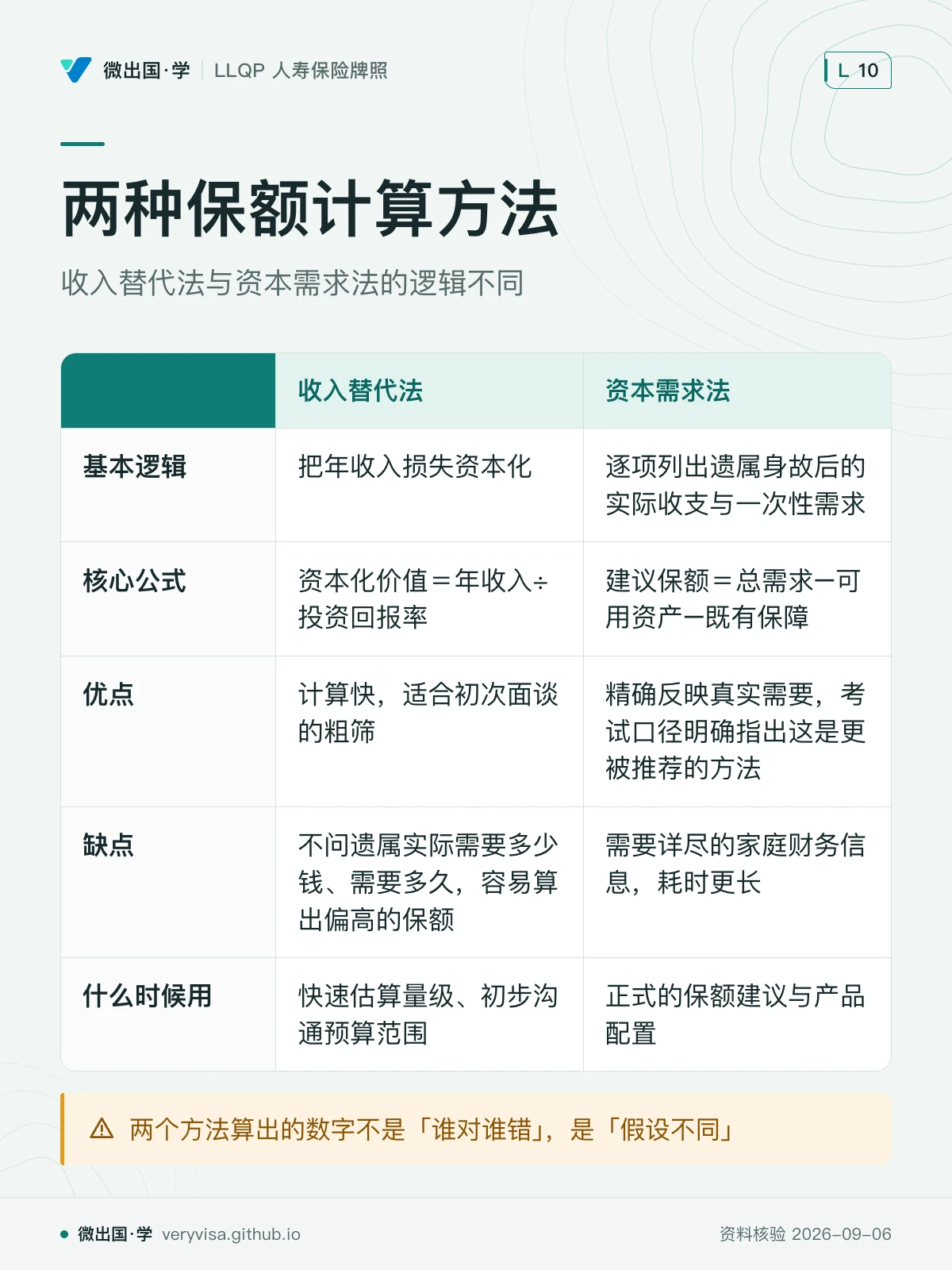
图:两种保额计算方法——收入替代法与资本需求法的逻辑不同
ℹ️
两个方法算出的数字不是「谁对谁错」,是「假设不同」
前者问「要永远替代这份收入,需要多少本金」,后者问「这个家庭实际的收支缺口有多大、要覆盖多久」。代理人的责任是让客户看到两个数字、理解假设差异,而不是只报一个「正确答案」。
3. 逐步算例一:收入替代法的四步演化——假设越精细,数字越夸张
素里的电气工程师 Farid,本例需替代的年税后可支配收入为 $84,000,家庭希望用收入替代法估算初步量级。假设投资回报率 5%、边际税率 25%、通胀率 2%:
未调整 :$84,000 ÷ 5% = $1,680,000 。计入税后回报 :税后回报率 = 5% × (1 − 25%) = 3.75%;$84,000 ÷ 3.75% = $2,240,000 。计入通胀调整 :通胀调整回报率 = (1 + 5%) ÷ (1 + 2%) − 1 ≈ 2.94%;$84,000 ÷ [(1.05 ÷ 1.02) − 1] = $2,856,000 (保留完整收益率计算)。同时计入税后与通胀 :税后通胀调整回报率 = (1 + 3.75%) ÷ (1 + 2%) − 1 ≈ 1.72%;$84,000 ÷ [(1.0375 ÷ 1.02) − 1] = $4,896,000 。
同一个人、同一份收入,四种假设精细度算出的保额从 $1,680,000 一路涨到近 $4,900,000,相差近三倍。 这正是收入替代法最大的弱点:分母(回报率)调得越保守、越精细,所需保额就放大得越夸张,而这个数字从没问过「遗属到底需要多少钱、需要多久」。
4. 逐步算例二:资本需求法——先算缺口,再选资本化方式(含现有团体险抵扣)
列治文的行政助理 Yuki,月开支身故后预计降到 $4,200 ,遗属能拿到的收入来源为:CPP 遗属月给付(本例假定已核定为 $803.54,且遗属没有新增所得税;不能向所有人预设最高额或忽略其应税性质) + 子女月给付 $307.81 ×1 名子女 = $1,111.35 。
收入缺口 = $4,200 − $1,111.35 ≈ $3,088.65/月 。
资本保留法 (缺口 ÷ 税后通胀调整回报率,假设仍取 1.72%):$3,088.65 × 12 ÷ 1.72% ≈ $2,155,000 (本金永存,只花利息)。资本耗尽法的零实际净收益简化例 (本例选择覆盖14年;假定税后收益刚好抵消通胀):$3,088.65 × 12 × 14 ≈ $519,000 (本金用尽即止)。
同样的月缺口,两种资本化方式相差超过 4 倍。 选哪一种取决于这笔钱有没有明确的终止年限——本例把18岁设为预算终点,不是 BC 抚养义务统一终点;成年后仍受扶养的子女亦可能有需求,用耗尽法更贴近真实需要;如果是配偶终身收入替代,才该考虑保留法。
再往下一步,Yuki 名下还有一份雇主提供的团体寿险,保额 $150,000 。若本例已确认死亡时可赔、可供家属使用且没有在别处扣除,这笔钱才从总需求中减掉;离职或退休后的缺口须另算,才是需要新增购买的保额——按耗尽法计算:$519,000(缺口资本化)+ 一次性资本需求(假设丧葬 $20,000 + 清偿信用卡 $8,000)− 既有团体险 $150,000 = 约 $397,000 建议新增保额。忘记减这一步,是需求分析里最常见、后果也最直接的错误——客户会为一份实际上已经有部分覆盖的保障重复付费。
5. 逐步算例三:房价 vs 按揭余额——净需求算的是「欠了多少」,不是「房子值多少」
本拿比的电工 Marcus 和妻子 Lena 共有一套市值 $980,000 的房产,按揭余额还剩 $520,000 (18 年期限,已还 6 年)。需求分析里要覆盖的是「身故后房子能不能保住」,正确算法是:
净需求(房贷部分)= 按揭余额 $520,000 ,不是房屋市值 $980,000。
常见错法 :直接把 $980,000 代入需求分析表,得出一个远超实际负债的保额建议。识别方法很简单:题干或客户资料只要同时出现「房屋市值」与「按揭余额」两个数字,需求分析要用的永远是按揭余额——市值只在计算「身故税负」(视同处置的资本利得)或「可用资产池」时才会用到,而且用的通常是资本利得的市值减 ACB;可用资产则看出售后扣债务、税费及交易成本的净额,不能把资本利得当成可用现金。
节末检索小测 · 先别往回翻,凭记忆作答 Quick recall check: answer from memory before scrolling back
When gathering information under the six-element client situation checklist, why must an insurance agent base the income analysis on the client's after-tax take-home pay rather than gross income, and how should registered retirement accounts be treated?
在按客户处境六要素清单收集信息时,为什么保险代理人必须以客户的税后实得收入(take-home pay)而非税前总收入作为收入分析基准,且应当如何对待注册退休账户?
a Take-home pay reflects the spending power survivors actually lose, and RRSP/RRIF balances are generally included in income at death unless a rollover applies. ✓ 正确:需求分析的收入基准是税后实得收入(take-home pay),因为它代表遗属实际损失的消费力;同时注册资产在身故时通常有计入收入规则,仅对配偶或符合条件的经济依赖子女或孙子女有展期例外,须分别核对资格。 Correct. The income baseline for needs analysis is after-tax take-home pay because it represents the actual spending power survivors lose; registered assets are generally included in income at death unless an eligible tax-free rollover to a spouse or financially dependent child or grandchild applies.
b Take-home pay is used only when calculating the basic personal amount, and all RRSP/RRIF balances are permanently exempt from tax upon death. ✗ 错在误解税法规则:基本个人免税额(BPA)属于税收抵免金额而非税后实得收入的定义,且RRSP/RRIF在身故时若无合格展期(rollover)须按市值计入死者最终报税表征税,绝非永久免税。 Incorrect. Misunderstands tax rules: the basic personal amount (BPA) is a tax credit rather than a definition of take-home pay, and RRSP/RRIF balances are included in the deceased's final return at fair market value unless an eligible rollover applies, never permanently tax-exempt.
c Gross income is required for the capital needs approach, while take-home pay is used exclusively to estimate the estate's probate and executor fees. ✗ 错在颠倒基准:无论收入替代法还是资本需求法,衡量家庭实际消费缺口的基准都是税后实得收入(take-home pay),遗嘱认证与执行人费用则按遗产资产规模估算而非按税后工资计算。 Incorrect. Reverses analysis baselines: both the income replacement approach and capital needs approach measure family consumption shortfalls using after-tax take-home pay; probate and executor fees are estimated based on estate asset size, not net salary.
d Take-home pay automatically deducts the client's mortgage balance, and registered accounts can never be transferred to a surviving spouse. ✗ 错在概念混淆:税后实得收入(take-home pay)只是扣除所得税及法定扣款后的净收入,并未扣除按揭本金余额;且注册账户在满足条件时可以展期转移给未亡配偶。 Incorrect. Confuses concepts: take-home pay is net income after taxes and statutory deductions, not after mortgage principal payments; moreover, registered accounts can be rolled over tax-deferred to a surviving spouse if eligible.
看答案与每个选项的解析 Show the answer and why each option is right or wrong 答案 Answer :a
四、2026 市场:先定保障缺口,再比较期限与持续付款能力 本节回答 This section answers 说明如何将不同期限的保障缺口与产品期限结构及预算匹配 Explaining how to align coverage gaps of different durations with policy terms and premium budgets.
以下是 2026-09-04 回读官网确认的产品实例。各行说明它对应本章的哪个判断;实际销售资格和责任范围仍须核对具体合同。
温哥华家庭做方案时,房贷看剩余本金与还款安排,教育金看未来支出扣除专款储蓄,赡养看实际依赖程度,企业主另核股份或经营权益的身故税务后果。LCGE 有资产资格、年度额度和个人已用额度限制,不能直接从所有企业权益增值中扣一个统一数字。
可比较三种自拟方案:一份覆盖主要收入缺口的定期险、按债务与抚养期限分层的定期组合、在确有长期需求时加入永久保障。为每种方案写出采用的收入、回报、通胀、期限及预算假设。这是分析方法,不是上述三家公司的报价或建议。
同样要减去真正可用的现有保障和资产。公司保单若要用于买卖协议,不能又把全部赔款当成家庭可自由支配的现金;短期可能随离职消失的团体保障也不应无条件抵掉长期缺口。
节末检索小测 · 先别往回翻,凭记忆作答 Quick recall check: answer from memory before scrolling back
After completing a needs analysis for a family in Vancouver, an agent identifies an 18-year mortgage balance, a 10-year child dependency period, and a permanent estate tax liability. How should the agent transition from the needs analysis to structuring coverage options?
在为温哥华一个家庭完成需求分析后,代理人识别出18年期的按揭余额、10年期的子女抚养期,以及一项终身遗产税负。代理人应当如何从需求分析过渡到设计保障方案?
a Combine all temporary and permanent expenses into a single longest-term contract and deduct the full face value of a corporate buy-sell policy as free family cash. ✗ 错在触犯「漏减可用既有保障」反向陷阱:不应用一张最长合同笼统套住所有不同期限的开支,且用于买卖协议(buy-sell agreement)的公司保单赔款已有锁定的企业用途,不能当成家庭可自由支配的现金。 Incorrect. Violates needs-matching principles: distinct needs of varying durations should not be lumped into a single longest-term policy, and proceeds from corporate policies earmarked for buy-sell agreements are legally committed to the business and cannot be treated as free family cash.
b Mark the end date for each distinct need, compare layered term options with permanent coverage where long-term needs exist, and state all return, inflation, and budget assumptions. ✓ 正确:实务中应先给房贷、抚养期及长期税负分别标注结束时间,比较单一定期险、按债务与抚养期限分层的定期组合以及针对长期需求加入永久保障的方案,并写明采用的收入、回报率、通胀、期限及预算假设。 Correct. In practice, an agent should identify the termination date for each distinct need (mortgage, dependency period, estate taxes), compare layered term structures alongside permanent coverage for long-term liabilities, and clearly disclose all income, return, inflation, and budget assumptions.
c Select a policy based solely on the lowest first-year premium and deduct the client's short-term group coverage unconditionally against the permanent estate tax need. ✗ 错在忽视续保与转换边界及期限错配:选择初始期限时必须同时查看届满续保成本和转换截止条件而不能只比首年保费,且短期可能随离职消失的团体寿险(group life insurance)不应无条件抵掉终身缺口。 Incorrect. Ignores renewal, conversion, and duration mismatch risks: choosing coverage cannot focus solely on the lowest first-year premium while ignoring renewal rate jumps and conversion cutoffs; furthermore, temporary group life that may end upon job termination should not unconditionally offset permanent estate tax liabilities.
d Apply a flat $1,275,000 lifetime capital gains exemption deduction to every category of family asset regardless of asset qualification or prior usage. ✗ 错在滥用豁免额度:终身资本利得豁免(LCGE)受资产资格、年度额度和个人已用额度三重限制,不能直接从所有家庭或企业资产增值中扣减一个统一数字。 Incorrect. Misuses exemption rules: the lifetime capital gains exemption (LCGE) is subject to strict asset qualification, annual statutory limits, and individual cumulative usage, and cannot be applied as a blanket deduction across all family or business assets.
看答案与每个选项的解析 Show the answer and why each option is right or wrong 答案 Answer :b
五、历史变革:这一章的数字为什么必须重算 本节回答 This section answers 解释为何需求分析公式不变但法定输入数字须按年核对 Explaining why needs analysis formulas remain constant while statutory input figures must be verified annually.
其一,CPP 月给付与一次性身故给付要分开核。 月给付受指数化及 CPP 增强部分影响;一次性身故给付基本额仍为 $2,500,但 2025 年起符合条件可另获 $2,500。已有合资格遗属的家庭不能直接套最高 $5,000。
其二,LCGE 必须按处置年度查。 2024 年提高至 $1,250,000,2025 年仍为该额;CRA 的 2026 栏已是 $1,275,000。合格小型企业股份与合格农渔业财产须核个人剩余额度及具体资格,不能给每类资产各算一份完整豁免。
其三,需求分析方法论本身没有变,变的是输入的数字。 两套公式的结构、税与通胀的调整步骤这些年没有变化——理解底层逻辑之后,换上 2026 年的现行数字,整套方法照样能用。结论落在机制上,数值只作当年快照,这条原则在需求分析这一章体现得比任何一章都明显。
节末检索小测 · 先别往回翻,凭记忆作答 Quick recall check: answer from memory before scrolling back
Why must an agent distinguish between the unchanging methodology of needs analysis and the annually indexed statutory inputs such as the CPP death benefit and the Lifetime Capital Gains Exemption (LCGE)?
为什么代理人必须把保持不变的需求分析方法论,与按年指数化调整的法定输入数字(如CPP一次性身故给付和终身资本利得豁免LCGE)区分开来?
a The tax and inflation formulas stay constant, while inputs such as the 2025 CPP death benefit top-up of $2,500 and the 2026 LCGE of $1,275,000 depend on year and eligibility. ✓ 正确:需求分析的两套公式结构及税与通胀调整步骤并未改变,但输入数字随年份与资格变化——例如CPP一次性身故给付基本额为$2,500,2025年起无合资格遗属等条件时才可另获$2,500(有合资格遗属的家庭不能套$5,000),LCGE在2024及2025年为$1,250,000而在2026年为$1,275,000。 Correct. The analytical formulas and multi-step tax and inflation adjustments remain constant, whereas statutory inputs vary by year and eligibility: the basic CPP death benefit is $2,500 (with an additional $2,500 top-up starting in 2025 only where there is no eligible survivor, so a family with an eligible survivor cannot apply the $5,000 figure), and the LCGE was $1,250,000 in 2024-2025 and is indexed to $1,275,000 in 2026.
b Because every family with a surviving spouse and children is automatically entitled to the $5,000 CPP death benefit and two separate $1,275,000 LCGE deductions. ✗ 错在误用「考场旧口径与现行规则混淆」陷阱:已有合资格遗属领取遗属养老金的家庭不符合$2,500附加额条件,不能直接套最高$5,000;且合格小型企业股份与合格农渔业财产共享个人终身LCGE额度,不能各算一份完整豁免。 Incorrect. Falls into the dual-benchmark trap: families with an eligible surviving spouse receiving a survivor's pension do not qualify for the $2,500 top-up and cannot claim $5,000; furthermore, QSBC shares and qualified farm property share a single cumulative LCGE limit rather than two separate full exemptions.
c Because the capital needs approach was replaced in 2026 by a statutory formula that ignores inflation and marginal tax rates. ✗ 错在否定方法论连续性:资本需求法(capital needs approach)与收入替代法的公式结构、税后及通胀调整步骤这些年完全没有变化,变化的只是代入的当年快照数字。 Incorrect. Denies methodological continuity: the core formulas, after-tax calculations, and inflation adjustments of the capital needs and income replacement approaches have remained unchanged; only the statutory snapshot inputs are updated annually.
d Because the LCGE decreased from $1,275,000 in 2022 to $913,630 in 2026, which increased the tax liability of every small business owner at death. ✗ 错在颠倒年份演进:$913,630是2022年考试口径的旧上限,随后在2024及2025年提高至$1,250,000,2026年进一步指数化上调至$1,275,000,而非下降。 Incorrect. Reverses historical indexing: $913,630 was the 2022 exam limit, which increased to $1,250,000 in 2024-2025 and was further indexed upward to $1,275,000 in 2026, rather than decreasing.
看答案与每个选项的解析 Show the answer and why each option is right or wrong 答案 Answer :a
六、案例:三个最容易在需求分析里算错的场景 本节回答 This section answers 通过混合家庭、一人公司与单亲房贷案例演练三大高频算错点 Practicing the three high-frequency error scenarios through blended family, sole shareholder, and single-parent mortgage cases. 本章考题 4 Question 4
案例 A:混合家庭的六要素清单(示例)
素里的项目经理 Aziz(46 岁)与再婚妻子 Farah(37 岁)育有一名 2 岁的儿子;Aziz 与前妻 Sana 共同监护一名 10 岁的女儿,按调解协议每月支付子女抚养费 $900 ,协议约定至女儿 19 岁;Farah 带着一名 5 岁的继子加入家庭,已被 Aziz 收养。Aziz 月税后收入 $6,800 ,Farah 目前全职照护两名幼子,计划 4 年后复工,预期月入 $3,500。
适用清单 :① 家庭结构——Farah 目前完全依赖 Aziz 的收入,复工前不能按「双收入家庭」计算需求;② 抚养义务——对 Sana 所生女儿的抚养费义务要按协议措辞判断是否随身故终止,本例协议未言明,故 Sana 仍可能对遗产提出索赔;③ 未成年子女——两名幼子的生活费按实际依赖年限及适用抚养义务覆盖,不能假定18岁一律终止,而非笼统按「到成年」一刀切。
常见错法 :把 Farah 当作「有工作能力的成年人」直接排除在收入替代需求之外——忽略了她目前完全依赖 Aziz 收入这一事实,复工后的收入潜力是未来假设,不能倒推到当下的需求计算里。
案例 B:一人公司股东的资产负债与税务缺口(示例)
列治文的物理治疗师 Helena,通过自己的 CCPC 执业,公司无其他股东。她名下总资产(个人 + 公司股权)合计 $1,180,000 ,其中本例假定死亡时公司股权公允市值 $650,000(ACB $10,000),符合 QSBC 股份定义、个人剩余 LCGE 足够,且无其他扣除限制。账面价值本身不能代替公允市值。
税务测算 :股权身故时视同处置,资本利得 = $650,000 − $10,000 = $640,000;按 2026 LCGE $1,275,000 ,资本利得 $640,000 的50%为应税资本利得 $320,000,再按符合条件的资本利得扣除抵减;一般税计算下可抵消这项收入,但须另核替代最低税 AMT,不能把它写成从未产生应税资本利得。
常见错法 :① 误以为公司股权和合伙企业权益一样不能用 LCGE——恰恰相反,CCPC 股份还须符合 QSBC 条件;合格家族农渔业合伙权益也可能适用 (第七节陷阱 5);② 把总资产 $1,180,000 直接当成「可用于遗产需求的资产」——若家人打算保留公司继续经营而非变卖,这部分权益就不该 计入可变卖资产池,实际可用资产会远小于账面总值。
案例 C:房贷、团体险与 CPP 现行值的综合计算(示例)
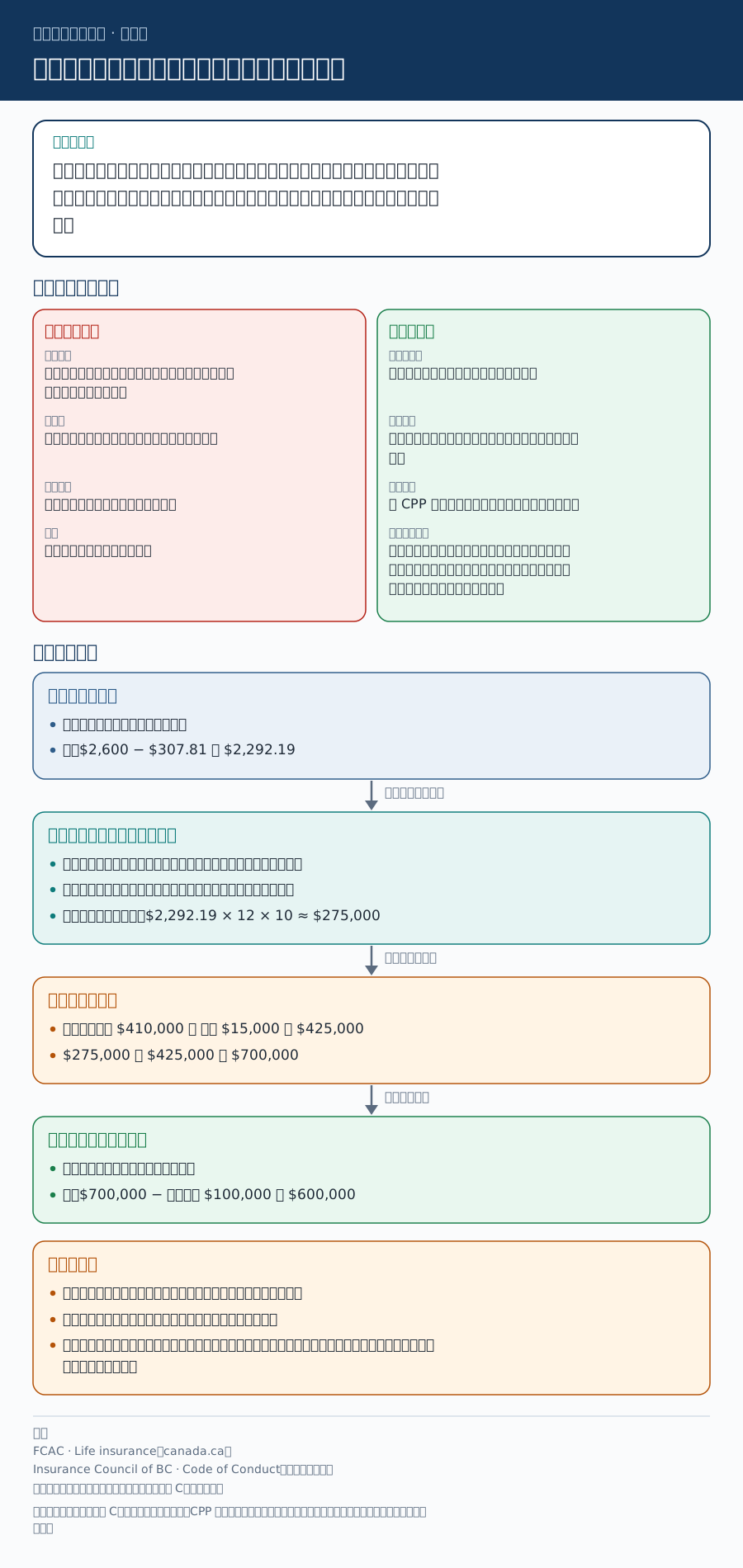
北温的护士 Priya(39 岁),单亲抚养一名 8 岁儿子。她月税后收入 $4,100,身故后预计月开支降至 $2,600(已剔除拟一次还清的按揭供款,保留地税、维修等开支);名下房产市值 $860,000,按揭余额 $410,000 ;雇主提供团体寿险 $100,000 ;儿子可领 CPP 子女月给付,本例假定母亲满足供款资格,按未满18岁标准 $307.81 ,并假定该子女没有因此产生所得税。
第一步,收入缺口 :$2,600 − $307.81 = $2,292.19/月 ,按零实际净收益的简化耗尽法覆盖10年;这是预算假设,18岁后抚养及升学需求应另列:$2,292.19 × 12 × 10 ≈ $275,000 。
第二步,一次性资本需求 :房贷部分用按揭余额 $410,000 (不是市值 $860,000)+ 丧葬费 $15,000 = $425,000。
第三步,总需求与既有保障相减 :$275,000 + $425,000 = $700,000;减去既有团体险 $100,000 = $600,000 建议新增保额。
常见错法 :① 把房屋市值 $860,000 代入而不是按揭余额,会让总需求虚增 $450,000;② 忘记减团体险 $100,000,会让客户为已有的保障重复付费;③ 把 CPP 子女给付误用考试口径 2022 年的 $264.53 而不是现行 $307.81——三处错法叠加,最终保额建议可能偏差超过 $500,000。
节末检索小测 · 先别往回翻,凭记忆作答 Quick recall check: answer from memory before scrolling back
Tariq, age 46, earns $6,800 per month after tax. His second wife, Nadia, is currently a full-time caregiver for their 2-year-old son and plans to return to work in 4 years earning $3,500 per month. Tariq also pays $900 per month in child support for his 10-year-old daughter from a prior marriage until age 19 under a mediation agreement that does not mention life insurance. How should Tariq's agent treat Nadia's status and the child support obligation in a current needs analysis?
46岁的Tariq月税后收入为$6,800。他的再婚妻子Nadia目前全职照护两人2岁的儿子,计划4年后复工,预期月入$3,500。Tariq还按调解协议为前段婚姻所生的10岁女儿每月支付$900抚养费至19岁,协议未提及寿险。在当前的需求分析中,代理人应如何处理Nadia的状况与这笔子女抚养费义务?
a Treat the household as a dual-income family combining both the $6,800 current income and the projected $3,500 future income immediately, and exclude the $900 monthly child support because the agreement is silent on insurance. ✗ 错在同时犯下两处典型错误:Nadia复工前完全依赖Tariq收入,不能把4年后的$3,500未来收入假设倒推当作现在的双收入家庭;且调解协议未言明抚养费随身故终止时,前配偶仍可能对遗产提出索赔,不能直接排除。 Incorrect. Makes two classic errors: prior to returning to work, Nadia is entirely dependent on Tariq's income, so the projected $3,500 of future earnings in four years cannot be counted today as a dual-income family; additionally, because the agreement is silent on termination at death, child support cannot be ignored because the former spouse can claim against the estate.
b Recognize Nadia's current full dependency before her planned return to work, and include the child support obligation until age 19 unless the agreement explicitly terminates it on death. ✓ 正确:按客户处境六要素清单(client situation checklist),Nadia目前全职照护幼子、完全依赖Tariq的$6,800月税后收入,复工前不能按双收入家庭计算;同时对前段婚姻女儿每月$900至19岁的抚养费,因协议未写明随身故终止,前任仍可向遗产索赔,必须纳入需求分析。 Correct. Under the six-element checklist, Nadia currently cares full-time for their toddler and is fully dependent on Tariq's $6,800 net income, so the household cannot be treated as dual-income before her return; moreover, the $900 monthly child support to age 19 must be included because the former spouse can claim against the estate unless the agreement explicitly terminates on death.
c Exclude Nadia from any income replacement need because she is an employable adult, and cap all children's living expenses strictly at age 18 in every case. ✗ 错在忽视实际依赖状况:把全职照护幼子的配偶当作有工作能力成年人直接排除会造成4年空档期无保障,且未成年子女生活费应按实际依赖年限及适用抚养义务(如协议约定的19岁)覆盖,不能假定18岁一律一刀切终止。 Incorrect. Ignores actual dependency: dismissing a stay-at-home caregiving spouse as employable leaves a four-year protection void; furthermore, child dependency expenses must cover actual support obligations (such as age 19 specified in the agreement) rather than an arbitrary age-18 cutoff.
d Deduct Nadia's projected $3,500 monthly income from Tariq's $6,800 income today, and replace the $900 support obligation with the $2,500 CPP death benefit. ✗ 错在混淆时间点与给付金额:未来4年后才可能实现的$3,500月收入不能抵扣当前的照护期缺口,且$2,500一次性身故给付远不足以覆盖每月$900直至19岁的持续抚养费义务。 Incorrect. Confuses timing and benefit amounts: the projected $3,500 monthly income four years away cannot offset current caregiving dependency gaps, and a one-time $2,500 CPP death benefit cannot substitute for an ongoing $900 monthly child support obligation lasting until age 19.
看答案与每个选项的解析 Show the answer and why each option is right or wrong 答案 Answer :b
七、考试陷阱与考场与现行对照清单 本节回答 This section answers 汇总八大考场算数陷阱与四项考场对比柜台的考场与现行对照清单 Summarizing eight high-frequency exam arithmetic traps and four dual-benchmark checklists comparing exam and current rules.
以下每条对应 CISRO 公开样题中需求分析相关题目的考点与陷阱形态,按版权边界只写形态,不复述题干。
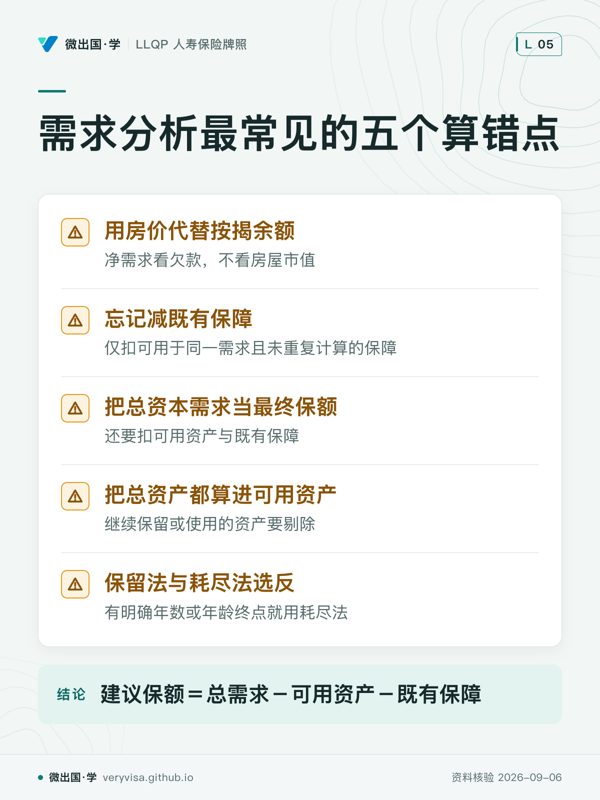
用房价代替按揭余额 (错误基准值)。净需求算的是「欠了多少」,不是「房子值多少」。题干同时给出市值与按揭余额两个数字时,需求分析永远用按揭余额;市值只在算资本利得或可用资产时才用得上。
忘记减既有保障 (漏算一步)。团体险、既有个人险、政府给付都要在总需求里先减掉,剩下的才是需要新增购买的保额。只有题干确认该保额可用于同一需求且未重复计算时才扣除;存在企业用途、受益人限制或失效风险时另判。
把「总资本需求」当成最终建议保额 (漏算一步)。正确公式是总需求减去可用资产、再减既有保障,两项都要参与最后一步相减,只减一项就是不完整答案。
「总资产」与「可用于需求的资产」混为一谈 (范畴误用)。配偶要继续居住的自住房、要继续持有的退休金账户、要传给子女的家族物业,即使账面价值很高也不计入 可变卖的资产池。题干出现「配偶将继续保留/使用」的措辞,这项资产就要剔除。
把所有合伙权益视为同一税务类别 。普通经营合伙通常不能用 LCGE;合格家族农渔业合伙权益可有例外。看到「合伙」先核资产定义,不直接排除。
两种方法的假设混用 (跳步或重复调整)。税后调整、通胀调整要按顺序依次进行,不能跳步、也不能对同一笔收入重复调整。先确认题目问的是哪一步,再选对应公式代入。
资本保留法与资本耗尽法选错 (方法误用)。有明确终止年限的需求(子女到 18 岁、赡养费到前配偶再婚或 65 岁)该用耗尽法;没有明确终点的长期收入替代需求才考虑保留法。题干给出具体年数或年龄终点,答案方向就是耗尽法,用保留法会大幅高估。
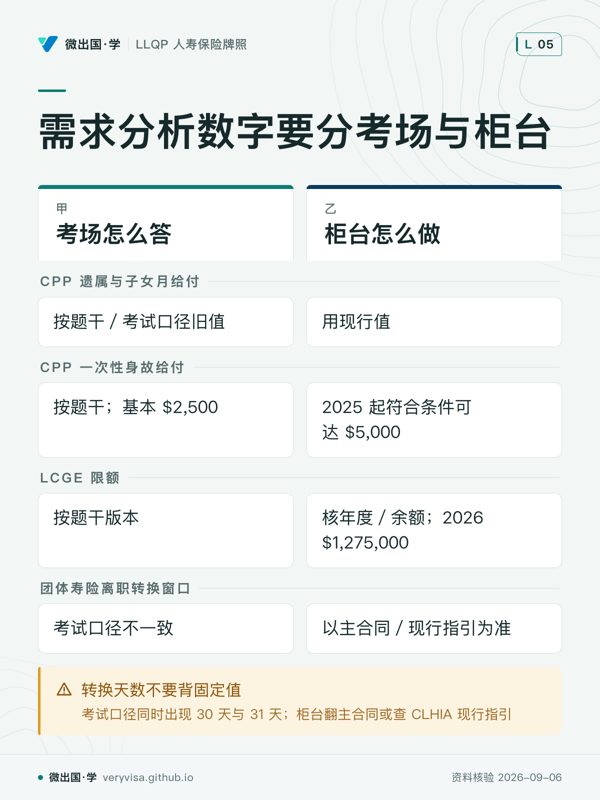
CPP 遗属给付误用考试口径 2022 年旧数字 (数字过期)。柜台一律用现行值;考场按题干给出的数字作答,题干没给具体数字才需要判断用哪个口径。
考场与现行对照清单(考场 vs 柜台) :① CPP 遗属月给付与子女月给付——考场按题干/考试口径旧值,柜台用现行值;② CPP 一次性身故给付——基本 $2,500,2025 年起符合附加条件可达 $5,000;③ LCGE 限额——考场按题干版本,实务核年度及剩余额度,2026 上限 $1,275,000;④ 团体寿险离职转换窗口天数——考试口径内部本身有 30 天与 31 天两处不一致,柜台一律翻主合同或查 CLHIA 现行指引,不背固定天数。
边学边测 :本章题库共 42,覆盖三层难度与四道以上情景算数题。
节末检索小测 · 先别往回翻,凭记忆作答 Quick recall check: answer from memory before scrolling back
Which of the following pairs correctly matches a classic LLQP needs analysis exam trap with the signal in the question stem that warns you to avoid it?
下列哪组配对正确对应了LLQP需求分析的经典考试陷阱,以及题干中提醒你避开该陷阱的识别信号?
a When the stem states the surviving spouse will continue living in the family home, include the home's full market value in assets available upon death. ✗ 错在落入「不可变卖资产混入可用资产池」陷阱:题干出现配偶将继续保留或居住(continue living in)的措辞时,该自住房属于不可变卖资产,必须从身故时可用资产(assets available upon death)池中剔除。 Incorrect. Falls into the trap of mixing illiquid assets into the available asset pool: when the question stem states the surviving spouse will retain or continue living in the home, the residence is an illiquid asset that must be excluded from assets available upon death.
b When the stem gives a specific 10-year dependency period for a child, use the capital retention method so the principal is never touched. ✗ 错在落入「资本保留法与耗尽法混用」陷阱:题干给出具体年数(如10年)或年龄终点时,属于有明确终止年限的需求,应选用资本耗尽法(capital drawdown method),用资本保留法会大幅高估所需保额。 Incorrect. Falls into the trap of confusing capital retention and drawdown: when the stem gives a specific number of years (such as 10 years) or an age milestone, the need has a definite duration and should use the capital drawdown method; using capital retention severely overestimates required coverage.
c When the stem lists both the property's market value and the remaining mortgage balance, use the mortgage balance to calculate the debt repayment need. ✓ 正确:对应「用房价代替按揭余额」陷阱——当题干同时给出房屋市值与按揭余额(mortgage balance)时,房贷净需求算的是欠了多少(按揭余额),市值只在算视同处置资本利得或可变卖资产净额时才用到。 Correct. Directly counters the trap of using property market value instead of mortgage balance: when both property market value and mortgage balance are given, debt clearance requires paying off the debt (the mortgage balance); market value is used only when assessing capital gains on deemed disposition or net sale proceeds.
d When the stem mentions an existing group life insurance policy, ignore it completely so the client builds a larger estate cushion. ✗ 错在落入「漏减可用既有保障」陷阱:只要题干确认既有团体寿险(existing coverage)在身故时可赔、可供家属用于同一需求且未重复计算,就必须从总资本需求中减去,否则会导致客户重复付费。 Incorrect. Falls into the trap of omitting existing coverage: as long as existing group life insurance is payable at death, available to the family for the specified need, and not duplicated, it must be deducted from total capital needs to prevent the client from overpaying for unnecessary coverage.
看答案与每个选项的解析 Show the answer and why each option is right or wrong 答案 Answer :c
术语双语表
注意:本页 2026-09-05 已回源的三项,及仍需留意的口径 本节回答 This section answers 核实遗属津贴、工伤给付与BC法定遗属年金比例 Verifying survivor allowances, workers' compensation benefits, and BC statutory survivor pension percentages.
OAS 遗属津贴 2026 现行月给付与收入门槛 ——月给付已核实为 2026 年 10–12 月的 $1,726.18,收入门槛 $31,152(Canada.ca(Employment and Soc… );两者每季按物价调整,申请时查适用季度官方表并向 Service Canada 确認,以实际核定为准。BC WorkSafeBC 工伤致死给付具体标准 ——已回源 RSCM Vol.II Chapter 8 现行条款,见第二节第4条表格;此前网络摘要给出的 $601.49/$186.69 系误读,已用一手源数字(配偶最低月给付 $1,451.63、超3子女每人加 $449.20)取代。BC《Pension Benefits Standards Act》法定 DBPP 遗属年金比例 ——已确认 BC 落点为 60%(现行 PBSA s.80:死亡后给付不低于原额60%),不是笼统区间里的任意一个数。
节末检索小测 · 先别往回翻,凭记忆作答 Quick recall check: answer from memory before scrolling back
Under British Columbia's current Pension Benefits Standards Act (PBSA) s.80 and the LLQP exam range, what is the statutory minimum survivor pension percentage for a retired member's joint and survivor pension in a defined benefit pension plan (DBPP), and how can a spouse waive it?
在BC省现行《养老金给付标准法》(Pension Benefits Standards Act, PBSA)s.80及LLQP考试资料区间下,确定给付养老金计划(DBPP)退休会员默认联合遗属年金的法定最低遗属给付比例是多少,配偶又该如何签署豁免?
a The exam gives a 60%–66% range; BC's PBSA s.80 sets 60%, which the spouse may waive within 90 days before commencement, before a witness and without the member present. ✓ 正确:考试资料给出因省而异的60%–66%区间,而BC省现行PBSA s.80确认落点在区间下限60%(任一方死亡后给付不低于原额60%);配偶若要放弃,须在起领前90天内、在见证人面前且会员不在场时签署规定豁免(waiver)。 Correct. Exam materials cite a provincial range of 60%-66%, and BC's PBSA s. 80 sets the statutory minimum at 60% (payable to the surviving spouse at no less than 60% of the original pension); a spouse may waive this right within 90 days before pension commencement by signing a prescribed waiver before a witness outside the member's presence.
b Both the exam and BC's PBSA set a flat minimum of 30% for spouses under age 50, which can be waived verbally at any time after retirement. ✗ 错在混淆工伤给付规则与养老金法规:50岁以下无子女配偶最低30%的递减规则属于BC省WorkSafeBC工伤致死给付(Workers' Compensation fatality benefits),而非PBSA管辖的DBPP联合遗属年金,且豁免绝不能口头或在起领后随意作出。 Incorrect. Confuses workers' compensation rules with pension statutes: the 30% minimum sliding scale for spouses under 50 without children belongs to BC WorkSafeBC fatality benefits, not DBPP joint-and-survivor pensions under the PBSA, and waivers can never be given verbally or arbitrarily after retirement.
c BC's PBSA sets the minimum survivor pension at 25%, and the member can unilaterally cancel the survivor benefit within 30 or 31 days of leaving employment. ✗ 错在张冠李戴数字:30天或31天是团体寿险离职转换窗口(group life conversion window)在考试口径中的天数,且会员无权单方面取消配偶的法定联合遗属年金权益。 Incorrect. Confuses figures across topics: 30 or 31 days refers to the group life conversion window under exam materials, and a pension plan member has no legal power to unilaterally revoke a spouse's statutory joint-and-survivor pension rights.
d BC's PBSA requires a 50% survivor pension offset against federal CPP benefits, subject to a flat monthly minimum of $1,451.63. ✗ 错在混淆WorkSafeBC规则:抵扣50%对应联邦给付并受$1,451.63最低月额保护是2026年BC省WorkSafeBC无子女遗属配偶工伤致死给付的计算规则,而非PBSA退休金计划的规定。 Incorrect. Confuses WorkSafeBC rules with pension law: a 50% offset against federal benefits with a $1,451.63 monthly minimum floor governs 2026 BC WorkSafeBC fatality benefits for surviving spouses without dependent children, not PBSA pension plan provisions.
看答案与每个选项的解析 Show the answer and why each option is right or wrong 答案 Answer :a
来源
本页知识卡 不看正文也能拿到这一节的核心内容:先看导读,再看图。点图放大,左右翻页。
放大 ⤢ 正确顺序是先算需求,再排除不能动用的资源与已有保障。 先看 先分清题目给的是价值、欠款,还是可动用资源。易漏 最容易漏的是最后的两次扣减。下一步 看到终止点,先选算法,再开始代数。详情与分享 → 放大 ⤢ 考场按题干口径作答;实务数额与期限按现行依据核实。 先看 先认题目要历史答法还是柜台现值。易漏 同一项目可能随年份、资格或合同条款变化。下一步 涉及具体数额或期限时,先锁定适用来源。详情与分享 → 本站依据官方原文自撰 · 出处见正文链接