🃏 Flashcards · 3 闪卡 · 3 张 🖼 Slides · 2 幻灯 · 2 页 ✍️ Questions · 7 刷题 · 7 道
人寿保险 Life Insurance P3 过一遍 P3 Skim
ZH EN ZH + EN
先看这一章怎么考 First, how this chapter is tested
保费与身故金税务判定题:给出雇主与员工各自的保费分摊比例及年薪倍数保额,考查哪一部分计入当年应税福利(taxable benefit)、哪一部分不可抵扣,以及身故保险金本金是否免税,专门测试是否与团体伤残险记反。 Premium and death benefit tax determination questions: Presenting employer and employee premium split percentages and salary-multiple coverage amounts, testing which portion constitutes a taxable benefit in the current year, which portion is not deductible, and whether the death benefit principal is tax-free, specifically checking whether candidates confuse the rules with group disability insurance. 离职或计划终止转换权(conversion privilege)计算与条件题:结合员工年龄(65岁前后)、原保额与非魁省 $200,000 免核保上限、31天申请及缴清首期保费窗口,考查员工在离职时能免健康证明转换多少个人寿险保额。 Conversion privilege calculation and condition questions upon termination or plan end: Combining employee age (before versus at age 65), original coverage, the non-Quebec $200,000 non-medical conversion cap, and the 31-day window to apply and pay the first premium, testing how much individual life coverage an employee can convert without evidence of insurability upon leaving employment. 三方合同关系与法定查阅权场景题:通过雇主调整或终止某一会籍分级(membership class)、更换承保人或员工索取条款发生争议,测试总合同(master contract)与福利手册(benefit booklet)的区别及 BC《Insurance Act》下的主保单取阅权。 Three-party contractual relationship and statutory inspection right scenario questions: Presenting employer adjustments or terminations of a membership class, insurer replacements, or disputes arising from an employee requesting policy terms, testing the distinction between the master contract and benefit booklet as well as the right to inspect and copy the master policy under the BC Insurance Act. 最常丢分的陷阱(看到题干信号就警觉) Traps that cost the most marks (watch for the signal in the stem)
跨险种税务方向记反 Inverting tax treatment across insurance lines 题干同时出现雇主分摊团体寿险保费比例(如 70%/30% 或全额支付)并询问员工当年 T4 应税福利或受益人身故金税务后果。 The question stem presents an employer group life premium contribution ratio (such as 70% / 30% or 100% employer-paid) and asks about the employee's current-year T4 taxable benefit or the beneficiary's death benefit tax consequences. 转换上限当成固定保额或漏看缴付条件 Treating the conversion cap as a fixed coverage amount or missing payment conditions 题干给出员工离职日期、原保额(高于或低于 $200,000)及年龄,询问免健康证明转换(conversion privilege)的额度或截止动作。 The question stem provides an employee's termination date, original coverage amount (above or below $200,000), and age, asking for the conversion privilege maximum amount without evidence of insurability or the required completion actions by the deadline. 主保单查阅权与总合同边界混淆 Confusing master policy inspection rights with master contract boundaries 题干出现福利手册与主保单条款不一致、理赔争议或雇主变更会籍类别,询问谁持有主保单及成员能否向保险人索取主保单副本。 The question stem presents inconsistencies between the benefit booklet and master contract terms, claim disputes, or an employer modifying membership classes, asking who holds the master contract and whether a member can request a copy of the master policy from the insurer. 本章考点页:导图、要点表、7 道带逐项解析的练习 →
核实日期:2026-09-06|本页现行数字的出处:Canada Life 官方转换须知(Canada Life(The Canada Life … )、Manulife 官方转换表格(Manulife(The Manufacturers L… )、CLHIA 指引列表页(CLHIA )、UBC 人力资源部官方页(UBC Human Resources(不列颠哥伦比亚大… )、行业比价站交叉 Sun Life 官网摘要(ebsource.com(员工福利行业信息站,二手源) )。本次另核 BC 法条、CRA 税务规则和 Sun Life 原文;具体适用范围分别说明。
复核周期:2027-01-31。转换权须同时查适用法律、合同与保险人须知,不以一个产品示例代替全行业;每年及办理前复核。
0. 这一章解决什么问题
你要考的是 人寿保险模块 ,本篇对应 CISRO 能力组件 c2「分析可用产品」,占本模块 30%——团体寿险是这一组件里最容易被低估的一章,因为它看起来像是「个人寿险的团体版」,实际上从合同结构到税务规则都换了一套逻辑。
这一篇讲的不是「团体寿险保额是多少」,而是一份保单里出现了三个当事人(雇主、保险公司、员工),而员工通常不是主保单的投保人,但依法或依合同仍有自己的权利,包括 BC 法定的取阅主保单权 ——这个结构性事实决定了后面每一条规则:为什么免核保、为什么保额受限、为什么离职之后权利这么单薄。
这一篇帮你做到三件事:① 说清楚团体寿险里「谁付保费」怎么反过来决定「谁交税」,而且这条逻辑和团体伤残险恰好相反;② 一个客户告诉你他下个月离职,你能立刻说出他有多少天、能转多少钱、要不要体检;③ 看到一道题里出现「团体计划」「福利手册」「总合同」这几个词,能判断哪句话对会员成立、哪句话只对雇主成立。
一、制度设计与底层逻辑:谁持有主保单,成员怎样取得条款 本节回答 This section answers 回答谁持有主保单、BC法定查阅权、逆选择控制及保费与给付税务 Explaining master policy ownership, BC statutory inspection rights, adverse selection control, and premium and benefit taxation. 本章考题 1 Question 1
1. 三个当事人,只有两个签了字
团体寿险通常由雇主或协会作为计划发起人与保险人订立主保单,成员按其资格获得保障。成员一般不拥有主保单的全部管理权,但这不等于没有直接权利,也不等于只能阅读福利摘要。
BC《Insurance Act》s41(5)(b) 规定:团体被保险人或合同索赔人在提出请求并给予合理通知后,可向保险人查阅并取得团体保单副本;s41(7) 允许后续副本收合理费用,首份除外。s41(8) 保护他人隐私,s41(9) 还把索赔人的查阅范围限于与索赔或拒赔有关的信息。s44 要求交付的保障证明说明终止时权利及取阅文件权。因此,考试口径强调魁省的说明不能被扩写为「BC 没有这项权利」。发生争议时,成员可以先索取与自己有关的主保单条款,再对照福利手册、参保资料及承保通知。
「团体」这个词的门槛也比多数人以为的宽:考试口径举的例子里,自雇人士本人开不了公司团体计划,但可以通过校友会、职业协会、商会这类组织买到团体寿险——只要这个群体有保险公司认可的「共同特征」,就能构成一个团体。
2. 保险公司与雇主在博弈什么:大数法则换来的免核保
团体基础保障常在免健康证明额度内承保,这背后是一笔精算上的交换:保险公司不对每个会员单独核保,代价是雇主把整个群体(而不是挑出来的健康人)都投进这份保单。人数越多、群体越整齐(不是雇主专门挑健康员工投保),逆选择(adverse selection)的风险就越低,保险公司才愿意用「团体整体特征定价」取代逐人核保。
这条逻辑延伸出两条重要推论:
- 保额受计划条款硬性限定 ,会员对保额几乎没有自主权——因为一旦允许会员自由选择保额,健康状况差的人会挑高保额,逆选择立刻回来。
- 自选追加保额是否免健康证明,须同时满足具体计划的额度、资格与申请窗口;考试口径的 60 天是示例,不能当作所有自选保额的免核保保证——这个短窗口本身就是在控制逆选择:健康人不会拖着不办,拖到窗口关闭才申请的人,统计上更可能是健康状况变差了才申请。
3. 法律后果:会员的权利边界画在「谁签了字」这条线上
发起人可依合同调整计划,但其权限也受合同、适用保险法及雇佣关系义务约束。取消一个类别是否会终止某成员的保障,须看新旧合同的资格、终止和连续保障条款;不能只凭「换了承保人」判断。
成员遇到变更,应取得生效日、原保障结束日、新保障开始日及转换通知。可考虑的衔接包括转换、符合条件的延续产品或重新核保的个人保险;已有伤残豁免和已发生索赔则要另外核对责任归属,不能假定计划停止就一笔注销。
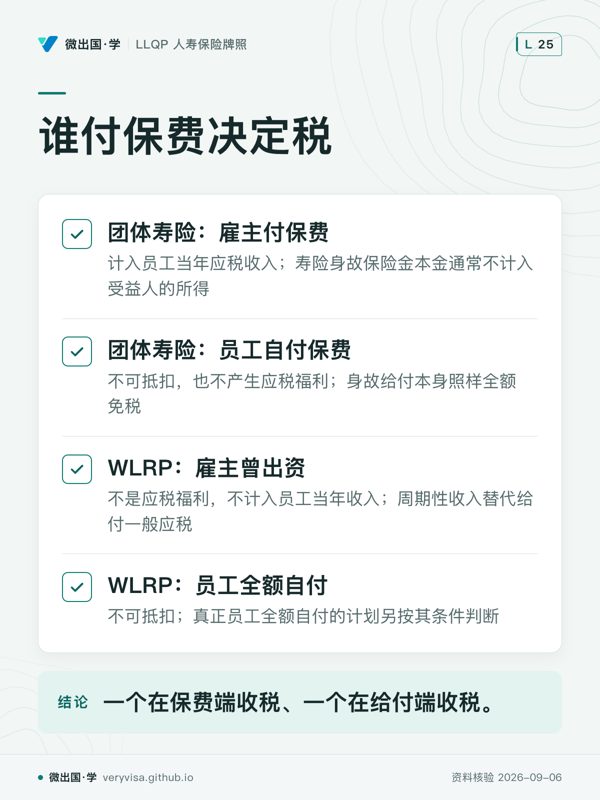
4. 谁付保费决定税——本章最容易考错、也最容易在柜台说错的一条
这条规则和你在团体伤残险那一章学到的逻辑方向正好相反 ,混在一起记就会两头都错。
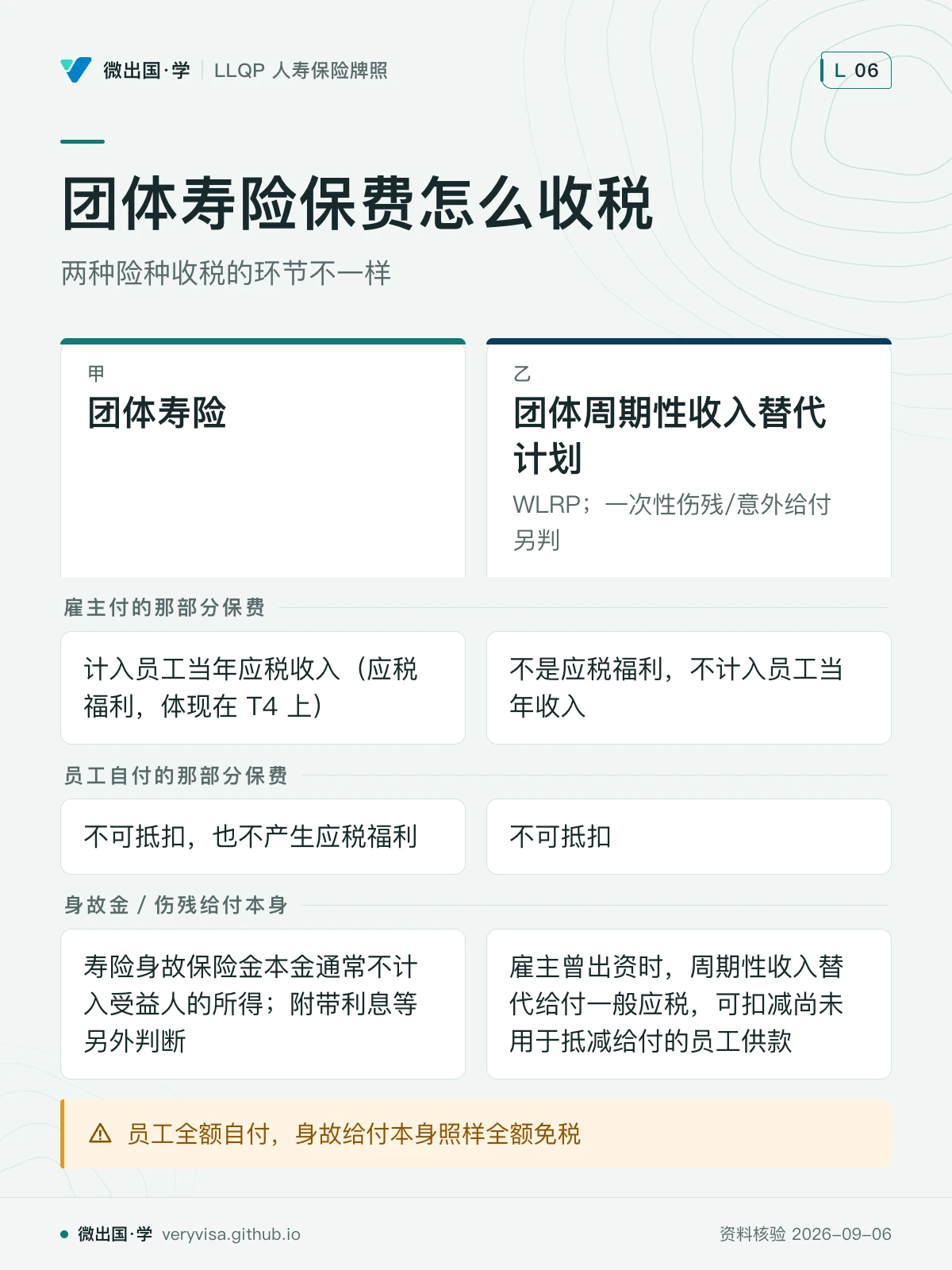
图:团体寿险保费怎么收税——两种险种收税的环节不一样
记这条规则的诀窍不是死背「团体寿险应税、团体伤残险不应税」,而是记住两种险种收税的环节不一样 :团体寿险是在缴保费的当下收一次税(作为员工的应税福利),之后的寿险身故保险金本金通常免所得税;团体伤残险是在领给付的时候收税,收不收看的是当初保费谁出的。一个在保费端收税、一个在给付端收税,这才是「相反」的真正含义,而不是简单的「一个应税一个不应税」。
⚠️
员工全额自付,是不是全部免税?
这里最容易被误解成「按比例」的一处:如果员工把团体寿险保费全部自己出,身故给付本身照样是全额免税 ——此处讨论的是通常免税的寿险身故保险金本金,跟谁付保费无关。真正因为「谁付保费」而变化的,是保费本身这一步是不是应税福利,不是身故给付那一步。把这两步分开想,就不会把「保费免不免税」和「给付免不免税」混成一回事。
节末检索小测 · 先别往回翻,凭记忆作答 Quick recall check: answer from memory before scrolling back
Elena is an employee covered under her employer's contributory group life insurance plan in BC. Her employer pays 60% of the group life premium ($480 per year) and Elena pays the remaining 40% ($320 per year) through payroll deduction. When a question arises about the exact wording of an exclusion, Elena asks whether she can inspect the master contract and how her premiums and death benefit are taxed. Which statement is correct?
Elena 是 BC 省一名参加雇主分摊型团体寿险计划的员工。雇主支付 60% 的团体寿险保费(每年 $480),Elena 通过工资扣款支付剩余 40%(每年 $320)。当对某项除外责任的确切措辞产生疑问时,Elena 询问她是否可以查阅总合同,以及她的保费和身故保险金如何征税。下列哪项陈述是正确的?
a BC law lets Elena get a copy of the master policy from the insurer, the $480 employer share is a taxable benefit, and the death benefit is tax-free. ✓ 正确。根据 BC《Insurance Act》s41(5)(b),团体被保险人(group life insured)在提出请求并给予合理通知后有权向保险人查阅并取得总合同(master contract)副本(首份免费);雇主代付的 $480 保费计入员工当年应税福利(taxable benefit),而寿险身故保险金本金通常免所得税。 Correct. Under BC Insurance Act s41(5)(b), a group life insured is entitled, on request and reasonable notice, to inspect and obtain a copy of the master contract from the insurer (with the first copy free of charge); the $480 employer-paid premium is reported as a taxable benefit on Elena's T4 slip, while the life insurance death benefit principal is generally exempt from income tax.
b Elena is only permitted to read the benefit booklet because she is not the policyholder, and 60% of any future death benefit will be taxable to her beneficiary. ✗ 错误。落入『主保单查阅权混淆』与『跨险种税务方向记反』两个陷阱:BC 省成员依法享有取阅主保单权,并非只能看福利手册(benefit booklet);且团体寿险在保费端收税,身故金本金不按雇主出资比例征税。 Falls into both the 'master policy inspection confusion' and 'inverting cross-line tax treatment' traps. BC members have a statutory right to inspect the master policy rather than being confined to the benefit booklet; furthermore, group life insurance is taxed at the premium stage, and the death benefit principal is not taxed proportionally to employer funding.
c Elena can deduct her $320 employee contribution on her personal tax return, while the $480 employer-paid portion is not a taxable benefit until a claim is paid. ✗ 错误。落入『员工自付可抵扣』与『跨险种税务方向记反』陷阱:员工自付的团体寿险保费不可抵扣(not deductible),而雇主支付的保费在当年即构成应税福利(taxable benefit)。 Falls into both the 'assuming employee contributions are deductible' and 'inverting cross-line tax treatment' traps. Employee-paid group life premiums are not deductible, while employer-paid premiums constitute an immediate taxable benefit in the year paid.
d Elena holds full ownership rights to amend the master contract directly, and the entire $800 total premium is reported as a taxable benefit on her T4 slip. ✗ 错误。落入『合同当事人角色混淆』陷阱:计划发起人(plan sponsor,即雇主)才是主保单持有人,员工不拥有主保单的全部管理或修改权;且只有雇主支付的 $480 属于应税福利,员工自付的 $320 不计入应税福利。 Falls into the 'confusing contractual party roles' trap. The plan sponsor (the employer) is the master policyholder, and individual employees do not hold ownership rights to amend the master contract; furthermore, only the $480 employer-paid portion constitutes a taxable benefit, whereas Elena's $320 contribution creates no taxable benefit.
看答案与每个选项的解析 Show the answer and why each option is right or wrong 答案 Answer :a
二、2026 现行政策与数字:考试口径写的「行业指引」扛住了十几年了吗 本节回答 This section answers 回答非魁省20万转换上限、31天缴费窗口及BC保费税 Explaining the non-Quebec $200,000 conversion cap, the 31-day payment window, and BC premium tax. 本章考题 2 Question 2
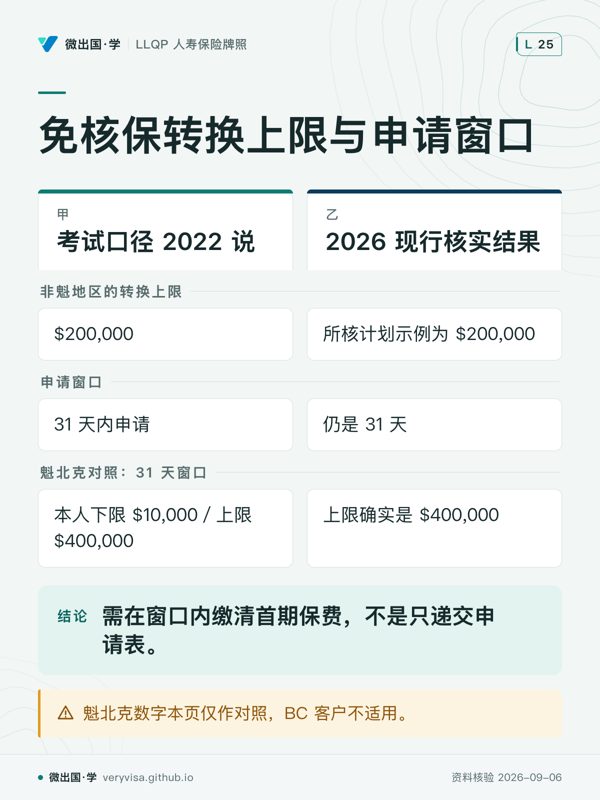
团体寿险这一章的现行数字集中在一个地方:离职转换权 。考试口径引用的 CLHIA Guideline G3 标注的发布年份是 2013 年,距今超过十年,团体寿险保额随薪资水涨船高,考试口径自己就提出了「这个上限有没有被通胀稀释」的疑问。本页这一节直接回官方与保险公司原文核实这个问题。
1. 考场与现行对照表:CLHIA G3 的 $200,000 / 31 天,十几年过去了还是这个数吗
公开的保险人须知能支持这些计划仍采用 $200,000 与 31 天,但不能证明行业十几年从未调整过。G3 列表页可见,最新详细条文未取得;柜台承诺以成员适用合同和保险人书面确认作依据。
ℹ️
65 岁边界要看具体合同
Canada Life 这份须知排除保障在 65 岁生日当天或以后终止者;这是该文件的条件,不能推广成所有保险人的统一禁令。Sun Life My Life Choice 的另一通道允许 65 岁或以下符合条件者申请,但要回答健康问题。两者不是同一种转换权,更不能只因一家公司有年龄限制就建议客户提前退休。
2. 考试口径自己前后不一致:转换窗口写的是 30 天还是 31 天
考试口径内部三处引用同一份 CLHIA 指引,天数却不完全一致:本章与另一处均写「31 天」,还有一处写「30 天」。这不是考试口径 vs 现行法的错位,是考试口径自己校对上的疏忽 ,本页处理原则是:采用两处独立佐证的「31 天」这一多数结论(也与本页核实到的三家官方文件一致),但提醒读者——考场遇到具体天数,一律以题干给出的合同条款数字为准,不要死记考试口径某一处的数字;柜台则永远翻回客户手上那份真实的福利手册,不假设是 30 还是 31。
3. BC 保费税与团体债权人险披露规则
保险保费税、部分省份的零售销售税及员工所得税是不同层次。考试口径列出的省级保费税区间与安省 8%、魁省 9%、曼省 7% 的销售税,应作为 2022 年考试口径表格理解,不凭一个转换表推定所有税种。BC 政府现行页明确:持牌保险人的寿险、意外及疾病保险保费税率为 2%,申报缴纳主体是保险人。这不是约 2% 的猜测,也不等于给员工再加一项 2% 应税福利。报价是否含税,应按保险人账单核对。
CLHIA 现行公开页确认债权人团体保险适用 Guideline G7,且法条优先于指引(CLHIA ,2026-09-05 真浏览器回读)。G7 详细条文(含考试口径引用的第 6(d) 项「收到证明后 20 天全额退款」)是会员限定内容;2022 年对 BC restricted licences 的提交 PDF 深链已死(302 到 clhia.ca 首页,Wayback 同 URL 不可达)。因此本页不把 20 天写成已核现行公开数字 。个人寿险的公开冷静期是另一条指引 G10 的 10 天,不要和 G7 混用。办理债权人团体险时仍须核当前团体合同。
4. 现行数字快照表
节末检索小测 · 先别往回翻,凭记忆作答 Quick recall check: answer from memory before scrolling back
Marcus, age 49, works in Victoria, BC and has $260,000 of basic group life coverage. His employment terminates on May 10, ending his group coverage that day. Under the standard industry guideline rules tested on the exam for non-Quebec provinces, what must Marcus do to exercise his conversion privilege without medical evidence, and how much can he convert?
49 岁的 Marcus 在 BC 省维多利亚工作,拥有 $260,000 的团体基础寿险保障。他的雇佣关系于 5 月 10 日终止,团体保障于当日结束。根据考试针对非魁北克省份考查的标准行业指引规则,Marcus 必须怎么做才能在不提供健康证明的情况下行使转换权,且最多能转换多少保额?
a He can convert the full $260,000 within 60 days without medical evidence, provided he also pays the 2% BC provincial premium tax directly to the government. ✗ 错误。落入『转换上限与窗口混淆』及『保费税主体混淆』陷阱:非魁省免核保转换上限为 $200,000(不能转全部 $260,000),标准转换窗口为 31 天而非 60 天,且 BC 省 2% 保费税由持牌保险人申报缴纳,不是员工直接向政府缴纳。 Falls into both the 'confusing conversion limits and windows' and 'misidentifying premium tax liability' traps. The non-Quebec non-medical conversion cap is $200,000 (meaning he cannot convert the full $260,000), the standard window is 31 days rather than 60 days, and the 2% BC premium tax is remitted by licensed insurers rather than paid by employees to the government.
b He can convert up to $200,000 without evidence of insurability if he submits the application and pays the first modal premium within 31 days of termination. ✓ 正确。依据 CLHIA Guideline G3 及现行核实标准,非魁省地区(含 BC)65 岁前终止保障时,免健康证明转换权(conversion privilege)上限为 $200,000 或原保额中较小者(故 $260,000 中可免核保转 $200,000),且须在 31 天窗口内提交申请并缴清首期保费。 Correct. Under CLHIA Guideline G3 and verified standards, when coverage terminates before age 65 in non-Quebec provinces (including BC), the conversion privilege without evidence of insurability is capped at the lesser of $200,000 or the prior group coverage (allowing Marcus to convert $200,000 of his $260,000), provided the application is submitted and the first modal premium is paid within 31 days.
c He can convert up to $400,000 without medical evidence as long as he mails the signed application form within 31 days, with the first premium due 20 days later. ✗ 错误。落入『魁省数字错配』与『漏看窗口内缴费条件』陷阱:$400,000 是魁北克省的转换上限而非 BC 省上限;且首期保费必须在 31 天转换窗口内缴清,不能只交申请表而延后缴费。 Falls into both the 'misapplying Quebec figures' and 'overlooking payment within the window' traps. The $400,000 cap applies solely to Quebec, not BC; furthermore, the first modal premium must be paid in full within the 31-day window rather than deferred after submitting the form.
d He cannot convert any coverage unless his employer cancels the entire master contract, because individual termination does not trigger a conversion privilege. ✗ 错误。落入『转换触发条件遗漏』陷阱:员工离职导致团体保障终止正是触发转换权(conversion privilege)的典型情形,并非只有整个主保单取消时才能转换。 Falls into the 'misidentifying conversion trigger events' trap. An individual employee's departure and resulting coverage termination is the classic scenario triggering the conversion privilege; conversion is not restricted solely to cancellations of the entire master contract.
看答案与每个选项的解析 Show the answer and why each option is right or wrong 答案 Answer :b
三、实务流程:从入职到离职,团体寿险这份保障怎么跟着一个人走 本节回答 This section answers 回答试用期与在职要求、高龄递减、家属险及AD&D比例 Clarifying probationary periods, actively-at-work requirements, late-age reductions, dependant life, and AD&D schedules. 本章考题 3 Question 3
1. 会籍资格:先过试用期,再看在职要求
新员工加入雇主团体计划前,通常要先满足发起人设定的资格条件——考试口径给出的常见试用期是 3 个月 。满足资格后,还有一道容易被忽略的门槛:在职要求(actively-at-work requirement)——须按合同判断员工是否满足 actively-at-work;病假、休假、正常休息日可能有不同处理,不能把所有不在办公室的情况都自动算作延后生效。这条规则的实务意义是:一个刚谈好入职、还没正式上班就出意外的人,团体寿险可能根本没生效。
2. 保额表的四种形式,以及退休后怎么递减
团体基础保额通常按下面四种形式之一设定,同一计划内也可以按职级分档(membership classes):薪资倍数 (如管理层 2 倍年薪、一线员工 1 倍年薪)、统一定额、服务年限挂钩(较少见)、以上组合。高薪员工的保额常设上限,避免逆选择集中在少数高保额会员身上。
退休或高龄会员的保额几乎都会递减——按固定比例、固定金额或逐年递减,通常到某个年龄(考试口径举例 70 岁)完全终止 。这条规则常被出成阶梯读表题,读题时要认清「递减的起点年龄」和「归零的终点年龄」这两个数,不要只记住有递减这件事。
3. 家属险与遗属收入给付:两笔容易混淆的钱
家属寿险(dependant life coverage) 是会员为配偶(含同居伴侣,不限异性)与符合合同年龄、在读或残疾受养条件的子女(考试口径示例:出生 14 天起、普通上限 18/19/21 岁、在读可至 23–25 岁;残疾延续须满足合同受养及证明条件)购买的附加保障。考试口径解释一些家属险采用统一家庭保费,不随合资格家属人数逐个增加;实务须先确认是否有家属、是否选择家庭保障及计费类别,不能假定无家属的人也必须付同样费用,也不在没有同条件报价时断言必定比个人险贵,这是一处常被出成「反直觉」考点的规则。
遗属收入给付(survivor income benefits) 是另一件事,通常自选购买,按月给付(不是一次性),配偶给付到 65 岁、再婚或身故为止,子女给付到特定年龄(在读可延长)。它和一次性身故金不是同一笔钱,而是叠加在身故金之外的按月生活费补贴。
4. AD&D:基础型自动给,自选型按单位买
意外身故与伤残险(AD&D)在团体计划里常见两种形式:基础型 随基础寿险自动提供;自选型按单位购买(如 $10,000 或 $25,000 一单位),因为只赔意外、不涉及疾病风险,通常免核保。家属 AD&D 常按会员本人保额的固定百分比给付,考试口径示例是「配偶单独覆盖为 50%,若同时覆盖配偶与子女则配偶降为 40%、每名子女 15%」——这类百分比表是读表计算题的常见形态。
5. 代理人在这条链上做什么
节末检索小测 · 先别往回翻,凭记忆作答 Quick recall check: answer from memory before scrolling back
Nadia is covered for $100,000 under her employer's group life and AD&D plan, which includes family AD&D coverage using the standard exam percentages and a flat-rate dependant life benefit. Nadia is married and has two eligible children aged 6 and 9. If her spouse and one child both die in a car accident, what is the spouse's AD&D benefit and how is Nadia's dependant life premium determined?
Nadia 在雇主的团体寿险及意外身故与伤残险(AD&D)计划下享有 $100,000 保额,该计划包含采用标准考试口径百分比的家属 AD&D 保障以及统一费率的家属寿险。Nadia 已婚并育有两名分别为 6 岁和 9 岁的合资格子女。如果她的配偶和一名子女在车祸中双双身故,配偶的 AD&D 给付是多少,且 Nadia 的家属寿险保费是如何确定的?
a The spouse's AD&D coverage is $50,000, and Nadia's dependant life premium increases proportionally for each additional child covered. ✗ 错误。落入『AD&D 有无子女比例混淆』与『家属险按人头加费』两个陷阱:50% 仅适用于只覆盖配偶、无子女的情形;且采用统一家庭保费(flat family rate)的家属寿险不随合资格子女人数逐个增加保费。 Falls into both the 'confusing AD&D percentages based on child coverage' and 'per-head dependant premium surcharge' traps. The 50% schedule applies only when covering a spouse with no eligible children; furthermore, flat-rate dependant life premiums do not increase with each additional child.
b The spouse's AD&D benefit is $40,000 (the child's is $15,000), and the flat-rate dependant premium does not rise with the number of children. ✓ 正确。按考试口径的家属 AD&D(dependant AD&D)示例,当同时覆盖配偶与子女时,配偶保额为会员保额的 40%($40,000)、每名子女为 15%($15,000);同时,采用统一家庭费率的家属寿险(dependant life coverage)保费不随合资格家属人数逐个增加。 Correct. Under the exam dependant AD&D schedule, when both a spouse and children are covered, the spousal benefit is 40% of the member's face amount ($40,000) and each child's benefit is 15% ($15,000); simultaneously, dependant life coverage with a flat family rate does not charge higher premiums for having more eligible dependants.
c The spouse's AD&D coverage is $40,000, but it is paid only as a monthly survivor income benefit until the surviving child turns 18. ✗ 错误。落入『AD&D 与遗属收入给付概念混淆』陷阱:家属 AD&D 是一次性意外身故给付,而按月发放的是另一项自选购买的遗属收入给付(survivor income benefits)。 Falls into the 'confusing AD&D with survivor income benefits' trap. Dependant AD&D is a lump-sum accidental death benefit, whereas monthly income is provided through a separate, optional survivor income benefit.
d The spouse's AD&D coverage is $25,000, and children are only eligible for dependant coverage after they reach age 14. ✗ 错误。落入『年龄单位记混』陷阱:子女符合家属寿险资格的起点年龄示例是出生满 14 天(14 days),而非 14 岁;配偶在有子女时的 AD&D 比例示例是 40%($40,000)而非 25%。 Falls into the 'confusing age units' trap. The exam example establishes that children become eligible for dependant life coverage from 14 days of age, not 14 years; additionally, the spousal AD&D percentage when children are covered is 40% ($40,000) rather than 25%.
看答案与每个选项的解析 Show the answer and why each option is right or wrong 答案 Answer :b
四、2026 市场:谁在管理团体寿险,柜台怎么说 本节回答 This section answers 回答核保宽松度与保额上限反向排列、团体险经纪与TPA角色 Summarizing the inverse relationship between underwriting leniency and coverage limits, alongside the roles of group brokers and TPAs.
以下内容均于 2026-09-04 从各机构官方页或官方文件直接核实或交叉核实;促销数字、具体保费费率不写。
Canada Life、Manulife、Sun Life 都提供团体福利及离开计划后的保险安排。本页引用的是各自公开须知;表格格式不同不证明没有法律约束。行业指引、适用法律和具体合同是不同依据:合同中的转换承诺也不能因为起源于自律指引就被当成可随意撤回。
Sun Life 的「My Life Choice」 是核实到的一个值得记住的产品形态:不同于免核保的标准转换选项,它需要回答几个简化健康问题,换来的是更高的上限($1,000,000)与更长的窗口(60 天)。它解决考试口径里的哪个概念:这正是考试口径反复强调的「保障强度与核保宽松度呈反向排列」在团体转个人这个场景下的具体版本——愿意多回答几个问题,就能换到远高于 $200,000 免核保上限的保障,而不必再走一次完整的新单核保。
团体险经纪与第三方管理商(TPA) 是本章第一节提到的「计划发起」背后另一层职业分工:雇主通常不会自己去跟保险公司谈判条款,而是通过专门的团体险经纪或全国性顾问公司完成计划设计、续保谈判与理赔行政。它解决考试口径里的哪个概念:考试口径把「投保人是雇主」写成一句陈述,但没有展开雇主自己往往也缺乏精算与理赔行政能力——这正是团体险经纪这个职业存在的理由,也是零售个人险代理人与团体险代理人两条不同职业路径的分水岭。
BC 持牌保险人的保险保费税由保险人申报缴纳;这与雇主支付团体寿险保费形成的个人应税福利是两件事,不能互相替代(BC 省政府 )。本文不作全国各省销售税比较,也不推断监管机关未发布执法行动。
节末检索小测 · 先别往回翻,凭记忆作答 Quick recall check: answer from memory before scrolling back
A medium-sized employer in BC wants to set up a group life plan and also asks how departing employees who want more than the $200,000 non-medical conversion limit are handled in the market. Based on the relationship between underwriting requirements, coverage limits, and group plan administration, which explanation is accurate?
BC 省一家中型雇主希望设立团体寿险计划,并询问市场上如何处理离职员工想要高于 $200,000 免体检转换上限的需求。基于核保要求、保额上限与团体计划管理之间的关系,下列哪项解释是准确的?
a Employers typically negotiate directly with actuaries without intermediaries, and departing employees can never obtain more than $200,000 from a group insurer even if they answer health questions. ✗ 错误。忽略了团体险经纪与第三方管理商(TPA)在计划设计与续保中的核心角色,且市场上有通过回答简化健康问题换取更高转换上限和更长窗口的通道。 Overlooks the central roles of group insurance brokers and third-party administrators (TPAs) in plan design and renewals, and ignores market pathways that offer higher conversion limits and longer windows in exchange for answering simplified health questions.
b Brokers or TPAs help employers design and run plans, and options that ask simplified health questions can offer more than the non-medical limit and a longer window. ✓ 正确。雇主通常借助团体险经纪或第三方管理商(TPA)完成计划设计、续保谈判与理赔行政;同时,遵循『保障强度与核保宽松度呈反向排列』逻辑,愿意回答简化健康问题的通道可换取高于 $200,000 免核保上限的保额与更长申请窗口(如 60 天)。 Correct. Employers typically rely on group insurance brokers or third-party administrators (TPAs) for plan design, renewal negotiations, and claims administration; simultaneously, reflecting the principle that coverage limits correlate inversely with underwriting leniency, pathways requiring simplified health questions can provide coverage exceeding the $200,000 non-medical cap alongside a longer application window (such as 60 days).
c Contractual conversion commitments can be revoked at any time by the insurer without notice simply because they originated from an industry guideline. ✗ 错误。行业指引、适用法律和具体合同是不同依据,写入合同中的转换承诺(conversion privilege)具有合同约束力,不能因为起源于行业自律指引就被当成可随意撤回。 Industry guidelines, applicable statutes, and specific contracts are distinct authorities; conversion commitments incorporated into a contract are legally binding and cannot be treated as revocable at will simply because they originated from self-regulatory industry guidelines.
d The 2% BC provincial insurance premium tax paid by the insurer replaces the employee's personal income tax obligation on employer-paid group life premiums. ✗ 错误。落入『保费税与个人应税福利混淆』陷阱:保险人申报缴纳的 2% 省级保险保费税与雇主支付保费形成的员工个人应税福利(taxable benefit)是完全独立的两件事,不能互相替代。 Falls into the 'confusing premium taxes with personal taxable benefits' trap. The 2% provincial premium tax remitted by the insurer and the employee taxable benefit created by employer-paid premiums are entirely distinct and cannot substitute for one another.
看答案与每个选项的解析 Show the answer and why each option is right or wrong 答案 Answer :b
五、考试口径背景与今天办理时要分清的依据 本节回答 This section answers 回答考试口径与现行合同依据的区分、魁省与BC规则不混用 Distinguishing exam standards from governing contract terms and avoiding cross-applying Quebec rules to BC.
考试口径把非魁省转换安排的行业指引来源与魁省成文规则相对照。这能解释规则的出处,却不能证明非魁省成员没有法律保护;BC 已有取阅主保单及保障证明等法定权利。至于某成员的转换额度、资格及期限,还须回到其合同,不以一家公司须知代替全省规则。
考试口径中的 $10,000–$400,000 魁省区间保留为考试背景,现行 Manulife 表确认其魁省组合上限 $400,000。本页没有把这份表当成整部魁省法的核验,也不把魁省条件搬给 BC 客户。
Canada Life 和 Manulife 所引文件带有旧版本日期,目前能从官方渠道取得,只能证明文件中的安排,不能独自证明 G3 在十几年间每个版本均未改变。Sun Life 的公开页则让读者看到两条不同路径:31 天保证转换,以及 60 天内回答健康问题申请 My Life Choice。办理时应并列比较资格、保额、价格和终止年龄;不要为了等后一条通道的答复而错过前一条窗口。
节末检索小测 · 先别往回翻,凭记忆作答 Quick recall check: answer from memory before scrolling back
An advisor in BC is helping a departing group member who wants to know whether to rely on Quebec's $10,000 to $400,000 statutory conversion range or whether she has two different post-employment continuation pathways with 31-day and 60-day deadlines. How should the advisor apply the rules?
BC 省一名顾问正在协助一位即将离职的团体成员,该成员想知道是否应依据魁北克省 $10,000 至 $400,000 的成文转换区间,以及面对 31 天免核保转换和 60 天简化健康问卷两条不同通道时该如何抉择。顾问应如何适用规则?
a Apply Quebec's $400,000 limit to the BC member because non-Quebec provinces have no statutory protections of any kind in group insurance. ✗ 错误。落入『魁省条件搬给 BC 客户』与『误以为 BC 无法定权利』陷阱:魁省 $400,000 上限不适用于 BC 客户,且 BC《Insurance Act》已赋予成员查阅主保单及获得保障证明等法定权利。 Falls into both the 'applying Quebec rules to BC clients' and 'assuming BC lacks statutory rights' traps. Quebec's $400,000 cap does not apply to BC members, and the BC Insurance Act grants statutory rights including inspecting the master policy and receiving certificates of insurance.
b Wait until day 55 to see if the 60-day simplified-health application is approved before deciding whether to apply for the 31-day guaranteed conversion. ✗ 错误。落入『错过 31 天保证转换窗口』的实务陷阱:31 天保证免核保转换窗口一旦届满即丧失,绝不能为了等 60 天简化核保通道的答复而错过前一条 31 天保证转换窗口。 Falls into the practical trap of forfeiting the 31-day guaranteed conversion window. The 31-day non-medical conversion privilege expires permanently once the window closes, so a client must never let that deadline lapse while waiting for an answer from a 60-day simplified-underwriting pathway.
c Check her own group contract for limits and deadlines, and weigh the 31-day guaranteed conversion against any 60-day health-question option without missing day 31. ✓ 正确。不能把魁省规则套用给 BC 客户,也不能用单一公司须知代替全省规则;实务中应核对成员的具体团体合同(master contract),并列比较资格、保额、价格与终止年龄,且绝不能因等待 60 天通道答复而错过 31 天保证转换(conversion privilege)窗口。 Correct. Quebec rules cannot be applied to BC clients, nor can a single insurer's guideline replace governing contract terms; advisors must verify the member's specific master contract, compare eligibility, coverage amounts, pricing, and termination age across options, and never miss the 31-day guaranteed conversion window while waiting on a 60-day pathway.
d Ignore the group contract wording altogether, because CLHIA Guideline G3 automatically overrides the terms of every group policy issued in BC. ✗ 错误。落入『行业指引凌驾于法条与合同』陷阱:法条优先于行业指引,且具体成员的转换额度、资格及期限必须回到其适用合同与保险人书面确认核对。 Falls into the 'assuming industry guidelines override statutes and contracts' trap. Statutes take precedence over industry guidelines, and an individual member's conversion limits, eligibility, and deadlines must always be verified against their governing contract and insurer written confirmation.
看答案与每个选项的解析 Show the answer and why each option is right or wrong 答案 Answer :c
六、案例:三个最容易在柜台上问到、也最容易在考场上算错的场景 本节回答 This section answers 回答31天转换实算、分级应税福利计算及65岁退休核对 Analyzing practical 31-day conversion calculations, tiered taxable benefit calculations, and age 65 retirement verification. 本章考题 4 Question 4
案例 A:离职后 31 天要做的事(示例)
素里的软件工程师 Wei,在一家中型科技公司工作五年,团体基础寿险保额是年薪的 2 倍,即 $180,000 。公司突然裁员,他最后一个工作日是 9 月 4 日。
适用规则 :假设合同确认保障于 9 月 4 日终止,Wei 未触及该计划年龄限制,申请及首期保费须在此后 31 天内送达(本例截止 10 月 5 日,具体收件截止时间向保险人确认),上限是 $200,000 或原保额中较小者。
结果 :他的原保额 $180,000 低于 $200,000 上限,可以全额转换,不需要体检、不需要回答健康问题,但转换后的个人保单保费会按他现在的年龄重新计算,通常明显高于团体保费。
常见错法 :① 以为团体离职后保障立刻结束、什么都做不了——忽略了转换权这条兜底;② 以为只要在 31 天内「决定要转换」就够了——考试口径与官方须知都强调必须在窗口内缴清首期保费,不是只递交表格;③ 以为 $200,000 是「另外多给的一笔钱」——它是转换额度的上限,不是保额本身会变成 $200,000。
案例 B:会籍分级与应税福利算在一起算(示例,组合 §一.4 与 §三.2)
列治文一家物流公司的团体计划规定:管理层保额为年薪 2 倍,一线员工为年薪 1 倍,保费由公司支付 70%、员工自付 30%。仓库主管 Priya 年薪 $80,000,按管理层类别计算基础保额 $160,000 ,用于本例计算的年度应税福利成本为 $960,员工支付 $288,假设无其他税费、退款或费率调整(实际团体定期寿险须依 CRA 公式计算)。
适用规则 :① 会籍分级决定保额——Priya 属管理层,按 2 倍年薪算;② 谁付保费决定税——公司支付的 70%($672)是 Priya 当年的应税福利,计入她的 T4;员工自付的 30%($288)不产生应税福利,但也不可抵扣。
结果 :Priya 的团体寿险保额是 $160,000,当年因公司代付保费而增加的应税收入是 $672。如果她今年身故,受益人拿到的 $160,000 身故金全额免税,与她生前是否为这份保费缴过税完全无关。
常见错法 :① 把「应税福利」和「身故金要交税」混为一谈——两者是完全不同的两件事,一个发生在缴费阶段,一个发生在给付阶段,寿险身故保险金本金通常免所得税;② 忘记按会籍分级算保额,直接套用「1 倍年薪」的一线员工标准。
案例 C:65 岁那年离职,转换权还在不在(示例,呼应第二节的官方核实结果)
本拿比一家制造企业的品控经理 Marco,原计划在 65 岁生日当天正式退休。他的团体基础寿险保额是 $250,000。
适用规则 :先确认 Marco 的保单是否适用 Canada Life 所引的年龄限制,以及最后工作日、退休日和保障终止日是否相同。仅知道他准备在 65 岁生日退休,还不能断定失去转换权。
结果 :代理人应在退休前取得书面条款及报价,同时比较退休后延续、保证转换和其他符合资格的产品。如果确实适用 $200,000 上限,原保额中 $50,000 的缺口还要另作安排;不能承诺原保额全部无条件延续。
常见错法 :把一家公司的 65 岁限制说成全行业禁令,或直接要求客户提前退休。退休日期涉及养老金和雇佣福利,不能只靠一个保险上限决定。
节末检索小测 · 先别往回翻,凭记忆作答 Quick recall check: answer from memory before scrolling back
Devon is a department director at a BC distribution firm earning $90,000 per year. Under the group plan's membership classes, directors receive basic life coverage of 2 times annual salary while general staff receive 1 times salary. The total annual premium for Devon's basic life coverage is $1,000, of which the employer pays 80% and Devon pays 20%. If Devon dies while employed this year, what are the tax and benefit amounts?
Devon 是 BC 省一家分销公司的部门总监,年薪 $90,000。根据团体计划的会籍分级,总监级别享有 2 倍年薪的基础寿险保额,普通员工为 1 倍年薪。Devon 基础寿险的全年总保费为 $1,000,其中雇主支付 80%,Devon 自付 20%。如果 Devon 今年在职期间身故,税务和保险金数额分别是多少?
a Devon's taxable benefit this year is $800, and his beneficiary receives a $180,000 tax-free death benefit. ✓ 正确。按会籍分级(membership class),总监保额为 2 倍年薪即 $180,000;雇主代付的 80% 保费($800)计入 Devon 当年的应税福利(taxable benefit),而受益人领取的 $180,000 寿险身故保险金本金全额免所得税。 Correct. Under the plan's membership classes, directors receive 2 times annual salary ($180,000 of coverage); the 80% premium portion paid by the employer ($800) is reported as a taxable benefit on Devon's T4, while the $180,000 life insurance death benefit principal received by the beneficiary is fully exempt from income tax.
b Devon's taxable benefit this year is $1,000, and his beneficiary receives a $90,000 tax-free death benefit. ✗ 错误。落入『漏看会籍分级』与『把员工自付保费也算进应税福利』两个陷阱:Devon 属于总监分级(2 倍年薪 $180,000 而非普通员工 1 倍 $90,000),且自付的 $200 不属于应税福利。 Falls into both the 'overlooking membership classes' and 'including employee contributions in taxable benefits' traps. Devon belongs to the director class (2 times salary, or $180,000, rather than general staff's 1 times salary, or $90,000), and his own $200 contribution is not a taxable benefit.
c Devon has no taxable benefit on the premiums, but 80% of the $180,000 death benefit ($144,000) is taxable to his beneficiary. ✗ 错误。落入『跨险种税务方向记反』陷阱:把保费端应税与给付端免税颠倒,且错误地按雇主出资比例对寿险身故金征税。 Falls into the 'inverting cross-line tax treatment' trap. Inverts the rule by making premiums non-taxable and the benefit taxable, and erroneously taxes the life insurance death benefit in proportion to employer funding.
d Devon can deduct his $200 premium payment, and his beneficiary receives $200,000 because the conversion limit automatically increases his coverage. ✗ 错误。落入『员工保费不可抵扣』与『把 $200,000 转换上限当成保额本身』陷阱:员工自付保费不可抵扣,且 $200,000 是离职转换上限,不会把在职 $180,000 保额自动调高到 $200,000。 Falls into both the 'assuming employee premiums are deductible' and 'treating the $200,000 conversion cap as coverage' traps. Employee-paid premiums are not deductible, and $200,000 is a post-termination conversion ceiling that does not automatically increase active coverage from $180,000 to $200,000.
看答案与每个选项的解析 Show the answer and why each option is right or wrong 答案 Answer :a
七、考试陷阱与考场与现行对照清单 本节回答 This section answers 回答十大常见陷阱辨析与考场vs柜台四项双口径处理原则 Identifying ten common exam traps and distinguishing exam standards from sales practice across four dual benchmarks.
以下每条对应团体寿险这一考点常见的陷阱形态,按版权边界只写形态,不复述任何官方题干。
把「谁付保费决定税」的方向和团体伤残险记反 (陷阱形态:跨险种规则混淆)。团体寿险是保费端收税、寿险身故保险金本金通常免所得税;团体伤残险是给付端收税、看的是保费谁出的。题干出现「雇主全额支付团体寿险保费」,正确方向是「员工产生应税福利,身故金依旧免税」,不是「给付要交税」。
员工全额自付就以为给付「更免税」 (陷阱形态:多加了一个不存在的条件)。团体寿险的身故保险金本金通常免所得税,不论保费是谁付的——员工自付只影响「保费端有没有应税福利」这一步,不影响给付本身。
把 $200,000 当成保额本身,而不是转换上限 (陷阱形态:概念偷换)。$200,000 是能免核保转换过去的额度上限,原保额如果本来就低于这个数,是全额转换;原保额超过这个数,超出部分转不过去。
忽略 65 岁这个隐藏门槛 (陷阱形态:漏看条件)。考试口径写「65 岁前/时」,容易被读成「65 岁当天还来得及」,Canada Life 所引须知排除当天或之后终止者,其他产品逐份核对。
团体转换窗口天数记混 (陷阱形态:考试口径内部矛盾未识别)。考试口径三处引用同一份指引,天数不完全一致(多数处写 31 天)。考场遇到具体天数以题干为准,不要死记某一处的数字。
家属险保费「因家属人数而变」 (陷阱形态:常识替代规则)。题干若设统一家庭费率,才按合资格家庭计费;无家属者是否付费另看计划——直觉上「孩子越多风险越大、保费该越高」,在这一处恰恰不成立。
推定自选追加保额也不用核保 (陷阱形态:范围扩大)。免健康证明取决于计划的基本或追加额度、参保资格和限定窗口;超过限定期之后再申请自选追加,需要走核保程序。
误以为福利手册就是总合同 (陷阱形态:概念偷换)。BC 成员也可按 Insurance Act s41(5)(b) 向保险人请求查阅及取得主保单副本,受合理通知、隐私及索赔相关性限制。
计划终止时把「保额降低」和「资格丧失」混淆 (陷阱形态:程度错配)。发起人终止某个会籍类别时,该类别会员在新计划下是直接失去资格,不是保额打折,须比较适用的转换、延续或重新核保路径。
把遗属收入给付当成身故金的一部分 (陷阱形态:概念混淆)。遗属收入给付是另外自选购买、按月发放的补贴,不是一次性身故金本身的组成部分。
考场与现行对照清单(考场 vs 柜台) :① CLHIA G3 转换上限——考场按题干与考试口径,柜台依实际合同;本页所核多个示例采用 $200,000,未取得 G3 详细最新版本,不声称十几年每版未变;② 转换窗口天数——考试口径内部 30 与 31 天并存,考场按题干,柜台翻福利手册;③ 65 岁与转换权的关系——柜台逐份核对,所引 Canada Life 须知不包含 65 岁当天或之后终止者,考场若题干未给出这条细节,按考试口径「65 岁前/时」的字面意思作答;④ 谁付保费决定税——两侧口径一致,没有考试口径与现行的错位,只有与团体伤残险的跨险种混淆风险。
边学边测 :本章题库共 52,覆盖三层难度并含两道税务判断题。
节末检索小测 · 先别往回翻,凭记忆作答 Quick recall check: answer from memory before scrolling back
An employer in BC amends its group life master contract to eliminate the membership class for part-time warehouse clerks, while keeping the rest of the group plan active. Clara, a part-time clerk who is healthy and working, also had optional survivor income benefits on her coverage. Which statement accurately avoids the common exam traps regarding Clara's situation?
BC 省一家雇主修改其团体寿险总合同,取消了兼职仓库文员这一会籍分级,同时保留团体计划的其余部分继续有效。Clara 是一名健康且在岗的兼职文员,她此前还附带自选了遗属收入给付。关于 Clara 的情况,下列哪项陈述准确避开了常见考试陷阱?
a Eliminating her membership class merely reduces Clara's coverage by half, and survivor income benefits are simply a partial lump-sum advance of her basic death benefit. ✗ 错误。同时落入『把资格丧失当成保额降低』和『把遗属收入给付当成身故金一部分』两个陷阱:取消某会籍类别会导致该类别成员失去参保资格而非保额减半;遗属收入给付(survivor income benefits)是按月发放的独立补贴,不是一次性身故金的组成部分。 Simultaneously falls into both the 'confusing loss of eligibility with benefit reduction' and 'treating survivor income as part of the death benefit' traps. Eliminating a membership class terminates coverage eligibility rather than cutting coverage in half; furthermore, survivor income benefits are independent monthly payments rather than components of the lump-sum death benefit.
b Clara loses eligibility when her class ends, so she should get notice of termination and conversion options, and survivor income is a separate monthly benefit. ✓ 正确。发起人取消某会籍分级(membership class)时,该类别会员在新计划下直接失去参保资格(而非保额打折),应取得生效日、原保障结束日及转换权(conversion privilege)通知;同时遗属收入给付(survivor income benefits)是叠加在一次性身故金之外按月发放的独立给付。 Correct. When a plan sponsor eliminates a membership class, affected members lose plan eligibility entirely (rather than experiencing a percentage reduction) and must receive notice regarding the effective date, prior coverage termination date, and conversion options; additionally, survivor income benefits are separate monthly income supplements paid on top of the lump-sum death benefit.
c Because the employer did not cancel the entire master contract, Clara has no conversion rights and cannot request to see the master policy wording in BC. ✗ 错误。落入『误以为只有整个计划取消才有权利』与『否定 BC 法定查阅权』陷阱:会员因会籍类别取消而终止保障时需核对转换或延续衔接,且 BC《Insurance Act》赋予成员查阅主保单副本的权利。 Falls into both the 'assuming rights exist only upon total plan cancellation' and 'denying BC statutory inspection rights' traps. Members whose coverage terminates due to class elimination must evaluate conversion or continuation options, and the BC Insurance Act grants members the right to inspect and obtain copies of the master policy.
d If Clara had been on approved disability waiver of premium before the class was eliminated, her waiver and coverage would immediately be wiped out with no further insurer liability. ✗ 错误。落入『假定计划变动将已有伤残豁免一笔注销』陷阱:对于已处于伤残保费豁免(waiver of premium)或已发生索赔的会员,即使雇主调整或终止合同,其豁免与保障仍须持续或核对责任归属,不能假定一笔注销。 Falls into the 'assuming plan amendments cancel existing premium waivers' trap. For members already on an approved disability waiver of premium or with existing claims, waiver and coverage rights must continue or have liability established between insurers even if the employer modifies or terminates the contract, rather than being summarily wiped out.
看答案与每个选项的解析 Show the answer and why each option is right or wrong 答案 Answer :b
术语双语表
本页的适用边界
G7 公开页只确认债权人团体保险有行业指引;20 天冷静期正文目前拿不到公开全文(会员限定 + 2022 提交 PDF 死链)。具体团体债权人合同、银行销售披露与投诉渠道应按销售机构及当期文件核对。本文没有把未搜索到执法案例解读为没有监管义务。
延伸阅读
论坛全文:加拿大团体保险离职转个人险:先锁住期限,再比较保费
来源
本页知识卡 不看正文也能拿到这一节的核心内容:先看导读,再看图。点图放大,左右翻页。
放大 ⤢ 具体上限以自己的福利手册为准。 先看 先横看两栏同一行,区分考试口径和现行核实。易漏 65 岁边界要看具体合同,不能推广成所有保险人的统一禁令。下一步 去练习,遇到计划差异时核成员适用合同和保险人书面确认。详情与分享 → 放大 ⤢ 寿险身故保险金本金通常免所得税,附带利息另判。 先看 先比较雇主出资在两种险种里的税务后果,别混着记。易漏 WLRP 不是按雇主与员工保费比例切分给付;员工全额自付另按条件判断。下一步 去模考,先圈出险种,再找保费是谁出的。详情与分享 → 本站依据官方原文自撰 · 出处见正文链接