🃏 Flashcards · 3 闪卡 · 3 张 🖼 Slides · 4 幻灯 · 4 页 ✍️ Questions · 7 刷题 · 7 道
T1 个人所得税基础 T1 basics P2 稳住 P2 Hold steady
ZH EN ZH + EN
先看这一章怎么考 First, how this chapter is tested
老年额递减计算题:2026 税年老年额上限 9,208 元、递减起点 46,432 元,超出部分按 15% 线性递减至归零。 Age amount phase-out calculation: for the 2026 tax year the age amount maximum is $9,208, the phase-out starts at $46,432, and the excess is reduced at 15% in a straight line until it reaches zero. 养老金收入额 65 岁合格分水岭判断题:重点考查 RRIF 提款在未满 65 岁(仅限配偶身故继承)与年满 65 岁后的资格转换,以及 CPP/OAS 永远不合格的法律边界。 Judging the age 65 dividing line for the pension income amount: tests how RRIF withdrawals qualify before age 65 (only through inheritance on a spouse's death) and after age 65, and the legal boundary that CPP/OAS never qualify. T1032 退休收入分割与边际税率及福利递减联动题:考查转满 50% 并非最优解的深层机制,重点测试转入方净收入增加对自身老年额削减与 OAS 回收税触发的逆向冲击。 T1032 retirement income splitting linked to marginal rates and benefit reductions: tests the deeper mechanism that transferring the full 50% is not optimal, especially the reverse impact of the receiving spouse's higher net income on their own age amount reduction and on triggering the OAS recovery tax. 最常丢分的陷阱(看到题干信号就警觉) Traps that cost the most marks (watch for the signal in the stem)
老年额超额全扣陷阱 Age amount fully lost above the threshold 题干给出 65 岁以上纳税人净收入在 5 万至 8 万元之间,问可申报的老年额,选项里有直接写 0 的干扰项。 The stem gives a taxpayer over 65 with net income between $50,000 and $80,000 and asks for the age amount claimable, with a distractor option that simply says 0. 未满65岁RRIF抵免陷阱 The RRIF credit under age 65 题干明确指出纳税人年龄在 60 至 64 岁之间,主要收入为自身 RRSP 转成的 RRIF 提款,询问 line 31400 抵免额。 The stem states that the taxpayer is between 60 and 64, with income mainly from RRIF withdrawals from his or her own converted RRSP, and asks for the Line 31400 credit. 退休收入分割无脑转满半数陷阱 Blindly transferring half in income splitting 题干描述一方高收入另一方已有适度收入且领取 OAS,询问最优 T1032 申报策略及为什么不直接转让 50%。 The stem describes one high-income spouse and another who already has moderate income and receives OAS, and asks for the best T1032 filing strategy and why not simply transfer 50%. 本章考点页:导图、要点表、7 道带逐项解析的练习 →
核实日期:2026-10-30|本页口径:2026 税年(2027 年 2–4 月申报) 。本页大量数字来自 CRA 与省府现行页,逐年指数化的门槛与十几年未动的长青数字并存,180 天复核一次(下次 2027-01-31);出处见文末来源。
一位纳税人一旦跨过 65 岁,报税表上至少有三处规则会跟着换挡:能不能拿老年额(line 30100)、养老金收入额(line 31400)认不认某一笔收入、退休收入分割(T1032)能分多少。这三处换挡各自挂在不同的法条上,互不隶属,却经常被读者当成同一件事记。本页只讲这三个开关,以及围着它们转的一圈周边规则——GIS 要不要报、CPP 给付分享和 T1032 分割怎么分工、OAS 回收线怎么用 T1213(OAS) 缓一缓、无障碍改造与残障额怎么报最不吃亏。养老金收入本身该落哪张 slip、哪一行,以及 RRIF 71 岁那一年的操作细节,见 ca-core-05-pension-investment-income 与 ca-invest-03-rrsp-tfsa-fhsa,本页不重复,只讲那两页没有展开的部分。这一页帮你算出任意净收入下的老年额;判断一笔养老金收入未满 65 岁时算不算数;看懂 T1032 转多少才是家庭最优,而不是简单转满 50%;分清 CPP 给付分享和退休收入分割该用哪一个;也说明无障碍改造、残障额、护理院费用这几张表之间哪些能叠加、哪些不能。
一、制度设计与底层逻辑:为什么偏偏是 65 岁 本节回答 This section answers 理解老年额补偿与防套利立法动机及CRA与ESDC分工 The legislative motives for the age amount and anti-arbitrage, and the division of work between the CRA and ESDC
《所得税法》里没有一条统一的「65 岁条款」,而是好几条互不相干的条文各自选中了 65 岁这个年龄——这不是巧合,是三种完全不同的立法动机凑到了同一个数字上。老年额(s.118(2))的动机是收入能力补偿 :退休后收入通常来自养老金与投资,不再享有在职者的加拿大就业额(Canada employment amount)与部分雇主福利,老年额是对这块空缺的部分补偿,同时按净收入递减,只补给真正需要的人,高净值退休者拿不到。养老金收入额(s.118(3))与「合格养老金收入」的定义(s.118(7))动机不同,是防止套利 :如果任何年龄的 RRIF 提款都能拿 $2,000 抵免,一个还在工作、尚未退休的人只要把小额 RRSP 转成 RRIF 逐年提一点,就能年年凭空多一项抵免——立法者用「未满 65 岁只认雇主养老金定期给付」把这条路堵死,只有真正到了法定退休年龄,或者因配偶身故被迫接手养老金收入,才放开 RRIF/RRSP 年金这一类。退休收入分割(T1032,s.60.03)的动机又不同,是缓解单一收入来源退休家庭的累进税负 (详见第五节),它本身不设年龄门槛,只卡「收入本身合不合格」——而哪些收入合格,同样按 65 岁分两套(见 2.2)。
三条规则背后站着三个不完全一致的利益方。纳税人要的是把家庭总税负降到最低;CRA 要防的是同一笔递延多年的注册账户资金,被包装成看似合格的收入去骗抵免或骗分割;而 ESDC(老年保障金 OAS、保障收入补助 GIS、CPP 的行政机关)站在第三个角度——它管的是普惠与济贫 两条线,OAS 靠居住年限普惠发放但对高收入者按 15% 回收,GIS 专门济贫且完全按收入递减,这两条线都不关心纳税人内部怎么分钱,只关心纳税人真实的、经年度核实的净收入。这也是为什么本页反复出现「按个人净收入算」与「按家庭合计净收入算」的区分——同一个动作(比如 T1032 分割)在 CRA 的抵免体系里可能重新分配了税负,在 ESDC 的普惠/济贫体系里却完全不影响家庭合计能拿到多少。
法律后果这一侧,三件事最容易被低估。第一,残障额(disability amount, line 31600/31800)以 Form T2201 的CRA 事前核准 为前提,这是一次行政决定,不随年度报税重新判断,当年没有已核准的 T2201 就无法首次申报,只能先按无该项申报、核准后再申请调整。第二,OAS 回收税算错不会让人「侥幸躲过」,它在年度评税时用当年实际净收入重新核算,多扣的会退、少扣的会连本带利追缴。第三,T1032 的联合选择一旦错报(比如把 OAS/CPP 也算进合格收入),错误部分会被评税时剔除,两个人的报税表都要跟着重新算,情节严重的还会触发利息。
节末检索小测 · 先别往回翻,凭记忆作答 Quick recall check: answer from memory before scrolling back
Under Canadian tax policy, different statutory provisions select age 65 for fundamentally different legislative purposes. What was Parliament's specific legislative motive for restricting the pension income amount (line 31400) primarily to employer RPP life annuities prior to age 65, while expanding it to RRIF and RRSP annuities only after age 65?
在加拿大税收政策中,不同法定条款选中 65 岁有着截然不同的立法动机。议会将养老金收入额(line 31400)在 65 岁前主要限制在雇主 RPP 人寿年金定期给付、而在 65 岁后才放开至 RRIF 与 RRSP 年金的具体立法动机是什么?
a To encourage early retirement by incentivizing workers under 65 to prematurely draw down their registered retirement savings. ✗ 错误。加拿大税收政策旨在鼓励持续储蓄防老,绝非鼓励在职劳动者过早提空注册账户资金。 Incorrect. Canadian tax policy aims to encourage continuous saving for old age and certainly not to encourage workers to empty registered accounts too early.
b To block arbitrage: workers could turn a small RRSP into a RRIF and draw a little each year just to get the credit. ✓ 正确。第一节明确指出:养老金收入额(pension income amount, s.118(3)/(7))在 65 岁前严格限定范围的动机是防止套利(prevent tax arbitrage)。如果任何年龄的 RRIF 提款都能享受 $2,000 抵免,在职员工只要把小额 RRSP 转成 RRIF 每年提取一点,就能凭空虚增一项税收抵免;因此立法者用「未满 65 岁只认雇主养老金定期给付」封堵了这一漏洞。 Correct. Section 1 states clearly that the motive for strictly limiting the scope of the pension income amount (s.118(3)/(7)) before age 65 is to prevent tax arbitrage. If RRIF withdrawals at any age could get the $2,000 credit, an employee could simply convert a small RRSP into a RRIF and withdraw a little each year to create a tax credit out of thin air; legislators closed this loophole by recognizing only employer pension periodic payments under 65.
c To allow ESDC to accelerate the clawback of Old Age Security benefits from younger registered account holders. ✗ 错误。OAS 是面向 65 岁及以上长者的社会福利,未满 65 岁根本不存在领 OAS 或 OAS 回收税的问题。 Incorrect. OAS is a social benefit for people aged 65 and over; under 65 there is no OAS to receive and no OAS recovery tax at all.
d To compensate individuals for the loss of the Canada employment amount during prime working years. ✗ 错误。补偿在职就业额缺失是老年额(age amount, s.118(2))的立法动机,而非养老金收入额防套利的立法初衷。 Incorrect. Compensating for the loss of the Canada employment amount after retirement is the legislative motive for the age amount (s.118(2)), not the anti-arbitrage purpose of the pension income amount.
看答案与每个选项的解析 Show the answer and why each option is right or wrong 答案 Answer :b
二、2026 税年现行规则与数字:三个开关分别怎么拨 本节回答 This section answers 掌握多代同堂改造抵免MHRTC可退还性质与抵免率 The refundable nature and credit rate of the multigenerational home renovation credit (MHRTC) 本章考题 1 Question 1 本章考题 2 Question 2 本章考题 3 Question 3 本章考题 4 Question 4
2.1 老年额(line 30100):一个满足条件就自动打开、按净收入关掉的抵免
任何在报税年度 12 月 31 日之前年满 65 岁的纳税人,都可以申报联邦老年额,金额随净收入线性递减到零。三年一张表(CRA ;完整版另见 kb-02-numbers-2026):
计算方式是「上限 − 15% × (净收入 − 递减起点)」,两者取较大的零。举例:某纳税人 2026 税年 65 岁、净收入 $55,000,老年额 = 9,208 元 − 15% × ($55,000 − 46,432 元) = 9,208 元 − $1,285 = $7,923 (示例)。这项抵免只看联邦一层;BC 省表有自己独立指数化的省级老年额(2026 税年 5,927 元),走法与门槛都和联邦各算各的,详见 ca-core-05-pension-investment-income 第四节。
2.2 养老金收入额(line 31400)与退休收入分割(T1032):合格范围与分多少
$2,000 上限本身长青不变、合格范围按 65 岁分两套的基础规则,ca-core-05-pension-investment-income 第 2.3 节已经讲过,这里不重复,只补两块那一页没展开的内容。
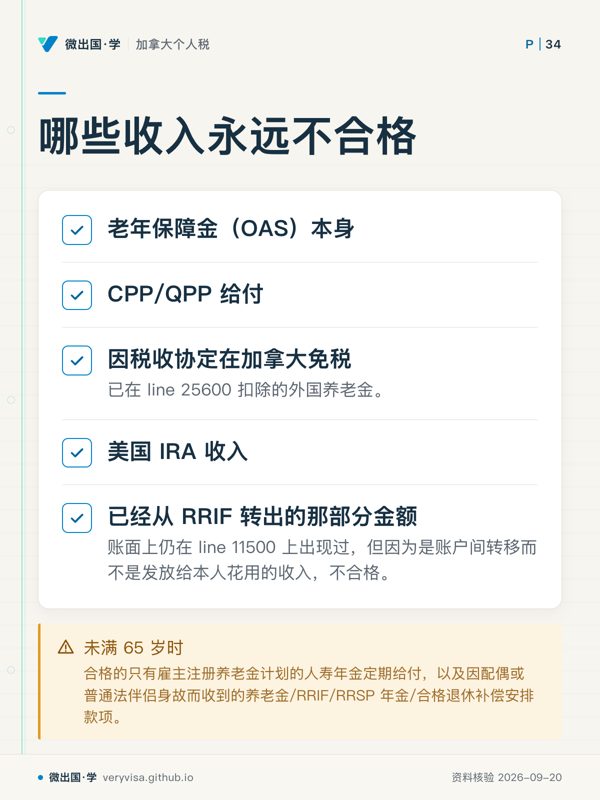
合格与不合格的完整边界 (CRA(1(论坛解读) 、2 )):未满 65 岁时,合格的只有雇主注册养老金计划(RPP)的人寿年金定期给付,以及因配偶或普通法伴侣身故而收到的养老金/RRIF/RRSP 年金/合格退休补偿安排款项;年满 65 岁(当年 12 月 31 日之前)后,RRIF 提款(含生活收入基金)、RRSP 年金给付、合格注册计划的年金支付才整体转为合格。永远不合格 的清单很短但很容易踩:老年保障金(OAS)本身、CPP/QPP 给付、因税收协定在加拿大免税且已在 line 25600 扣除的外国养老金、美国 IRA 收入、以及已经从 RRIF 转出到另一个 RRSP/RRIF/年金账户的那部分金额——这最后一条容易被忽略:钱从一个registered账户挪到另一个,账面上仍在 line 11500 上出现过,但因为是账户间转移而不是发放给本人花用的收入,不合格。
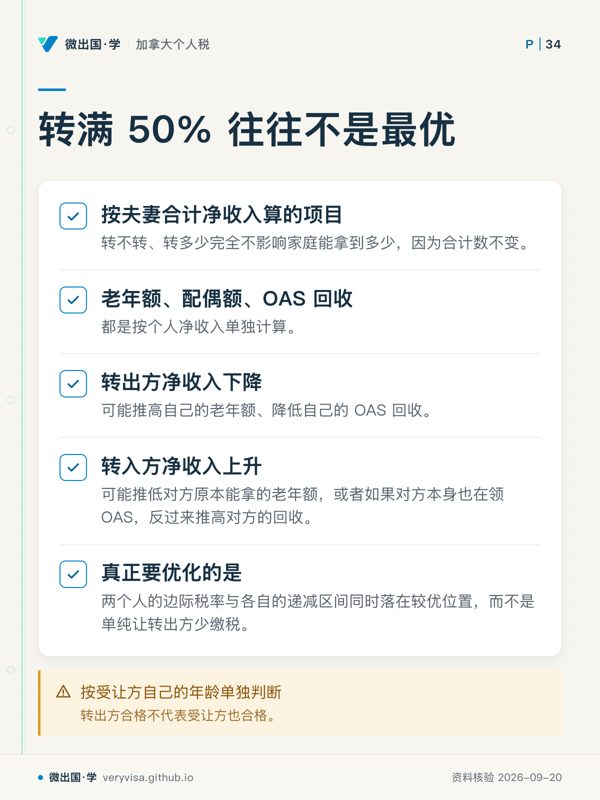
T1032 该转多少才是最优,而不是转满 50%。 CRA 自己的说明把「按个人净收入计算的福利」与「按家庭合计净收入计算的福利」明确分成了两类(CRA ):像 Canada Groceries and Essentials Benefit(CGEB,2026 年 7 月起取代原 GST/HST 抵免)这类按夫妻合计净收入 算的项目,转不转、转多少完全不影响家庭能拿到多少,因为分割只是把同一笔钱在两个人之间挪位置,合计数不变。但老年额、配偶额、OAS 回收这几项都是按个人净收入 单独计算——转出方净收入下降,可能推高自己的老年额、降低自己的 OAS 回收;转入方净收入上升,则可能推低对方原本能拿的老年额,或者如果对方本身也在领 OAS,反过来推高对方的回收。这正是考试口径里那句「转满 50% 往往不是最优选择」的官方依据:真正要优化的是两个人的边际税率与各自的递减区间同时落在较优位置 ,而不是单纯让转出方少缴税。还有一条容易漏看的边界条件:受让方能不能在自己的 line 31400 上申报这笔转入的养老金收入额,要按受让方自己的年龄单独判断 ——转出方合格不代表受让方也合格,这一点在 Form T1032 第四步的附注里单独有规定,两个人的资格不是同一件事的两面。
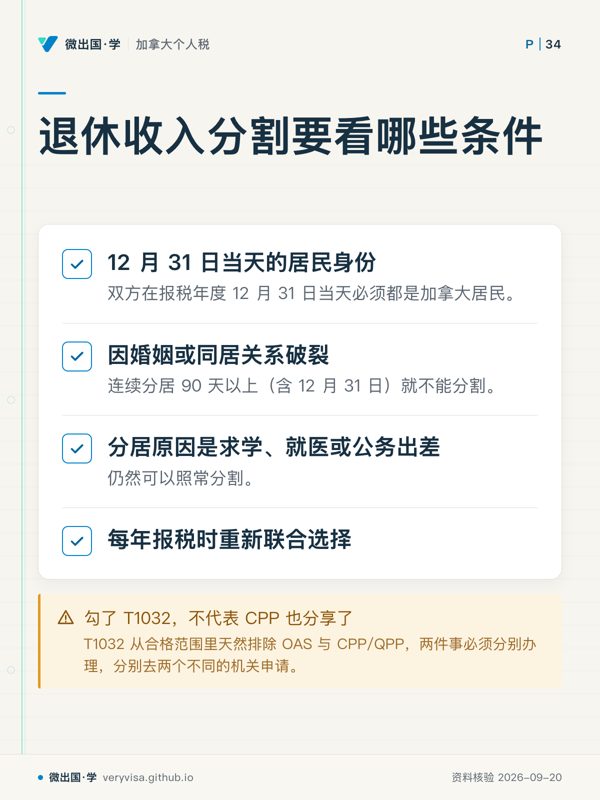
分割的资格条件里还有一条常被忽略的例外:双方在报税年度 12 月 31 日当天必须都是加拿大居民 ;如果是因婚姻或同居关系破裂、连续分居 90 天以上(含 12 月 31 日)就不能分割了,但如果分居原因是求学、就医或公务出差 ,仍然可以照常分割(CRA )——这条例外救回了不少「异地不代表分手」的家庭。
⚠️
「我们已经在做退休收入分割了」不代表 CPP 也分享了
很多家庭在报税软件里勾了 T1032 联合选择,就以为「养老金已经均分掉了」,却不知道 CPP 那部分从头到尾没有动过——T1032 从合格范围里天然排除 OAS 与 CPP/QPP,两件事必须分别办理,分别去两个不同的机关申请(详见 2.5)。
2.3 OAS 回收与 T1213(OAS):门槛不能改,但预扣的时点可以调
OAS 回收门槛的三列表与「CRA/ESDC 两页互相打架」的活例,ca-core-05-pension-investment-income 第 2.1 节已经写过(2026 税年门槛 95,323 元,CRA ),这里只讲那一节没讲的操作工具:Form T1213OAS (CRA )。这张表解决的是预扣的时点 ,不是回收本身。默认情况下,7 月起新一年度的 OAS 回收预扣税按上一年 净收入推算;如果纳税人当年收入已经明显下降——刚退休、RRIF 停止大额提取、去年一次性资本利得已经消化完——可以提前填 T1213OAS 向 CRA 申请按当年预计收入 减少预扣,避免现金流被多扣一整年、等报税季再退回来。它不能免掉回收税本身,年终评税时仍按当年实际净收入重新核算,多退少补。
2.4 GIS:免税,但免税靠的是先报后抵,不是不用报
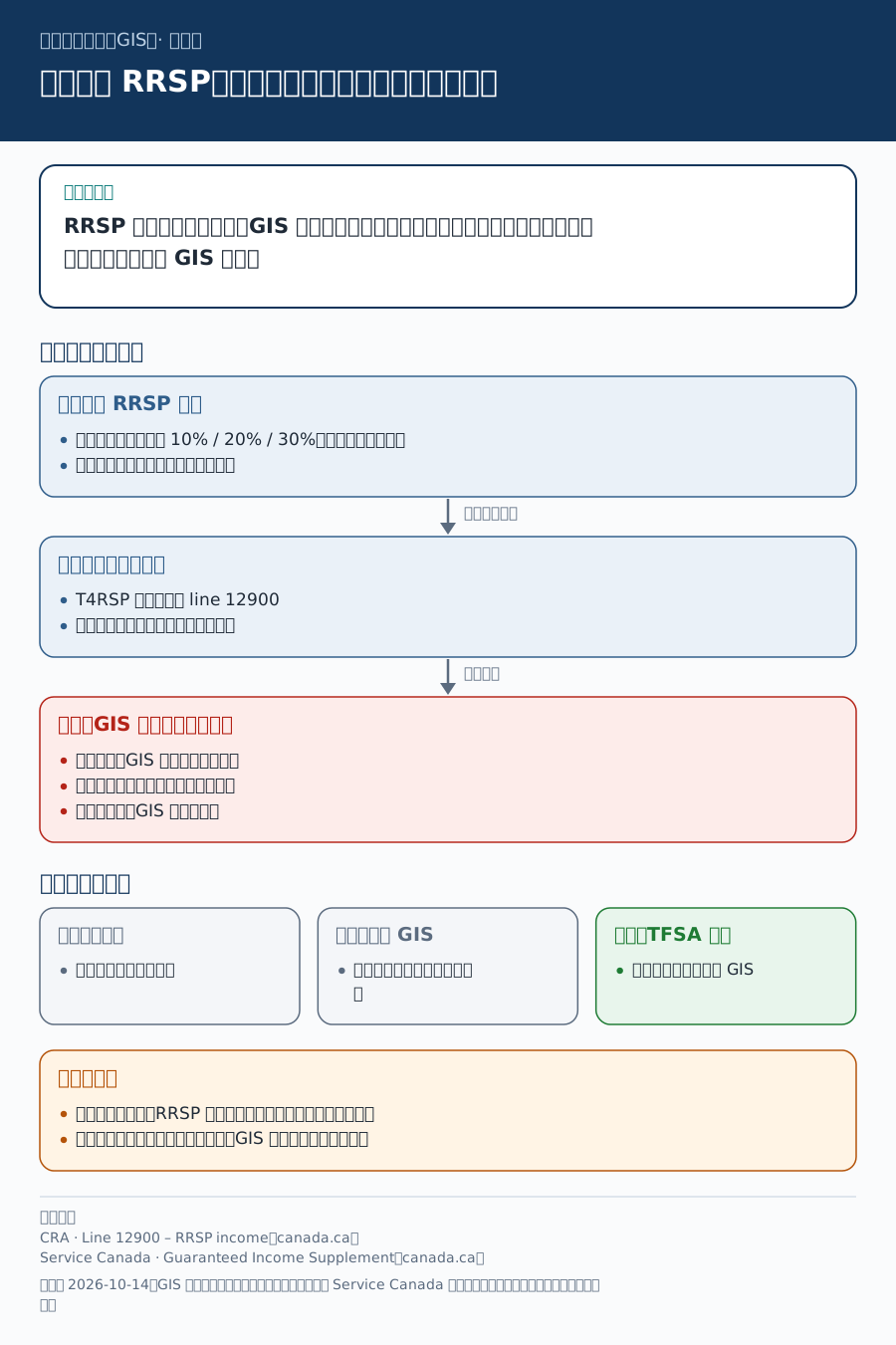
保障收入补助(Guaranteed Income Supplement, GIS)官方定性为「免税」(tax-free),但这句话背后有一套具体的记账机制(ESDC 、CRA(论坛解读) ):GIS 走 line 14600 (净联邦补助)报进 line 14700,并入 line 15000 总收入,再在 line 25000 用「其他给付扣除」全额扣回,两步相抵,净税负通常为零。「通常」两个字有一个门槛:CRA 的计算图表规定,只有当纳税人的计算结果不超过 OAS 回收门槛 时才能全额扣回,超过门槛要按图表打折——现实中因为 GIS 本身就是按净收入递减发放的济贫项目,能拿到 GIS 的人净收入通常远低于这道门槛,这条「打折」条款很少真正触发,但「GIS 绝对不产生税负」这句话不是无条件成立。真正影响绝大多数 GIS 领取者的是另一件事:GIS 续领与报税深度绑定 ——如果没有按时申报当年联邦税表,GIS 付款可能会被暂停或减少,Service Canada 依赖报税信息来核实每年的续领资格,报税晚了或漏报了,比算错税本身更容易导致钱领不到手。2026 年 10–12 月现行月度上限(canada.ca「OAS payment amounts」,每季按物价调整):单身 / 鳏寡 / 离异每月最高 $1,138.90,配偶也领全额 OAS 者每月最高 $685.56。
2.5 CPP 给付分享(Pension Sharing)与 T1032 退休收入分割:两套并行的制度,别用错申请入口
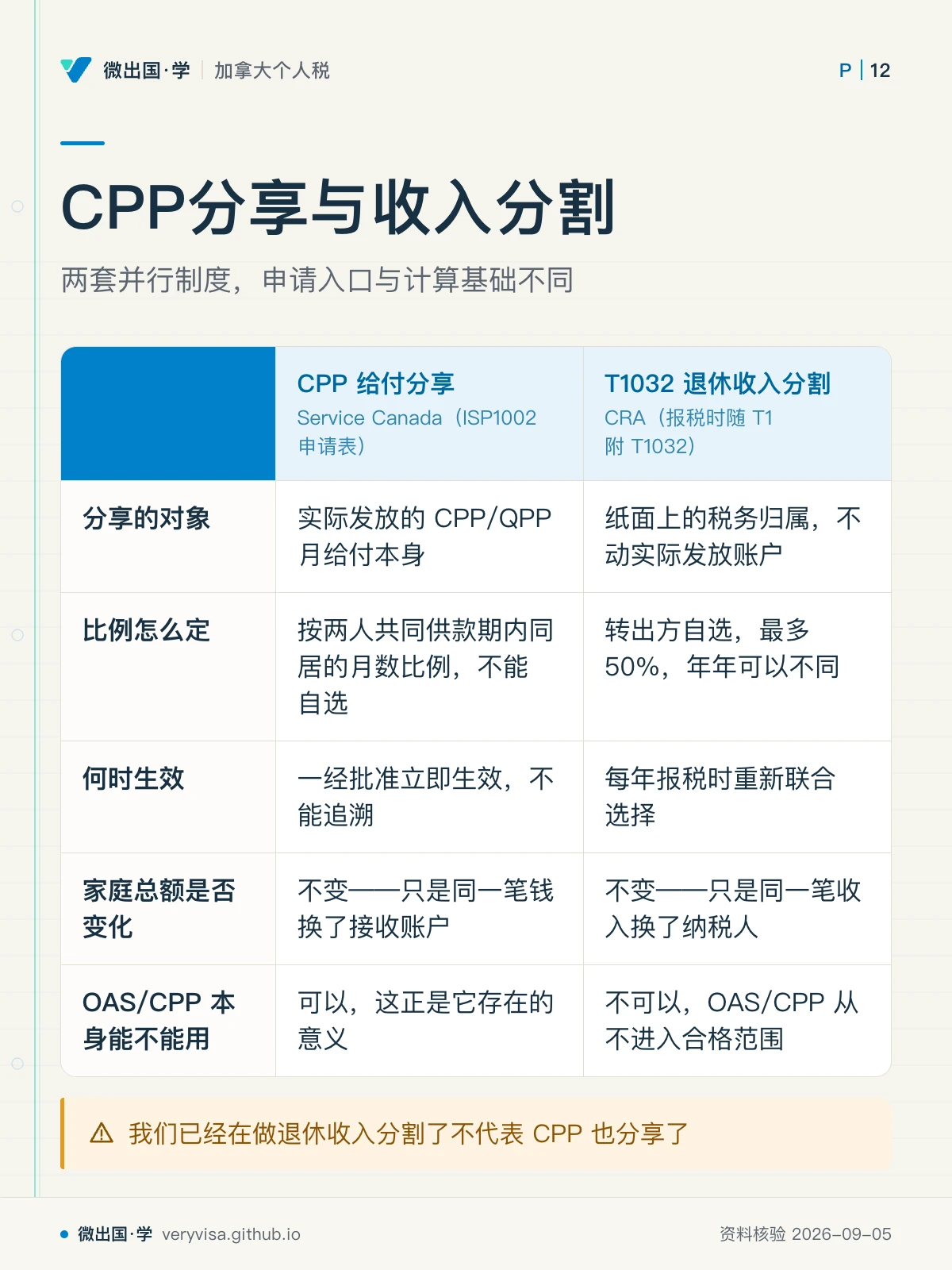
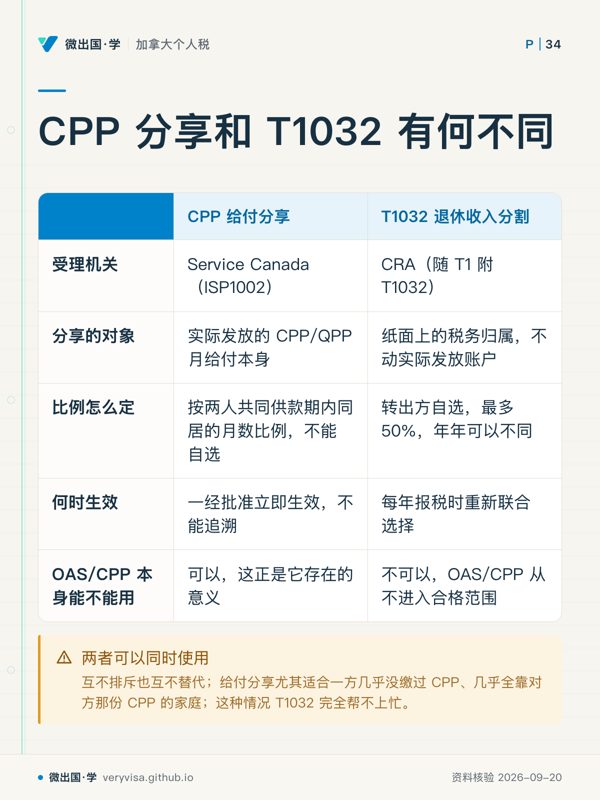
图:CPP分享与收入分割——两套并行制度,申请入口与计算基础不同
这是本页最容易被读者当成同一件事的两个概念,官方原文直接写明「pension sharing is not the same as Canada Revenue Agency's pension income splitting」(ESDC(论坛解读) )——两者从机构、申请路径到计算基础完全不同:
两者可以同时使用:CPP 走给付分享把实际到手的月给付重新分配,其余合格养老金(RPP 定期给付、RRIF 提款等)走 T1032,互不排斥也互不替代。给付分享尤其适合「一方几乎没缴过 CPP、几乎全靠对方那份 CPP」的家庭——这种情况 T1032 完全帮不上忙,因为 CPP 本身从不合格,只有把给付本身真正分掉才能让低收入一方的报税表上出现属于自己的养老收入。
2.6 老年人家庭无障碍改造:HATC、MHRTC 与 BC 的第三套抵免,三本账不是一本账
无障碍改造这块最容易被读者以为只有一项抵免,实际同时存在三套互相独立 的制度:
联邦家居无障碍改造抵免(HATC,line 31285) :不可退还的非退还抵免,合格支出上限 20,000 元,这个上限自 2022 税年起就没变过(CRA(论坛解读) )。2025 及以前税年 ,同一笔改造支出如果同时满足医疗费用抵免(METC)的条件,可以两项都报 ;2026 税年起 ,Budget 2025 的实施法已把「已在 METC 下申报的支出」明确排除出 HATC 的合格支出定义,同一笔钱只能二选一(加拿大财政部 、Parliament of Canada 、CRA )——这是一条有时间窗口 的规划提醒:新规自 2026-01-01 起生效,HATC 的合格支出按「支出发生的年度」(当年取得的货物或服务)归年,不看整项工程哪天完工;2025 年内发生的支出仍按旧规双报,跨年项目要逐笔算清哪一笔落在哪一年。
多代同堂改造抵免(MHRTC,line 45355) :可退还 (税额不够也能拿到现金),专门针对为了让老人或残障家人与亲属同住而新建的自建套房,一项合格翻修的合格支出共享上限 50,000 元,抵免率挂钩联邦最低税阶(ITA s.122.92)。同一合格个人终身只能享用一项合格翻修,不能每年重报上限。适用比例随联邦最低税率调整:2024为15%、2025为14.5%、2026为14%,这是税率修法,不能称为通胀指数化(CRA ):
BC 有第三套完全独立的省级抵免 :老年人及残障人士家居翻新抵免(Home Renovation Tax Credit for Seniors and Persons with Disabilities),可退还 ,上限 1,000 元(合格支出 10,000 元 的 10%),走 Schedule BC(S12) → BC479 表 box 60480(BC 省政府 )。BC非老年残障对象须符合ITA118.3(1)的残障资格;因看护/护理院医疗费互斥而未申领DTC,只免除(c)款限制,不免除残障认定本身。合格翻新支出可按BC ITA146(2)与医疗费抵免并用,但联邦HATC/MHRTC须各按自身规则判断。(BC 省政府 )
2.7 残障额、看护费与护理院费用:能不能并用,取决于一个 10,000 元 的开关
残障额(disability amount)以 CRA 事前核准的 Form T2201 为前提,申报在 line 31600(本人)或 line 31800(从受抚养人转移);这个前提是本页第一节强调的行政决定,与年度报税互相独立(CRA )。它和看护/护理院费用之间有一套长青不变的组合规则(CRA ):如果把护理院的全额 费用当医疗费申报(line 33099/33199),本人及所有人都不能 再为同一人申报残障额;但如果护理院账单里能拆分出「看护」部分,只把这部分限额 10,000 元 (若当年去世则 20,000 元)算作医疗费,就可以同时 申报残障额——这两个上限不指数化,2024 税年与现行页面是同一个数。选哪条路,取决于看护费用总额与残障额本身哪个对家庭更划算,需要按当年实际数字算一遍再定。
✕
T2201 没批下来,残障额那一格先空着,别先斩后奏
CRA 不会在证书审核完成前受理残障额抵免;抢先按「预计会批准」的假设报了残障额,一旦证书被拒或迟迟没批下来,这笔抵免会在评税时被剔除,涉及的家庭成员(本人 + 受让方)都要重新算一遍应缴税额,还可能产生利息。稳妥做法是先按不含这笔抵免的版本申报,证书核准后再申请调整(reassessment)。
节末检索小测 · 先别往回翻,凭记忆作答 Quick recall check: answer from memory before scrolling back
In 2026, an eligible homeowner completed a secondary suite renovation costing $45,000 to allow an elderly qualifying parent to live in their home. Which of the following correctly describes the key tax characteristics of the Multigenerational Home Renovation Tax Credit (MHRTC, line 45355)?
2026 年,一位符合条件的业主花费 $45,000 完成了一项自建套房翻新工程,以方便一位合格的老年父母与其同住。下列哪项正确描述了多代同堂改造抵免(MHRTC, line 45355)的关键税务特征?
a It is a non-refundable tax credit calculated at 15% of eligible expenditures, capped at an annual maximum expenditure limit of $20,000. ✗ 错误。不可退还、合格支出上限 20,000 元的是 HATC,不是 MHRTC。 Incorrect. It is the HATC, not the MHRTC, that is non-refundable with a qualifying expenditure cap of $20,000.
b It can be claimed annually for ordinary ongoing property maintenance and repair expenses. ✗ 错误。MHRTC 针对的是为符合资格亲属新建独立自建套房的翻新工程,且同一合格个人终身仅限享用一次,绝非年度日常维护维修开销。 Incorrect. The MHRTC is for renovations to create a separate self-contained secondary suite for a qualifying relative, and a qualifying individual can use it only once in a lifetime; it is not for ordinary annual maintenance and repair costs.
c It is refundable, allows one qualifying renovation per eligible person for life, and its rate follows the lowest federal rate. ✓ 正确。MHRTC(line 45355)是可退还抵免(税额不够也能拿现金),一项合格翻修的合格支出上限 50,000 元,同一合格个人终身只能享用一次,抵免率挂钩联邦最低税阶(ITA s.122.92),2026 税年为 14%。 Correct. The MHRTC (Line 45355) is a refundable credit (cash is paid even if tax is insufficient), the qualifying expenditure cap for one qualifying renovation is $50,000, a given qualifying individual can use it only once in a lifetime, and the credit rate is tied to the lowest federal bracket (ITA s.122.92), 14% for the 2026 tax year.
d It is a fully taxable capital gain adjustment that must be deducted against the lifetime capital gains exemption. ✗ 错误。MHRTC 属于个人所得税抵免,与资本利得终身免税额核算毫无关联。 Incorrect. The MHRTC is a personal income tax credit and has nothing to do with the lifetime capital gains exemption calculation.
看答案与每个选项的解析 Show the answer and why each option is right or wrong 答案 Answer :c
三、实务流程:从收到钱到填对格子 本节回答 This section answers 理清T1213OAS预扣时点申请与T2201事前核准流程 Applying for T1213OAS withholding timing, and the T2201 advance approval process
一笔养老金收入先落进 T4A(OAS)、T4A(P)、T4A、T3、T4RIF 上对应的 slip 框号,抄进 line 11300/11400/11500(ca-core-05-pension-investment-income 已给全表),本页接着往下走:老年额在联邦工作底稿 Line 30100 里按净收入自动算出,填进 Step 5 的非退还抵免合计;养老金收入额与 T1032 分割一起走 Form T1032 的四步流程,两个人的表格必须同时签署、内容一致,随各自的纸质报税表一并寄出(电子报税则各自在软件里申报对应数字);分割部分的预扣税也要按分割比例在 line 43700 之间重新分配。HATC 走 Schedule 12 的 line 31285,MHRTC 走同一张 Schedule 的 line 45355——两条线在同一张表里,容易被看漏其中一条;BC 那套省级抵免另走 Schedule BC(S12),填进 BC479 表的 box 60480。T2201 的申报节奏和年度报税完全脱钩:没有已核准的证书就不要在当年报税时先报残障额 ,更稳妥的做法是先按不含这笔抵免的版本报税,等 CRA 审核通过 T2201 后再申请调整(reassessment),CRA 一般不会在证书审核完成前受理这笔抵免。T1213OAS 要在年度开始前 尽早提交才有意义——它调整的是全年的预扣节奏,提交得越晚,当年能省下来的预扣现金流就越少。
节末检索小测 · 先别往回翻,凭记忆作答 Quick recall check: answer from memory before scrolling back
A tax preparer is filing a 2026 T1 personal tax return for an elderly client who applied for the Disability Tax Credit (Form T2201) in March 2026 but has not yet received a decision from the CRA by April 30. How should the preparer properly handle the disability amount on line 31600?
报税员正在为一位老年客户申报 2026 年 T1 个人税表。该客户于 2026 年 3 月向 CRA 提交了残障税收抵免申请(表格 T2201),但在 4 月 30 日报税截止日前尚未收到 CRA 的审批决定。报税员应当如何在 line 31600 上正确处理该笔残障额?
a File the 2026 return without claiming the disability amount on line 31600, and request a formal reassessment (T1-ADJ) once the CRA formally approves Form T2201. ✓ 正确。第三节实务流程与自查清单明确强调:残障税收抵免(Form T2201)是一项事前行政决定,必须拿到 CRA 核准后方可申报。当年没有已核准的 T2201 绝不能抢先申报残障额(line 31600);稳妥合规的做法是先按不含该抵免的版本申报,等收到 CRA 批准函后再通过 T1-ADJ 申请调整(reassessment),以避免抢报被剔除产生罚息。 Correct. The practical procedure and self-check list in Section 3 stress that the disability tax credit (Form T2201) is an advance administrative decision and can be claimed only after CRA approval. Without an approved T2201 for the year, the disability amount (Line 31600) must never be claimed ahead of time; the safe and compliant approach is to file first without the credit and, after the CRA approval letter arrives, request an adjustment (reassessment) through T1-ADJ, avoiding a premature claim that is disallowed with interest.
b Claim the full disability amount on line 31600 immediately, as CRA automatically suspends interest and penalties for pending medical applications. ✗ 错误。掉入事先抢报陷阱。CRA 不会在证书审核通过前受理该抵免,抢先填报会被直接核减并触发利息。 Incorrect. This falls into the trap of claiming ahead of approval. The CRA will not accept the credit before the certificate is approved, and a premature claim will be reduced directly with interest.
c Attach a copy of medical diagnostic receipts directly to line 31600 to serve as a temporary substitute for the T2201 certificate. ✗ 错误。医疗收据只能用于申报医疗费抵免(METC),绝不能替代 CRA 事前核准的法定 T2201 残障证明书。 Incorrect. Medical receipts can only be used to claim the medical expense credit (METC) and can never replace the legally required T2201 disability certificate approved in advance by the CRA.
d Delay filing the entire T1 tax return indefinitely until CRA issues the formal T2201 determination letter. ✗ 错误。无限期延期申报会导致退税延误,若有低收入福利(如 GIS、CGEB)还会直接引发福利停发。 Incorrect. Delaying the entire T1 indefinitely delays the refund and, if the person has low-income benefits (such as GIS or CGEB), leads directly to benefits being suspended.
看答案与每个选项的解析 Show the answer and why each option is right or wrong 答案 Answer :a
四、联邦之外:BC 这条线怎么走 本节回答 This section answers 明确BC省翻新抵免最高一千元与联邦表格分离申报 The BC renovation credit up to $1,000 and its separate filing from the federal forms
BC 428 省表复刻了联邦的老年额与养老金收入额两项非退还抵免,但走势完全独立(ca-core-05-pension-investment-income 第四节已给出 2025/2026 具体数值),本页要补的是第 2.6 节提到的第三套省级抵免 ——老年人及残障人士家居翻新抵免——它不在 428 表上,走的是单独的 Schedule BC(S12),可退还,上限只有 $1,000,非老年对象仍须符合残障资格;因看护医疗费互斥而未实际申领DTC者可能合格,不能以护理费收据替代残障认定(BC 省政府 )。对一个同时想申报联邦 HATC(20,000 元 上限)、联邦 MHRTC(如果在建自建套房)、以及这项省级抵免的 BC 家庭来说,三份表格要分别填、分别核对合格支出范围,不能假设填对了联邦那两张就自动覆盖了省这一张。CPP 给付分享与 GIS 是全国统一的联邦/机构项目,不因居住省份而有 BC 特例;OAS 回收门槛与 T1213OAS 同理,全国一个口径。
节末检索小测 · 先别往回翻,凭记忆作答 Quick recall check: answer from memory before scrolling back
A 67-year-old resident of Vancouver incurred $8,000 in qualifying home accessibility renovation expenses in 2026. The taxpayer files both federal and British Columbia provincial tax forms. How does BC handle its provincial home renovation credit for seniors and people with disabilities?
一名 67 岁的温哥华居民在 2026 年发生了 $8,000 的合格家庭无障碍翻新支出。该纳税人同时申报联邦与 BC 省税表。BC 省如何处理省级老年人及残障人士家居翻新抵免?
a It is an automatic 15% non-refundable credit integrated into Form BC428 line 58400, matching federal HATC dollar-for-dollar. ✗ 错误。BC 省该项抵免不在 BC428 表上,且该抵免属于可退还抵免,并非不可退还抵免。 Incorrect. This BC credit is not on Form BC428, and it is a refundable credit, not a non-refundable one.
b It replaces both federal HATC and MHRTC, exempting the taxpayer from filing federal Schedule 12 entirely. ✗ 错误。BC 省级抵免与联邦抵免互不替代,联邦表格仍须按联邦规定独立填报。 Incorrect. The BC provincial credit does not replace the federal credit, and the federal forms still have to be filed separately under the federal rules.
c It is an administrative subsidy paid out by BC Housing and cannot be claimed through the T1 income tax return. ✗ 错误。该项抵免属于 BC 省税法下的税务抵免,完全通过个人所得税申报表申报申领。 Incorrect. This credit is a tax credit under BC tax law, claimed entirely through the personal income tax return.
d It goes on Schedule BC(S12) to BC479 box 60480 as a refundable 10% credit, capped at $1,000. ✓ 正确。这是独立于联邦的第三套抵免:不在 BC428 上,走 Schedule BC(S12),填入 BC479 的 box 60480,可退还,上限 $1,000(合格支出 10,000 元 的 10%),要与联邦表分别核算。 Correct. This is a third credit independent of the federal ones: it is not on BC428, it goes through Schedule BC(S12) and is entered in box 60480 of BC479, it is refundable, with a cap of $1,000 (10% of qualifying expenses of $10,000), and must be calculated separately from the federal forms.
看答案与每个选项的解析 Show the answer and why each option is right or wrong 答案 Answer :d
五、历史变革:为什么会有两套「分」的制度、无障碍改造为什么突然不能双报了 本节回答 This section answers 弄清CPP分享与T1032分割制度演变与旧规双报终结 How CPP sharing and T1032 splitting evolved, and the end of the old double-claim rule 本章考题 5 Question 5
CPP 给付分享的存在远早于退休收入分割,这是社会保险制度设计里常见的「婚姻期间共同贡献、退休后共同受益」理念的直接体现,针对的是「一方几乎没缴过 CPP」这种收入结构性差距。而 T1032 退休收入分割是 2007 年才引入的后来者(ca-core-05-pension-investment-income 第五节已展开这段历史),它解决的是 CPP 给付分享完全够不着的另一个问题——雇主养老金、RRIF 这类收入原本没有任何分享或分割机制,单一收入来源的退休家庭因此比双收入来源的家庭多缴不少税。先有的是「政府直接管的那部分」(CPP)的分享,「私人养老金与注册账户那部分」(RPP/RRIF)的分割空白要到 2007 年才补上。
无障碍改造这条线的变化则新得多、也快得多。2025 年及以前,HATC 与 METC 可以对同一笔改造支出双报,这曾经是老年与失能家庭报税时常用的一招;Budget 2025 提出、并已随实施法案生效,从 2026 税年起两者互斥。考试口径(2024 税年口径)完整覆盖了 HATC 本身的规则,却不可能提到这条 2026 年才生效的新规——考试口径没写错,只是它印刷的那一刻,这条规则还不存在。
节末检索小测 · 先别往回翻,凭记忆作答 Quick recall check: answer from memory before scrolling back
From a tax history perspective, what policy gap prompted the introduction of the Form T1032 pension income splitting rules in 2007, despite the long-standing existence of CPP pension sharing (ISP1002)?
从税收历史沿革的角度来看,既然加拿大社保体系中早已存在 CPP 给付分享(ISP1002),为什么联邦政府还在 2007 年引入了表格 T1032 退休收入分割制度?
a Because Parliament completely eliminated CPP pension sharing in 2007 and required all seniors to use CRA annual elections. ✗ 错误。CPP 给付分享从未被废止,至今仍由 Service Canada 独立受理运行。 Incorrect. CPP pension sharing has never been abolished and is still handled independently by Service Canada.
b CPP sharing covered only the public plan; employer pensions and RRIF income had no split, burdening single-earner couples. ✓ 正确。第五节明确指出:CPP 给付分享早在多年前就已设立,解决的是政府社保层面的结构性贡献差距;但在 2007 年之前,雇主养老金(RPP)和注册退休基金(RRIF)没有任何分割机制,导致单一收入来源的退休家庭比双收入退休家庭承担沉重得多的累进税负。政府直到 2007 年才通过引入 T1032(ITA s.60.03)填补了私人养老金与注册账户无法分割的税法空白。 Correct. Section 5 states clearly that CPP pension sharing was set up many years earlier and addresses the structural gap in contributions at the government social security level; but before 2007, employer pensions (RPP) and registered retirement income funds (RRIF) had no splitting mechanism at all, so single-income retired families bore a much heavier progressive tax burden than two-income retired families. Only in 2007 did the government fill the tax law gap for private pensions and registered accounts by introducing T1032 (ITA s.60.03).
c Because CRA required all employer registered pension plans to be converted into guaranteed annuities upon retirement. ✗ 错误。政府并未强制要求将 RPP 转换为终身年金,T1032 解决的是家庭内部报税分割问题。 Incorrect. The government did not force employer RPPs to be converted into life annuities; T1032 solves the problem of splitting within the family for tax reporting.
d Because the Supreme Court ruled that OAS clawback taxes were unconstitutional unless equal pension sharing was mandated. ✗ 错误。OAS 回收税合宪且一直正常执行,T1032 立法与最高法院司法判决无关。 Incorrect. The OAS recovery tax is constitutional and has always been enforced normally; the T1032 legislation has nothing to do with any Supreme Court ruling.
看答案与每个选项的解析 Show the answer and why each option is right or wrong 答案 Answer :b
六、案例 本节回答 This section answers 掌握护理院看护费限额一万元与残障额转移实操对比 Comparing the $10,000 attendant care limit in nursing homes with a transfer of the disability amount
案例一:温哥华的退休夫妇,T1032 该转多少(示例) 。李先生 70 岁,2026 年有 RPP 定期养老金 $48,000,另有其他净收入 $62,000,分割前净收入合计 $110,000;太太 63 岁、本人收入较低。RPP 定期养老金属于合格分割收入,最多可转 $24,000;若转满,李先生净收入降至 $86,000,低于本年的 OAS 回收起点。这只是一个可比较的方案,仍须同时计算太太增加的税款、两人的省税及个人抵免变化。太太未满 65 岁,不应在本年虚算她未来的老年额;也不能把李先生仅有的 $48,000 RPP 当成已经超过 OAS 回收门槛。
案例二:素里的老年翻新家庭,2025 与 2026 两种算法(示例) 。王女士 68 岁,2025 年底为方便轮椅进出,花 $18,000 装了坡道与加宽门框,同时这笔支出里有 $6,000 部分也满足医疗费用条件;因为这笔支出发生在 2025 税年,她可以同时 报 HATC(按 $18,000 计算,上限 20,000 元 内全额合格)和 METC($6,000 部分),双报生效。如果这 $6,000 的工料拖到 2026 年才发生(2026 年才取得货物或服务),则那 $6,000 只能二选一——不能只凭支出名称判断哪项更划算:METC 是按法定抵免率计算的非退还抵免,并非按个人边际税率扣除。应分别核医疗费门槛、HATC 合格额、可用税额以及适用的 top-up 规则后比较。同一年,她还为让患病的母亲搬来同住,新建了一个自带卫浴的地下室套房,花费 $42,000,这笔另算 MHRTC——2025 税年按 14.5% 算是 $6,090($42,000 未到 50,000 元 上限,按实际支出算)。
案例三:列治文的儿子与护理院里的父亲(示例) 。陈先生的父亲全年住在护理院,账单总额 $46,000,护理院提供了看护部分 $9,500 的明细拆分,父亲本人已经拿到 CRA 核准的 T2201。陈先生面前有两条路:路径 A,把 $46,000 全额当医疗费申报,但父亲(及所有人)当年都不能再申报残障额;路径 B,只把 $9,500 的看护部分当医疗费申报,同时申报残障额(2026 税年 10,341 元,CRA )。父亲名下没有足够应缴税额用完这笔残障额,未用部分可以转给陈先生(line 31800)。两条路须比较合格费用、按被申报者分别适用的净收入门槛、法定抵免率、可用税额与残障额转移资格,常见错报是想都不想就选「金额更大」的路径 A,而没有算残障额转移那一侧的实际节税空间。
节末检索小测 · 先别往回翻,凭记忆作答 Quick recall check: answer from memory before scrolling back
In the chapter case study of an elderly father in a nursing home with an approved Form T2201, total nursing home fees were $46,000, with an itemized attendant care breakdown of $9,500. Why might choosing 'Path B' (claiming $9,500 attendant care plus the disability tax credit) yield greater family tax savings than 'Path A' (claiming the full $46,000 as medical expenses)?
在第六节关于护理院父亲的案例中,持有已核准 Form T2201 的父亲全年护理院费用为 $46,000,看护费明细拆分为 $9,500。为什么选择「路径 B」(申报 $9,500 看护费加残障额)可能比「路径 A」(将 $46,000 全额报为医疗费)产生更大的家庭税收利益?
a Because Path A causes the CRA to automatically impose a 50% luxury tax on nursing home accommodations exceeding $30,000. ✗ 错误。加拿大税法中完全不存在对养老护理院开支征收奢侈税的规定。 Incorrect. Canadian tax law has no provision at all for a luxury tax on nursing home spending.
b Because Path A permanently cancels the father's OAS and GIS entitlement for the remainder of their lifetime. ✗ 错误。医疗费用申报方式完全不影响纳税人依法领取 OAS 和 GIS 等法定长者福利。 Incorrect. How medical expenses are claimed has no effect on a taxpayer's statutory entitlement to seniors' benefits such as OAS and GIS.
c Path B keeps the full disability amount, and any unused part can go to a supporting child with tax to absorb it. ✓ 正确。路径 A 全额报医疗费会排除残障额;路径 B 只把看护费在 10,000 元以内报医疗费,同时保住残障额(2026 税年 10,341 元)。父亲税额不够时,未用部分可转给有税可抵的子女(line 31800)。两条路仍要按实数比较。 Correct. Path A, claiming full medical expenses, excludes the disability amount; Path B claims only attendant care within $10,000 as medical expenses while keeping the disability amount ($10,341 for the 2026 tax year). When the father's tax is insufficient, the unused part can be transferred to a child who has tax to offset (Line 31800). The two paths still have to be compared on actual figures.
d Because Path B allows the family to claim a cash refund of the entire $46,000 directly from ESDC. ✗ 错误。医疗费用抵免与残障额均为不可退还税收抵免(non-refundable tax credits),无法向 ESDC 兑换现金退税。 Incorrect. Both the medical expense credit and the disability amount are non-refundable tax credits and cannot be exchanged for a cash refund from ESDC.
看答案与每个选项的解析 Show the answer and why each option is right or wrong 答案 Answer :c
七、常见错报与自查清单 本节回答 This section answers 排查T2201未核准抢报与未满65岁误报RRIF等雷区 Spotting traps such as claiming an unapproved T2201 early and wrongly claiming a RRIF under 65
以为未满 65 岁把 RRSP 转成 RRIF 就能拿养老金收入额。 识别方法:先看这笔收入是不是因配偶身故收到的,不是的话,未满 65 岁这一招基本不成立。把 OAS 或 CPP/QPP 收入算进 T1032 分割的合格范围。 识别方法:合格清单里从来没有这两项,任何年龄都没有。把 CPP 给付分享和 T1032 退休收入分割当成同一件事,只办了一个就以为两个都办了。 识别方法:给付分享要单独向 Service Canada 提交 ISP1002,报税表上的 T1032 选择替代不了它。以为 GIS 完全免税就不用报、报晚了也没关系。 识别方法:GIS 走 line 14600 且续领资格靠年度报税核实,报税延误直接影响下一期能不能领到。2026 税年还想把同一笔无障碍改造支出同时报 HATC 和 METC。 识别方法:先看这笔支出是不是在 2025-12-31 之前发生(取得货物或服务),2026 年发生的只能二选一,不看整项工程的完工日。护理院费用全额报了医疗费,又想同时报残障额。 识别方法:全额报医疗费和申报残障额互斥,只有把看护部分限额在 10,000 元(去世当年 20,000 元)以内单独申报,才能两者并用。T2201 还没拿到 CRA 核准,就在当年报税表上先报了残障额。 识别方法:先查有没有收到 CRA 关于 T2201 的核准通知,没有就先不报,核准后再申请调整。T1032 无脑转满 50%,以为这样一定最省税。 识别方法:看转出方和受让方各自是不是都受 OAS 回收或老年额递减影响,只影响一方时才该往那个方向多转。
节末检索小测 · 先别往回翻,凭记忆作答 Quick recall check: answer from memory before scrolling back
A tax preparer is reviewing a senior's draft return against the chapter's self-audit checklist. Which of the following represents an erroneous tax filing practice that will likely be flagged and rejected by the CRA upon assessment?
报税员正在对照本章常见错报与自查清单审核一份老年人的报税草表。下列哪项代表了极可能被 CRA 评税系统标记并剔除的典型错报行为?
a Reporting GIS payments received on line 14600 and subsequently claiming an offsetting deduction on line 25000. ✗ 错误。这是申报保障收入补助(GIS)的标准规范记账流程,完全符合税法要求。 Incorrect. Reporting GIS received on Line 14600 and then claiming an offsetting deduction is the standard correct bookkeeping for GIS, fully consistent with the tax rules.
b Excluding CPP retirement benefits from eligible pension income when completing Form T1032. ✗ 错误。CPP/QPP 依法严禁计入 T1032 合格养老金范围,排除 CPP 属于完全正确的合规操作。 Incorrect. CPP/QPP are by law barred from the T1032 qualifying pension scope, so excluding CPP is a fully correct compliant practice.
c Claiming an itemized attendant care amount of $8,500 as medical expenses while simultaneously claiming the disability amount for a holder of an approved Form T2201. ✗ 错误。看护费在 10,000 元限额内报医疗费、同时申报已核准的残障额,是讲解页明确认可的组合。 Incorrect. Claiming attendant care within the $10,000 limit as medical expenses while also claiming an approved disability amount is a combination the lecture page expressly recognizes.
d Claiming the disability amount on line 31600 on the assumption that an unapproved Form T2201 application will eventually be granted. ✓ 正确。第七节自查清单与常见错报明确列出:在未获得 CRA 事前正式核准之前,绝对不能在当年报税表上抢先申报残障额(line 31600/31800);CRA 不会在证书获批前认可该抵免,抢报会被评税系统直接剔除,导致涉及家庭成员重新核算应纳税额并产生利息。 Correct. The self-check list and common misreporting in Section 7 list this explicitly: before formal prior CRA approval is obtained, the disability amount (Line 31600/31800) must never be claimed ahead of time on the return for the year; the CRA does not recognize the credit before the certificate is approved, and a premature claim is simply removed by the assessment system, which means recalculating the tax payable of the family members involved, with interest.
看答案与每个选项的解析 Show the answer and why each option is right or wrong 答案 Answer :d
术语双语表
法条与条例(现行合订本):ITA s.118(2) 老年额 · s.118(3)/(7) 养老金收入额与合格养老金收入定义 · s.60.03 退休收入分割 · s.122.92 多代同堂改造抵免(加拿大联邦法规库(论坛解读) 同源合订本)。
CRA/ESDC 现行页面:年度指数化总表(CRA )· OAS 付款说明页(ESDC )· Pension income amount(CRA(论坛解读) )· Pension income splitting(CRA )· Line 11500(CRA(论坛解读) )· Guaranteed Income Supplement 首页(ESDC )· Line 25000(CRA(论坛解读) )· CPP Pension Sharing(ESDC(论坛解读) )· T1213OAS 表(CRA )· Line 31285 HATC(CRA(论坛解读) )· Line 45355 MHRTC(CRA )· Line 31600 Disability amount(CRA )· RC4065 Medical Expenses(CRA )· Budget 2025 CRA 说明(CRA )· C-15 御准摘要(Parliament of Canada )· Budget 2025 税务措施全文(加拿大财政部 )· BC 老年人及残障人士家居翻新抵免(BC 省政府 )。
本站依据官方原文自撰 · 出处见正文链接