🃏 Flashcards · 3 闪卡 · 3 张 🖼 Slides · 2 幻灯 · 2 页 ✍️ Questions · 7 刷题 · 7 道
意外与疾病 Accident & Sickness P3 过一遍 P3 Skim
ZH EN ZH + EN
先看这一章怎么考 First, how this chapter is tested
场景匹配题:给出独资、合伙或紧密控股公司面临的伤残冲击(固定开支断流、核心骨干失能、残疾合伙人退出),考你精准区分营业费用险(business overhead expense insurance, BOE)、关键人伤残险(key person disability insurance)和买卖协议伤残买断险(disability buyout insurance)的功能边界。 Scenario-matching questions: Given the disability impacts faced by a sole proprietorship, partnership, or closely held corporation (disrupted fixed operating expenses, disability of a key employee, or exit of a disabled partner), test your ability to precisely distinguish the functional boundaries of business overhead expense (BOE) insurance, key person disability insurance, and buy-sell disability buyout insurance. BOE可报销清单与结转计算题:给出一组企业月度账单(房租、员工薪资、业主个人薪水、商业贷款本金与利息、新设备采购)及月度封顶,考你剔除不可报销项并运用结转条款(carryover provision)计算当月实际报销额。 BOE eligible expense filtering and carryover calculation questions: Given a set of monthly business expenses (rent, employee wages, owner's personal salary, commercial loan principal and interest, new equipment purchases) and a monthly benefit cap, test your ability to exclude ineligible items and apply the carryover provision to calculate the actual reimbursement for the month. 税务处理正反对比题:将营业费用险(BOE)与商业贷款保护伤残险(business loan protection DI)并列,考你判断哪一种保费可抵税且给付应税、哪一种保费不可抵税但给付免税,以及两者能否就同一笔贷款重复理赔。 Tax treatment contrast questions: Juxtaposing business overhead expense (BOE) insurance with business loan protection disability insurance, test your ability to determine which policy has tax-deductible premiums and taxable benefits versus non-deductible premiums and tax-free benefits, and whether both policies can claim against the same loan. 最常丢分的陷阱(看到题干信号就警觉) Traps that cost the most marks (watch for the signal in the stem)
BOE范围混淆陷阱 BOE Eligible Expense Scope Confusion Trap 题干账单中混入业主个人薪资(owner's salary)、商业贷款本金(loan principal)或新购设备(new equipment purchase)。 The question stem mingles the owner's personal salary, commercial loan principal, or new equipment purchases into a list of monthly business expenses. 税务正反颠倒陷阱 Tax Treatment Reversal Trap 题干同时出现商业贷款保护险与BOE,询问保费可否抵税(tax-deductible)或理赔金是否免税(tax-free)。 The question stem presents both business loan protection disability insurance and BOE, asking whether premiums are tax-deductible or benefits are tax-free. 受益人与用途错配陷阱 Beneficiary and Purpose Mismatch Trap 题干问关键人伤残险的受益人(beneficiary)是谁,或如何估算招聘与培训替代窗口期的保额。 The question stem asks who the beneficiary of a key person disability policy is, or how to calculate the benefit amount needed for the replacement recruitment and training window. 本章考点页:导图、要点表、7 道带逐项解析的练习 →
核实日期:2026-09-04|考纲位置:A&S c2「分析可用产品」(占本模块 30%),本章内容同时触及 c3「落实推荐」(25%)——企业场景很少是"选对一份产品"就完事,而是要把诊断出的风险敞口精确匹配到对的产品组合。
复核周期:本页现行数字以公司官网产品结构为主,非年度指数化数字,360 天复核一次(下次 2027-09-01)。买卖协议的交叉持有/公司赎回机制细节见 life-ch08-business-life,本页不重复,只讲这些结构在伤残触发 下的差异。
0. 这一篇解决什么问题
企业主自己干不了活,谁替公司交房租发工资?公司里最能干的那个人(不一定是老板)出事,公司怎么撑过招人培训的空窗期?几个合伙人里走了一个,剩下的人靠什么钱把股份买下来?这三个问题分别对应营业费用险(business overhead expense insurance,BOE)、关键人伤残险(key person disability insurance)、买卖协议伤残买断险(disability buyout insurance)三套机制。它们表面上都叫"企业伤残险",实际上保的对象、给付形态、税务处理彼此都不一样,甚至彼此相反 ——这正是本章出题密度最高的地方。这一篇帮你做到三件事:①给一个企业风险场景,判断该配哪一种或哪几种产品;②算清楚 BOE 的月度封顶×给付期总封顶与结转机制;③说清楚为什么这三类产品的税务处理不能相互套用。
一、制度设计与底层逻辑:企业为什么要为"暂时干不了活"这件事单独买保险 本节回答 This section answers 三类企业伤残风险如何分别匹配BOE、关键人险与买断险 How three business disability risks match BOE, key person disability, and buyout insurance respectively
1. 三类风险,三种"垮法"
考试口径把企业主面对的伤残风险拆成三类,每一类"垮"的方式都不一样:丧失工作能力(inability to work) ——业主本人还活着,企业也没被卖掉,但固定开支(房租、水电、员工工资)照样要付,收入却断了;丧失出售能力(inability to sell) ——业主想退出或必须退出(比如伤残到无法继续经营),但没有现成买家、没有定好的价钱、更没有资金完成交易;失去关键员工(loss of key employee) ——受影响的不是业主本人,而是企业里那个走了会导致营收下滑、招聘替代成本飙升的人。这三类风险分别对应下表三种产品,考试口径反复强调它们互不替代:
可保利益在这里怎么成立 :判断标准与人寿保险一样——投保人会不会因为被保险人伤残而遭受实际经济损失。BOE 是一种特殊情形:形式上是"企业"为"业主"投保,实质是双向成立——业主的持续工作能力对企业的存续有经济价值,企业的持续经营也是业主收入的来源,二者互为因果。关键人险与买断险的可保利益更直观:企业对核心人才、合伙人对彼此的持股结构都有清楚的经济利害关系。
2. 企业组织形式仍然决定风险敞口,但角度和死亡场景不同
life-ch08-business-life 已经讲过组织形式如何决定身故场景下的风险敞口(独资无独立 ACB、合伙人连带责任、公司股权独立处置)。在伤残场景下,逻辑近似但触发点不同:伤残不触发《所得税法》下的视同处置 (人还活着,股权没有转手),伤残本身一般不触发死亡式视同处置,但后续股份出售、公司赎回与保险给付仍可能有税务后果;应分别核交易和现金流——业主干不了活,收入立刻断,但企业的固定支出、贷款还款义务不会因此暂停。这正是为什么 BOE 与买卖协议融资的设计重点都是"钱从哪来"而不是"税怎么算"。
ℹ️
历史精算表只保留考试口径
考试口径引述1985年表,以45岁业主到65岁前较长期伤残概率约40%、两位共同业主至少一人约62.5%、平均持续3.2年说明风险。原始表适用人群及现行加拿大等效统计未核实,不能用这些数值推销或估个案概率。已登记的2016年资料讨论团体长期伤残准备金,不能证明个人1985表在该年统一被替换。
节末检索小测 · 先别往回翻,凭记忆作答 Quick recall check: answer from memory before scrolling back
Marcus owns a small physiotherapy clinic with two salaried receptionists and a long-term commercial lease. He is healthy today but worries that if a severe illness leaves him temporarily unable to treat patients for several months, the clinic will still have to pay rent and staff wages while generating no revenue. How does the tax and insurance framework treat this specific disability risk?
Marcus拥有一家小型物理治疗诊所,雇有两名领薪前台并签有长期商业租约。他目前身体健康,但担心如果严重疾病导致他连续数月暂时无法接诊,诊所在没有收入的情况下仍须支付房租和员工工资。税务与保险制度框架如何处理这一特定的伤残风险?
a Marcus's disability triggers a deemed disposition of his clinic shares under the Income Tax Act, requiring immediate estate liquidity. ✗ 错误(混淆身故与伤残税务触发陷阱)。根据讲座,伤残时业主本人仍然健在且股权未发生转移,不会触发《所得税法》(Income Tax Act)下的死亡式视同处置(deemed disposition)。 Incorrect. Falls into the Confusing Death and Disability Tax Triggers trap: When an owner is disabled, the individual remains living and equity does not transfer, so it does not trigger a death-related deemed disposition under the Income Tax Act.
b The clinic faces an inability-to-work risk where fixed overhead continues despite halted revenue, which is addressed by business overhead expense (BOE) insurance. ✓ 正确。Marcus面临的是暂时丧失工作能力(inability to work)导致收入中断但房租、员工工资等固定开支照付的风险,正对应由企业投保并作受益人的营业费用险(business overhead expense insurance, BOE),且企业与业主之间存在双向成立的可保利益(insurable interest)。 Correct. Marcus faces an inability-to-work risk where revenue halts while fixed overhead such as rent and employee wages continues, which precisely corresponds to business overhead expense (BOE) insurance owned by and payable to the business, supported by mutual insurable interest between the corporation and its owner.
c The clinic should purchase disability buyout insurance with a 15-day waiting period to reimburse the monthly rent and receptionist wages. ✗ 错误(产品功能错配陷阱)。买卖协议伤残买断险(disability buyout insurance)解决的是合伙人永久退出时的股权收购资金(inability to sell),等待期长达12至24个月,不用于报销短期月度房租与工资。 Incorrect. Falls into the Product Functional Mismatch trap: Buy-sell disability buyout insurance provides funding for share redemptions upon a partner's permanent exit (inability to sell), features a long elimination period of 12 to 24 months, and is never used to reimburse short-term monthly rent and staff salaries.
d The clinic lacks insurable interest in Marcus because a business entity cannot suffer a financial loss from the temporary disability of its own owner. ✗ 错误(可保利益判断陷阱)。在营业费用险(BOE)中,业主的持续工作能力对企业存续有经济价值,企业的持续经营也是业主收入来源,可保利益(insurable interest)双向成立。 Incorrect. Falls into the Misjudging Insurable Interest trap: Under business overhead expense (BOE) insurance, the owner's active working capacity holds direct economic value for the firm's survival, and the ongoing business generates the owner's livelihood, establishing insurable interest in both directions.
看答案与每个选项的解析 Show the answer and why each option is right or wrong 答案 Answer :b
二、2026 现行政策与数字 本节回答 This section answers BOE报销边界、税务反转、关键人参数、买断龄减与PHSP规则 BOE reimbursement boundaries, tax reversals, key person parameters, buyout age reductions, and PHSP rules 本章考题 1 Question 1 本章考题 2 Question 2 本章考题 3 Question 3
2.1 考场与现行对照表:业主残疾风险统计——考试口径引用的是美国法定准备金表,不是加拿大消费者统计
2.2 BOE:可报销 vs 不可报销费用清单、结转机制、税务反转
可报销的固定开支 :房租/租赁费、水电燃气等公用事业费、员工薪资(不含业主本人)、商业贷款利息 (不含本金)、会计/法律等固定专业服务费、设备租赁费、企业保单保费(含本险种自身保费)。不可报销的支出 :业主本人的薪水/收入替代(这是本章最容易出陷阱题的一条,见第七节)、新增资本性支出(购置新设备、扩张性新增员工)、贷款本金 偿还部分、库存采购。这条清单的逻辑很直接:BOE 保的是"企业在业主缺席期间原地不动、不倒闭所需要的最低开支",不是"企业照常经营甚至扩张"。
月度与总额限制分别核 :考试口径用月上限乘最长给付月数说明总资金池,并介绍结转设计。未用额度可结转,与已发生但未报完费用结转,是不同机制;后者不等于在本月提前借用尚未累积的未来额度。实际合同可能有自己的总额、期间和逐月限制。考试口径常见15–24个月给付期、15–90天等待期只作例子,RBC官方 BOE 页确认其为固定营业费用报销,具体起付与结转仍取签发条款。
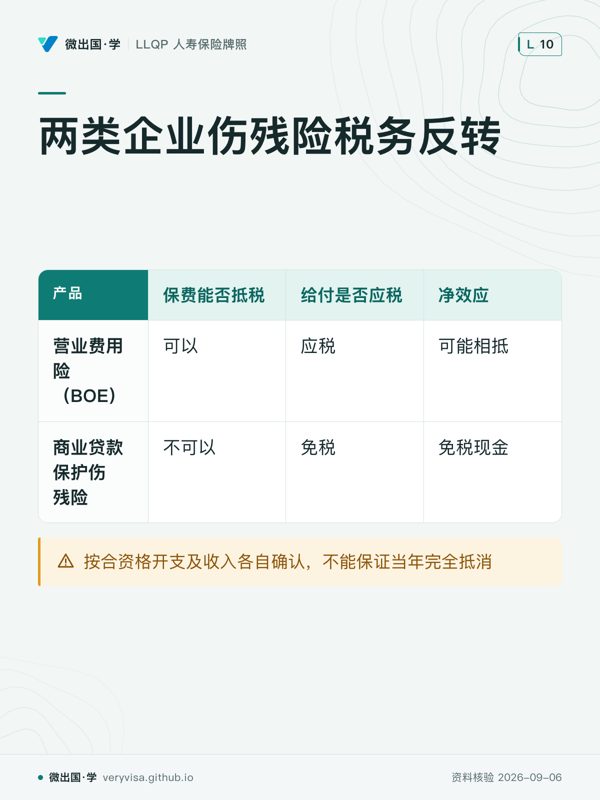
税务:分别记录可扣费用与保险收入 :BOE 的保费可以 作为营业费用抵税,但给付应税 (因为报销的开支本身在没有保险时也是可抵税支出,保险公司替企业垫付了这笔开支,等于替企业"实现"了这笔应税收入)。给付与对应可扣经营费用可能相抵,但金额、确认年度和资格未必相同,不能承诺净税效应为零——这条常被拿来跟商业贷款保护伤残险对比出题:
⚠️
两种产品税务处理正好相反,不能凭"抵税就划算"这种直觉判断
商业贷款保护伤残险专款专用于偿还合格商业贷款本息(考试口径举例采用3年盈利史、约$10,000/月×24个月或一次性$250,000且不超过贷款余额75%;这些不是已核实的现售统一参数),与 BOE 不能就同一笔贷款重复理赔 ——如果一笔商业贷款的利息已经算进 BOE 的可报销开支,就不能再用商业贷款保护险对同一笔贷款重复申请给付。题干把这两种产品的税务处理讲反、或暗示两者可以对同一笔债务叠加理赔,是常见陷阱。
2.3 关键人伤残险:考试口径示例与实际核保参数
考试口径举例的持股上限落在10%–50% 之间,表示不同产品可能设不同阈值;不是持股处于这个区间一概失格,具体资格依产品;给付上限常见为年薪的100% ,考试口径给出约 $15,000/月 的封顶。这类具体承保参数是各保司核保指引的内部数字,RBC 与 Canada Life 的关键人险官网产品页均未公开具体的持股比例上限或月度给付封顶(这类数字通常不对外网站公开)——考试口径给出的区间应作为行业惯例值使用,实际承保额度以客户签约保司当前核保指引为准 ;等待期 30–90 天 ,给付期通常不超过 12 个月 (比 BOE 更短,因为关键人险要覆盖的是"招到并培养出替代者"这段有限窗口,不是长期收入替代)。常见附加险三种:保费豁免(waiver) 、复发条款(recurrent) 、替代招聘费用附加险(replacement expense) ——最后一项直接把猎头费、培训双薪这类具体开支纳入给付计算,比单纯的年薪倍数更贴近实际损失。
关键人伤残给付额怎么估算,与人寿关键人险不同 :life-ch08-business-life 讲过的关键人寿险 保额估算(收入倍数法、利润贡献法、替代与债务保障法)着眼的是"这个人永久消失"的一次性损失;关键人伤残 险因为给付期通常不超过 12 个月,估算逻辑更窄——核心问题是"这段有限窗口里,企业每个月要多付出多少钱才能撑住",通常直接按"该关键人月薪 × 一个合理倍数(覆盖招聘、培训、短期生产力损失)"再对照 $15,000/月这类保司封顶做校正,而不是像寿险那样去估算他对企业毛利润的长期贡献份额。这个差异本身就是一道好考题:题干如果把关键人险的保额估算方法在寿险与伤残险之间张冠李戴,就是常见的"同名不同算法"陷阱。
2.4 买卖协议伤残买断险:协议与实际保单对齐
定义门槛比一般 DI 更严——常见写法是"regular occupation 且完全没有工作 "(不是 own occ 那种"可以从事其他工作照领不误"的宽松定义,也不是纯粹的 any occ),考试口径给出等待期区间 12–24 个月 (本页 2026 现行核实:RBC 官网确认其买卖协议伤残险等待期为 360 天 ,约合 12 个月,落在考试口径区间下限,见 RBC Insurance );给付形态考试口径写"常仅一次性,或 50% 一次性+分期",RBC 现行给出更具体的选项——60 期等额月付、一次性、或两者组合 (RBC Insurance );保额常见上限 $1,000,000 ,部分可达 $2,000,000 ;考试口径示例中60岁后每年递减20%,实际保单须另核龄减表 (这是本章最容易被当成固定保额忽略的一条,见第七节);未来购买权(FPO)可能允许免新增医疗证据增购,财务证明、额度及行使窗口仍须满足;终止与转换条款处理股东退出或企业解散时保单的去留。
2.5 其他企业保险计划:一项已核实机制变化,一项法定/惯例值需分身份判断
企业还常配套三类附加计划:
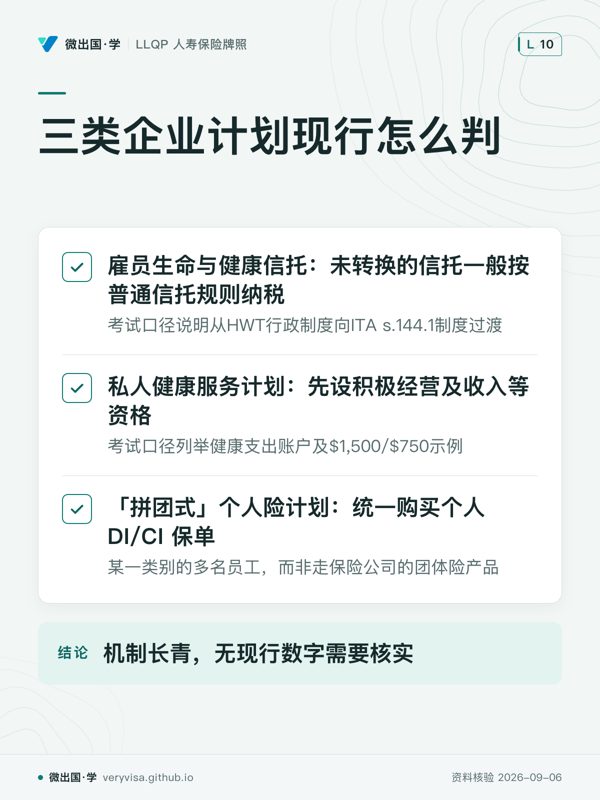
现行法条的出处是联邦《Income Tax Act》,不是 BC 省同名法。联邦 s.20.01(2)(b) 在符合雇员覆盖条件的期间限制为可比保障成本;s.20.01(2)(c) 对不属于该分支的期间,按年内天数比例计算 $1,500/$750 金额;如另符合 s.20.01(2)(d),还须取该公式与可比保障成本的较低者。使用这些分支前仍须满足 s.20.01(1) 的资格,不能把扣除限制称为所有 PHSP 的供款上限。(联邦现行原文,加拿大联邦法规库 ;BC 同名法,定义中的 federal Act )
🔧
PHSP 在小企业主/自雇者身上最常见的用法
PHSP 报销的是医疗支出 (牙科、视力、处方药这类 MSP 不覆盖或覆盖不足的项目),不是收入替代,也不是营业费用——它跟 BOE、关键人险、买断险不是同一类产品,不能互相替代,只能作为整体保障拼图里补"医疗自付部分"这一块的工具。一人公司或小型合伙企业常用它给业主自己和家庭成员报销日常医疗开支,是否可扣及是否产生福利须核实际PHSP结构、费用与参加身份;股东个人开销不能仅因由公司付款就变成免税雇员福利。
节末检索小测 · 先别往回翻,凭记忆作答 Quick recall check: answer from memory before scrolling back
Clara operates an unincorporated graphic design business as a sole proprietor with no regular employees. She sets up a qualifying Private Health Services Plan (PHSP) covering herself, her spouse, and her two children aged 10 and 14. Under the exam's reference to the federal Income Tax Act rules for a self-employed individual without arm's-length employees, what is the annual deduction limit framework for her PHSP premiums?
Clara以独资经营一家未注册成立公司的平面设计企业,没有全职雇员。她设立了一份合资格的私人健康服务计划(PHSP),覆盖她本人、配偶以及分别为10岁和14岁的两个孩子。根据考试口径援引的联邦《所得税法》针对无独立雇员自雇者的规定,她PHSP保费的年度抵扣限额框架是什么?
a Up to $1,500 each for herself and her spouse, plus up to $750 for each child under age 18, subject to active business income qualification and period proration. ✓ 正确。根据联邦《所得税法》第20.01条(ITA s.20.01)及考试口径,自雇者在满足积极经营收入等资格且不适用雇员可比保障分支时,按期间折算的扣除限制为成人每人$1,500(Clara与配偶各$1,500)、未满18岁子女每人$750(两名子女各$750),总额最高$4,500。 Correct. Under Income Tax Act s.20.01 and exam conventions, when a self-employed individual meets active business income requirements and the employee-equivalent coverage branch does not apply, the period-prorated deduction limit is $1,500 per adult ($1,500 each for Clara and her spouse) plus $750 per child under age 18 ($750 for each of the two children), reaching a maximum total limit of $4,500.
b Unlimited tax deductibility for every family medical expense, because a PHSP set up by any business owner has no statutory deduction limit or eligibility test. ✗ 错误(无限抵税陷阱)。自雇者的私人健康服务计划(Private Health Services Plan, PHSP)受联邦《所得税法》第20.01条严格限制,并非无限额抵税,且股东或业主个人开销不能仅因企业付款就无条件全额免税扣除。 Incorrect. Falls into the Unlimited Deduction trap: A self-employed individual's Private Health Services Plan (PHSP) is strictly limited by Income Tax Act s.20.01 and does not offer unlimited deductions; personal expenses of an owner or shareholder cannot be deducted tax-free simply because the business paid them.
c Zero tax deductibility unless Clara converts her PHSP into a Health and Welfare Trust (HWT) under the pre-2021 administrative rules. ✗ 错误(福利工具混淆陷阱)。健康福利信托(Health and Welfare Trust, HWT)旧行政规则自2021年底后已停止适用,且合资格的自雇者无需转为HWT即可按ITA s.20.01规则在限额内抵扣PHSP费用。 Incorrect. Falls into the Benefit Tool Confusion trap: Legacy administrative rules for Health and Welfare Trusts (HWT) ended after 2021, and an eligible self-employed individual does not need to convert to an HWT to deduct PHSP expenses within statutory limits under ITA s.20.01.
d A flat $15,000 monthly deduction limit matching the standard industry cap for key person disability insurance. ✗ 错误(数字张冠李戴陷阱)。$15,000/月是考试口径中关键人伤残险(key person disability insurance)的常见月度给付上限示例,与私人健康服务计划(PHSP)的税务扣除限额无关。 Incorrect. Falls into the Misattributed Figures trap: $15,000 per month is an exam example of the common monthly benefit cap for key person disability insurance, and has no relation to the tax deduction limits for a Private Health Services Plan (PHSP).
看答案与每个选项的解析 Show the answer and why each option is right or wrong 答案 Answer :a
三、2026 市场:谁在卖、产品叫什么、柜台怎么说 本节回答 This section answers 现售企业伤残险在等待期、合伙人数与月度限额上的实务核实特征 Practical verification characteristics of current business disability products regarding waiting periods, partner counts, and monthly limits
以下公司与产品线名均于 2026-09-04 从官方页回源核实(编号 RBC Insurance 至 05),促销数字与保费一律不写;未能官方核实的产品细节不作在售事实使用。
RBC Insurance ——现行个人 DI 旗舰产品 官方 BOE 产品页列明 Business Overhead Expense Insurance,是费用报销保障;Professional Series 指南把企业产品列为需另行比较的组合,不能据此认定一定是该DI的内含或附加责任,对应考试口径 5.3.1。RBC 另有独立的 Buy Sell Insurance 产品页,官网原文确认其伤残买断部分等待期为 360 天 、面向 2–5 名合伙人 的合伙企业或专业公司、要求在业满 3 年以上且净值达 $50,000 以上、保单维持到被保人 64 岁或离开公司为止,给付可选 60 期月付、一次性、或组合(RBC Insurance )——它解决的正是考试口径 5.4.2 讲的"买卖协议必须有资金支持"这个问题,且给出了考试口径只用区间描述的具体数字。
Canada Life ——官网把"关键人保险"列为其商业保险的独立产品类别,且明确写出伤残触发条件("if you, or a key employee is suddenly unable to work",Canada Life ),对应考试口径 5.5.1;同一产品家族下的个人 DI 页面(面向自雇者/企业主)明确写出给付可用于"购买因伤残丧失工作能力的股东或合伙人的股份"(Canada Life ),对应考试口径 5.4.2 买断险;该页也提及可覆盖企业营运开支,与 BOE 机制呼应,Canada Life官方顾问指南另列明确命名的 Overhead expense plan(November 2024 series),不能因消费者网页没单列就认为没有产品。
iA Financial Group ——现行 Superior Program 与 Acci-Jet Program 把"overhead expenses"列为可承保项目,官网明确定义"企业运营的固定开支,业主伤残时可获覆盖",并标注业主/自雇者的"营业费用"给付最高可见 $6,000/月 (iA Financial Group )——这是 BOE 险现行在售最具体的一条月度数字来源,对应考试口径 5.3.1;iA 页面未见关键人险或买断险的独立命名产品。
它们分别对应考试口径的哪个概念 :RBC BOE 费用报销产品对应5.3.1;RBC Buy Sell Insurance 对应 5.4.2(且把考试口径"12–24 个月"的区间精确到了 360 天);Canada Life 的关键人险栏目对应 5.5.1;Canada Life 的自雇 DI 页对应 5.4.2 与 5.3.1 的交叉;iA 的 overhead expenses 条款对应 5.3.1。
历史产品清单与当前新售产品须分开核实。已取得RBC、Canada Life及iA官方页面可作比较样本;其他公司网页未检索到独立产品,或访问失败,都不能证明其退出。未取得保险人原始公告的停售日期、原因和市场集中度不作已核事实,签发资格与现有保单服务须直接核保险人文件。
节末检索小测 · 先别往回翻,凭记忆作答 Quick recall check: answer from memory before scrolling back
Three partners who have operated an engineering partnership for five years with a net worth of $300,000 are reviewing current commercial disability buyout policies in the marketplace to fund their buy-sell agreement. How do verified current market offerings align with the exam's conceptual framework for disability buyout coverage?
三位合伙人经营一家工程合伙企业已满五年,净值达$300,000,目前正在审视市场上现售的商业伤残买断保单以为其买卖协议提供资金。已核实的现行市场产品特征如何与考试口径的伤残买断险概念框架相对应?
a Current standalone buyout policies use a 30-day waiting period and pay monthly expense reimbursements capped at $6,000 per month. ✗ 错误(把BOE与关键人参数混入买断险陷阱)。30–90天等待期属于关键人伤残险或BOE,最高$6,000/月是现行市场某营业费用险(BOE)条款的月度给付上限样本,而非伤残买断险参数。 Incorrect. Falls into the Conflating BOE and Key Person Parameters with Buyout trap: Waiting periods of 30 to 90 days apply to key person disability or BOE, and up to $6,000 per month is an observed modern market sample limit for a BOE contract rather than a disability buyout parameter.
b Current market buyout policies specify a 360-day waiting period—at the lower end of the exam's 12-to-24-month range—and offer lump-sum, 60-month installment, or combined payouts. ✓ 正确。讲座第三节核实现行在售的独立买卖协议伤残买断险(disability buyout insurance)面向2–5名合伙人、在业满3年且净值达$50,000以上的企业,等待期为360天(正好对应考试口径12–24个月区间的下限),给付可选60期等额月付、一次性或两者组合。 Correct. Verified modern stand-alone buy-sell disability buyout insurance is available for businesses with 2 to 5 partners, in operation for at least 3 years, and having a net worth of at least $50,000; it features a 360-day elimination period (matching the lower end of the exam's 12-to-24-month range) and offers payout options of 60 equal monthly instalments, a lump sum, or a combination.
c No insurer in the current market offers any coverage for business overhead expenses or buy-sell disability triggers because all carriers have exited the market. ✗ 错误(未经核实断言退出市场陷阱)。讲座明确指出多家保险公司现行仍提供营业费用险(BOE)、关键人伤残险及伤残买断险,不能将部分公司网页未单列或二手传闻当成全行业退出。 Incorrect. Falls into the Unverified Assertion of Market Withdrawal trap: Multiple Canadian insurers continue to offer BOE, key person disability, and disability buyout insurance; an insurer's omission of public web pages or second-hand rumors cannot be taken as an industry-wide market withdrawal.
d Current buyout policies remain in force until age 85 with a guaranteed level face amount and no minimum years-in-business requirement. ✗ 错误(忽略核保与终止年龄陷阱)。现行核实的买断产品通常要求在业满3年以上且净值达$50,000以上,保单维持到被保人64岁或离开公司为止,且考试口径强调60岁后有年龄递减而非维持终身平准保额。 Incorrect. Falls into the Overlooking Underwriting Criteria and Termination Age trap: Verified modern buyout products typically require at least 3 years in business and net worth over $50,000, maintain coverage until age 64 or leaving the business, and feature post-age-60 reductions rather than lifelong level benefits.
看答案与每个选项的解析 Show the answer and why each option is right or wrong 答案 Answer :b
四、实务流程:三种产品各自怎么落地,代理人在哪一步做什么 本节回答 This section answers 买卖协议伤残触发差异、代理人各阶段动作与三层保障拼图 Buy-sell agreement disability trigger nuances, advisor action steps across each phase, and the three-layer protection framework
4.1 买卖协议资金结构:链接而不重复
买卖协议的三种资金结构——交叉持有(cross-purchase)、公司赎回(entity purchase / share redemption)、混合法(本票法)——在死亡触发下的机制、税务后果与选择逻辑,life-ch08-business-life 第三节已经完整讲过,本页不重复。伤残触发下唯一的实质差异是:等待期极长 (12–24 个月,现行 RBC 产品为 360 天),给付形态更灵活 (一次性、分期、或组合,而不是寿险那种一次性死亡给付),以及60 岁后保额每年递减 20% ——这三条是伤残买断险相对身故买断险独有的设计,题干如果把死亡买断的机制原样套到伤残买断上(比如假设伤残买断也是纯一次性、没有龄减),就是典型的"同一份协议、不同触发条件"混淆。
4.2 BOE 与关键人险的销售/服务流程
4.3 PHSP 与个人 DI 的整合位置
一份完整的企业主保障方案,通常是 BOE(企业固定开支)+ 个人 DI 或团体计划(业主个人收入)+ PHSP(医疗自付部分)三层叠加,缺一层就会在对应场景下出现保障空白:只有 BOE 没有个人 DI,业主自己没有收入来源;只有个人 DI 没有 BOE,企业固定开支没人管;有了这两层,PHSP 补的是两者都不管的日常医疗账单。第六节的三个案例会分别展示这三层怎么落地到具体人身上。
节末检索小测 · 先别往回翻,凭记忆作答 Quick recall check: answer from memory before scrolling back
An insurance advisor is designing a comprehensive protection plan for Nadine, who owns a veterinary clinic with four employees. Nadine already has a business overhead expense (BOE) policy for the clinic and a qualifying Private Health Services Plan (PHSP). Why does the advisor point out that a critical gap still exists in Nadine's overall protection?
一位保险顾问正在为拥有一家四名员工兽医诊所的Nadine设计全面保障方案。Nadine已经为诊所配置了营业费用险(BOE)以及合资格的私人健康服务计划(PHSP)。为什么顾问指出Nadine的整体保障中仍然存在一个关键缺口?
a Neither BOE nor a PHSP replaces Nadine's personal income if she becomes disabled, so she still needs individual or grouped disability income insurance. ✓ 正确。完整的企业主保障方案由BOE(企业固定开支)、个人伤残收入险(individual DI)或团体计划(业主个人收入替代)以及PHSP(日常医疗自付账单)三层叠加;只有BOE和PHSP而没有个人DI时,Nadine失能期间自己家里没有个人收入来源。 Correct. A complete protection package for a business owner stacks three layers: BOE (covering fixed business overhead), individual disability insurance or a group plan (replacing the owner's personal income), and a PHSP (reimbursing routine out-of-pocket medical expenses); having only BOE and a PHSP without personal DI leaves Nadine with no personal income stream during disability.
b The PHSP will reimburse the clinic's commercial rent and staff wages, making the BOE policy redundant. ✗ 错误(混淆PHSP与BOE功能陷阱)。私人健康服务计划(PHSP)只报销牙科、视力、处方药等医疗支出,绝不报销企业营业费用,不能替代营业费用险(BOE)。 Incorrect. Falls into the Confusing PHSP with BOE Functions trap: A Private Health Services Plan (PHSP) reimburses only health expenses like dental, vision, and prescription drugs, never business overhead expenses, and cannot replace business overhead expense (BOE) insurance.
c During a BOE claim, the insurer pays a fixed monthly benefit automatically without requiring Nadine to submit invoices or payroll records. ✗ 错误(混淆报销制与定额给付陷阱)。营业费用险(BOE)是报销制(reimbursement basis)而非定额给付,理赔时代理人需协助企业整理房租、水电、工资发放记录及供应商发票等实际单据。 Incorrect. Falls into the Confusing Reimbursement with Stated Amount trap: Business overhead expense (BOE) insurance operates on an expense-incurred reimbursement basis rather than a fixed stated amount, requiring the advisor to help assemble actual receipts such as rent, utility bills, payroll records, and vendor invoices at claim time.
d Because the clinic has four employees, it exceeds the size threshold for BOE and must replace the BOE policy with a cross-purchase buyout plan. ✗ 错误(人数门槛与产品错配陷阱)。5人以下的小型企业正是BOE最典型的适用场景,且Nadine是单一业主,不需要合伙人之间的交叉购买(cross-purchase)伤残买断协议。 Incorrect. Falls into the Employee Threshold and Product Mismatch trap: Small businesses with fewer than five staff are the primary target market for BOE; furthermore, Nadine is a sole owner who does not need a cross-purchase disability buyout agreement designed for multi-owner partnerships.
看答案与每个选项的解析 Show the answer and why each option is right or wrong 答案 Answer :a
五、历史资料与现行投保资格分开核对 本节回答 This section answers 区分历史清单与现售资格,及HWT向ELHT过渡的税务后果 Distinguishing historical product lists from current eligibility, and tax consequences of transitioning from HWT to ELHT
历史产品清单与当前新售产品须分开核实。已取得RBC、Canada Life及iA官方页面可作比较样本;其他公司网页未检索到独立产品,或访问失败,都不能证明其退出。未取得保险人原始公告的停售日期、原因和市场集中度不作已核事实,签发资格与现有保单服务须直接核保险人文件。
历史产品清单与当前新售产品须分开核实。已取得RBC、Canada Life及iA官方页面可作比较样本;其他公司网页未检索到独立产品,或访问失败,都不能证明其退出。未取得保险人原始公告的停售日期、原因和市场集中度不作已核事实,签发资格与现有保单服务须直接核保险人文件。
ELHT 与 HWT 的变化主要是税务制度过渡。2018年联邦提出结束HWT旧行政待遇;CRA自2021年底后不再适用该套规则。未转换者一般按普通信托纳税,符合条件的过渡选择另按ITA s.144.1办理,不能把税务优惠终止叙述为所有旧信托被强制撤销。
节末检索小测 · 先别往回翻,凭记忆作答 Quick recall check: answer from memory before scrolling back
During a policy review in 2026, a corporate client asks their advisor about two issues: first, an older Health and Welfare Trust (HWT) established years ago that was never converted into an Employee Life and Health Trust (ELHT); second, an insurer whose website does not display a standalone key person disability page. Which statement accurately reflects how the advisor should verify and explain these items?
在2026年的一次保单检视中,一位企业客户向顾问询问两件事:第一,公司多年前设立但一直未转换为雇员生命与健康信托(ELHT)的旧健康福利信托(HWT);第二,某家保险公司消费者网页上未单独列出关键人伤残险页面。哪项陈述准确反映了顾问应如何核实并解释这两项内容?
a All unconverted HWTs were automatically dissolved by statute at the end of 2021, and any insurer without a standalone consumer web page has legally exited the market. ✗ 错误(夸大强制撤销与盲目断言停售陷阱)。税局自2021年底停止适用HWT旧行政规则,并非法律强制所有未转换信托解散;同样,消费者网页未单列产品不能证明保险公司已退出市场。 Incorrect. Falls into the Exaggerating Forced Revocation and Asserting Market Withdrawal trap: The CRA discontinued legacy administrative positions on HWTs after 2021, but did not enact a statutory mandate to dissolve all unconverted trusts; similarly, the absence of public product listings does not prove insurers have withdrawn from the market.
b Unconverted HWTs are generally taxed under ordinary trust rules rather than abolished, and current issue eligibility must be checked directly in the insurer's own documents. ✓ 正确。根据第五节,CRA自2021年底不再对旧健康福利信托(Health and Welfare Trust, HWT)适用旧行政待遇,未转换为雇员生命与健康信托(Employee Life and Health Trust, ELHT)的信托一般按普通信托规则纳税而非强制撤销;历史产品清单与现行投保资格须直接核对保险人文件。 Correct. The CRA no longer applies legacy administrative positions to Health and Welfare Trusts (HWT) after 2021, and trusts that did not transition to Employee Life and Health Trusts (ELHT) are generally taxed as ordinary trusts rather than forcibly revoked; historical product schedules and current underwriting eligibility must be verified directly against insurer documents.
c The old HWT continues to enjoy pre-2021 administrative tax preferences indefinitely, and historical exam insurer lists guarantee current policy issuance. ✗ 错误(忽略税务过渡与历史资料时效陷阱)。HWT旧行政规则已于2021年底终止,且历史清单不能直接当成当前新单签发资格的保证。 Incorrect. Falls into the Overlooking Tax Transition and Outdated Historical Data trap: Legacy HWT administrative guidelines expired at the end of 2021, and historical product schedules cannot be treated as guarantees of current underwriting availability.
d An unconverted HWT automatically becomes a Private Health Services Plan (PHSP) with a $15,000 monthly tax-free payout. ✗ 错误(概念混同陷阱)。未转换的HWT按普通信托规则处理,不会自动变成PHSP,更不存在$15,000月度免税给付的规定。 Incorrect. Falls into the Conceptual Confusion trap: Unconverted HWTs are governed by ordinary trust tax rules, do not automatically convert into PHSPs, and have no provision for $15,000 monthly tax-free payouts.
看答案与每个选项的解析 Show the answer and why each option is right or wrong 答案 Answer :b
六、案例 本节回答 This section answers 诊所BOE结转实算、买断60期给付衔接与一人公司自留风险 Clinic BOE carryover calculation, buyout 60-month instalment coordination, and single-shareholder self-insured retention 本章考题 4 Question 4
案例一:列治文诊所——BOE 月度封顶、结转机制怎么算
列治文一家小型牙科诊所,业主一人执业加 3 名员工,投保 BOE:月度封顶 $8,000,给付期 24 个月 ,总封顶 $8,000 × 24 = $192,000 。假定业主已度过等待期,随后六个月均符合失能定义及报销条件,费用如下(房租、员工工资、水电、贷款利息、会计费):
六个月合计报销 $7,200 + $8,800 + $8,000×4 = $48,000 ,远低于 $192,000 的总封顶,实际费用$48,100中报销$48,000,仍有第二个月的$100未报销;本例只设额度结转,不另设超支费用结转。这一笔给付需要计入诊所应税收入 ,但当初支付的房租、工资、水电本身也是可抵税的营业费用——两相抵消,诊所实际税负变化很小。业主的个人薪水本身不在 这份 BOE 的报销范围内,他失能期间的个人收入需要靠单独的个人 DI 或团体计划来补。
案例二:素里两位合伙人——买卖协议伤残买断怎么触发、怎么给付
素里一家会计师事务所由两位合伙人共同经营,签有买卖协议并配套伤残买断险,等待期 360 天 (现行 RBC 结构),定义为"regular occupation 且完全没有工作"。合伙人甲因慢性病导致无法继续执业,从满足保单伤残定义并持续失能之日起按条款计算等待期,不能直接用确诊日起算;协议另有自己的买卖触发条件。事务所选择的给付形式是60 期等额月付 而非一次性——好处是不需要一次性抽调大额现金,须由协议确定买方如何向甲付款,并核保险金收款人与60期给付怎样衔接;保险分期不等于乙必须以自有资金独担五年付款,期间事务所的现金流规划必须把这笔固定支出纳入考虑。若甲在 62 岁触发买断(保单约定 60 岁后每年递减 20%),实际可用保额已经从原始保额打了折扣——这也是为什么买卖协议应当定期复核,而不是签一次就一劳永逸。
案例三:一人公司——按费用与经济利益判断需要
本拿比建筑设计顾问以一人有限公司经营,没有雇员。先列家庭生活费、公司固定开支、既有储备及客户项目受损成本:若固定开支较小且储备充足,可以合理自留BOE层风险,但不是一人公司依法不能投保。公司可能对业主的工作能力有经济利益,关键人产品是否接受高持股者还要看核保条件,不能仅因业主与关键人同一人就否认可保利益。本例假定比较后个人DI与合资格PHSP优先,公司固定费用由储备承担,并记录储备可撑多久。以后引入合伙人或核心员工,再核买卖融资与关键人需要。
节末检索小测 · 先别往回翻,凭记忆作答 Quick recall check: answer from memory before scrolling back
Victor operates a structural engineering consultancy as a single-shareholder corporation with no employees. He works from a home office with minimal fixed corporate overhead and holds six months of liquid cash reserves inside the corporation, but his family relies entirely on his consulting drawings for living expenses. Based on the case analysis framework, how should Victor's disability needs be prioritized?
Victor以一人有限公司形式经营一家结构工程咨询公司,没有雇员。他在家庭办公室工作,公司固定运营开支极小,且公司账上留有可撑六个月的流动现金储备,但他的家庭生活费完全依赖他的咨询收入。根据案例分析框架,应如何排列Victor伤残保障需求的优先级?
a A single-shareholder corporation is legally prohibited from purchasing BOE or key person coverage because an owner-employee never creates insurable interest. ✗ 错误(误判一人公司法律资格与可保利益陷阱)。案例三明确指出,一人公司并非依法不能投保BOE,公司对业主的工作能力依然可能有经济利益(insurable interest),只是需结合固定费用规模、既有储备及核保条件综合判断。 Incorrect. Falls into the Misjudging Single-Shareholder Eligibility and Insurable Interest trap: Case 3 explicitly clarifies that a single-shareholder corporation is not legally barred from purchasing BOE, and the company still maintains an insurable interest in the owner's working capacity; the decision simply requires balancing fixed overhead scale, existing reserves, and underwriting guidelines.
b Put individual DI and a qualifying PHSP first, self-insure the small corporate overhead from reserves, and revisit buyout or key person cover if partners or staff join. ✓ 正确。根据案例三,当一人公司固定开支很小且现金储备充足时,可以合理自留营业费用险(BOE)层面的风险,优先配置个人伤残险(individual DI)保障家庭生活费及合资格私人健康服务计划(PHSP),待日后引入合伙人或核心员工时再核查买卖协议融资与关键人险。 Correct. Under Case 3, when a single-shareholder corporation has minimal fixed overhead and sufficient cash reserves, it can reasonably self-insure the BOE exposure and prioritize individual disability insurance (DI) to protect personal household income alongside a qualifying PHSP, deferring buy-sell funding and key person coverage until partners or staff are added.
c Immediately purchase a cross-purchase disability buyout policy with a 360-day waiting period as his primary protection. ✗ 错误(无合伙人却配买断险陷阱)。Victor是一人公司且没有其他股东或合伙人,目前不存在合伙人之间互相买断股份的需求,无需在现阶段优先配置交叉购买伤残买断险(disability buyout insurance)。 Incorrect. Falls into the Recommending Buyout Without Partners trap: Victor operates a single-shareholder corporation without other shareholders or partners, meaning no buy-sell transfer need exists, so arranging cross-purchase disability buyout insurance is unnecessary.
d Buy only a BOE policy so that the monthly benefit can directly pay his family's groceries and residential mortgage payments. ✗ 错误(BOE范围混淆陷阱)。营业费用险(BOE)只报销企业实际发生的合格固定运营开支,绝不能用来支付业主本人的薪水或家庭生活开支。 Incorrect. Falls into the BOE Scope Confusion trap: Business overhead expense (BOE) insurance reimburses only actual eligible fixed business overhead incurred by the enterprise, and can never pay an owner's personal salary or residential household expenses.
看答案与每个选项的解析 Show the answer and why each option is right or wrong 答案 Answer :b
七、考试陷阱与考场与现行对照清单 本节回答 This section answers 八大高频命题陷阱盘点与考场对柜台四项双口径对照 Review of eight high-frequency exam traps and four exam-versus-practice dual perspectives
BOE 不报销业主自己的薪水 (陷阱形态:范围混淆)。它保的是企业的固定运营开支,不是业主的个人收入替代——题干如果暗示"BOE 给付可以直接补贴业主本人的生活费",是常见错误。业主个人收入损失要靠个人 DI 或团体计划来补。BOE 与商业贷款保护伤残险的税务处理正好相反 (陷阱形态:机制混淆)。BOE 保费可抵税、给付应税,净效应接近抵消;商业贷款保护险保费不可抵税、给付免税。题干如果说两者税务处理"一样"或"顺序反了",都是错的。关键人险的给付付给企业,不是付给受伤的那个人 (陷阱形态:受益人错配)。关键人险的受益人始终是企业本身,用来弥补企业的营收下滑与替代成本——题干如果暗示给付会直接进入关键员工个人账户,混淆了它与个人 DI 的受益结构。关键人险的持股上限 10%–50% 是区间,不是固定数字 (陷阱形态:把区间当定值)。各保司标准不同,考试口径给出的是常见区间;题干如果给出一个具体数字并暗示这是"唯一正确门槛",要留意这只是行业惯例区间的一个样本值。伤残买断险 60 岁后每年递减 20%,不是固定保额到终身 (陷阱形态:忽略递减条款)。案例二里合伙人甲 62 岁触发买断时可用保额已经打折——题干如果按原始投保额直接计算给付,忽略了年龄递减这一步,就会算错。买卖协议没有资金支持只是一纸空文 (陷阱形态:漏算一步,与 企业寿险:关键人、买卖协议与公司持有保单,温哥华小老板最常问的三件事 同一条纪律的伤残版本)。协议本身只约定"谁买、什么价",没有寿险或伤残买断险的资金支持,触发时协议可能无法真正执行。伤残买断险的定义门槛比一般 DI 更严 (陷阱形态:定义级别混淆)。它常用"regular occupation 且完全没有工作"这种复合门槛,比单纯的 own occ 更严——题干如果按 own occ 的宽松标准(可以从事其他工作照领不误)去判断买断险是否触发,会得出错误结论。交叉持有随股东数量增加会迅速变得难以管理 (陷阱形态:忽略规模效应,与 企业寿险:关键人、买卖协议与公司持有保单,温哥华小老板最常问的三件事 一致的机制在伤残场景下同样成立)。三位以上股东用交叉持有需要的保单数量按排列组合式增长,题干如果暗示"股东数量不影响结构选择",忽略了这条现实约束。
考场与现行对照清单(考场 vs 柜台) :① 业主残疾风险统计——考场按考试口径 1985 年精算表数字答,柜台只用其结论性判断,不背具体百分比,原始统计及替换日期未核实,不作为现行概率(本页 2.1);② 关键人险给付上限约 $15,000/月——考试口径行业惯例值,柜台需按具体保司现行核保指引核实,不能直接照搬(本页 2.3);③ 买卖协议伤残买断等待期——考试口径给区间 12–24 个月,柜台按具体保单条款(RBC 现行 360 天,本页 2.4);④ PHSP 供款上限 $1,500/$750——柜台先确认客户是自雇适用s.20.01的哪项分支、是否有合资格雇员,以及公司安排是否符合PHSP和雇员福利条件(本页 2.5)。
边学边测 :本章题库共 40。
节末检索小测 · 先别往回翻,凭记忆作答 Quick recall check: answer from memory before scrolling back
Four equal shareholders of an architectural firm want to fund a disability buy-sell agreement and ask whether they should use a cross-purchase structure or an entity purchase (share redemption) structure, and what disability definition applies. Which statement avoids the common exam traps identified in this chapter?
一家建筑事务所的四位等额股东希望为一份伤残买卖协议安排保险资金,并询问应当采用交叉持有结构还是主体购买(股份赎回)结构,以及适用何种失能定义。哪项陈述避开了本章指出的常见考试陷阱?
a The number of shareholders has no impact on policy administration, so four shareholders only need four policies in total under a cross-purchase structure. ✗ 错误(忽略规模效应陷阱)。当股东人数达到三位以上时,交叉持有结构(cross-purchase agreement)所需的保单数量按排列组合式增长(4位股东互持需4×3=12份保单),管理会迅速变得繁琐,此时公司持有的主体购买(entity purchase)结构更易管理。 Incorrect. Falls into the Overlooking Economy of Scale trap: When shareholder count reaches three or more, the number of policies required under a cross-purchase structure multiplies combinatorially (4 shareholders require 4 x 3 = 12 policies), quickly becoming administratively burdensome; an entity-purchase (share redemption) structure owned by the corporation is far simpler to administer.
b A signed buy-sell agreement automatically guarantees cash will be available at disability even without insurance policies backing it. ✗ 错误(无资金支持空文陷阱)。买卖协议本身只约定谁买、什么价,如果没有伤残买断险等资金支持,触发时协议只是一纸空文,可能无法真正执行。 Incorrect. Falls into the Unfunded Agreement Trap: A buy-sell agreement merely specifies who buys and at what price; without backing insurance funds like disability buyout coverage, the agreement remains an unfunded document that may prove impossible to execute when triggered.
c Disability buyout insurance uses a strict composite definition—unable to perform one's regular occupation and not working at all—and cross-purchase becomes unwieldy as shareholder count grows. ✓ 正确。根据第七节考试陷阱清单,伤残买断险(disability buyout insurance)的定义门槛比一般DI更严,常采用“常规职业(regular occupation)且完全没有工作”的复合标准(而非宽松的own occupation),且股东人数较多时交叉持有保单数量剧增、难以管理。 Correct. Buy-sell disability buyout insurance employs a stricter composite definition than ordinary personal DI, requiring inability to perform one's regular occupation and not working at all (rather than a liberal own-occupation standard); furthermore, as the number of shareholders grows, cross-purchase policy counts multiply rapidly, making administration cumbersome.
d If a disabled shareholder cannot perform their own specialty but works full-time in another lucrative profession, the disability buyout benefit will still trigger and pay out in full. ✗ 错误(失能定义级别混淆陷阱)。那是一般个人DI中宽松本职职业(own occupation)的特征;伤残买断险要求满足“regular occupation且完全没有工作”,全职从事其他工作不会触发买断给付。 Incorrect. Falls into the Disability Definition Level Confusion trap: Working in another occupation while disabled from one's specialty reflects a liberal own-occupation feature in personal DI; disability buyout insurance requires being unable to perform one's regular occupation and not working at all, so full-time work in another lucrative profession does not trigger buyout benefits.
看答案与每个选项的解析 Show the answer and why each option is right or wrong 答案 Answer :c
术语双语表
来源
Canada Life, "How key person insurance can help your business"(Canada Life ,复用自 企业寿险:关键人、买卖协议与公司持有保单,温哥华小老板最常问的三件事 )
RBC Insurance, "Key Person Insurance"(RBC Insurance(论坛解读) ,复用自 企业寿险:关键人、买卖协议与公司持有保单,温哥华小老板最常问的三件事 )
RBC Insurance, "Buy Sell Insurance"(RBC Insurance ,复用自 企业寿险:关键人、买卖协议与公司持有保单,温哥华小老板最常问的三件事 )
RBC Insurance, "Compare Disability Insurance Plans"(RBC Insurance ,本页新抓,暂用 staging 编号)
RBC Insurance, "Buy Sell Insurance"(disability 细节页,RBC Insurance ,本页新抓)
Canada Life, "Why you should have disability insurance if you're self-employed"(Canada Life ,本页新抓)
Canada Life, "What are the different types of business insurance?"(Canada Life ,本页新抓)
iA Financial Group, "Disability and Income Insurance"(iA Financial Group ,本页新抓)
Advisor.ca, "Manulife discontinues disability products for business owners"(Advisor.ca(行业媒体) ,二手行业媒体源,本页新抓)
Insufin, "Business Overhead Expenses Coverage"(Insufin(保险经纪商) ,经纪商行业惯例说明,本页新抓)
HelloSafe, "What is disability buyout insurance? 2026 guide"(HelloSafe(比价网站) ,比价站,未采信其排他性市场结构断言,本页新抓)
ITA s.144.1(ELHT 定义条款,现行有效)——加拿大联邦法规库 ;Lawson Lundell,HWT 转换截止日期说明——Lawson Lundell LLP(法律事务所简报,二… ;联邦 ITA s.20.01(PHSP 自雇扣除资格与分支)——加拿大联邦法规库 ;TaxTips.ca(二手 PHSP 线索,不作为公司可无限抵税的依据)——TaxTips.ca(二手税务实务站,转述 CRA 立场… ;Society of Actuaries/Academy of Actuaries(2013 IDIVT 取代 1985 表)——American Academy of Actuarie… ;Desjardins 企业保险官网(无专门命名产品)——Desjardins ;The Co-operators 官网词汇表——The Co-operators
加拿大联邦法规库 :Income Tax Act s.144.1 — Employee life and health trust
加拿大联邦法规库 :Income Tax Act s.20.01 — PHSP premiums (self-employed individuals)BC Laws(Queen's Printer)(论坛解读) :Insurance Act (RSBC 2012, c 1) Part 4 — Accident and Sickness Insurance, s.101 Statutory Conditionscanada.ca :CRA保险保费应税福利canada.ca :CRA HWT administrative policy discontinuedCanada Life :What are the different types of business insurance?RBC Insurance :Buy Sell Insurance | RBC Insurancerbcinsurance.com(论坛解读) :RBC Business Overhead Expense Insurance
本页知识卡 不看正文也能拿到这一节的核心内容:先看导读,再看图。点图放大,左右翻页。
放大 ⤢ 一种保费可抵税但给付应税,另一种相反 先看 先对照前两栏的方向相反,再看最后一栏落点。易漏 经营开支与保险收入分开确认,金额、确认年度和资格未必相同。下一步 去练习,用同一笔贷款是否重复理赔来检验判断。详情与分享 → 放大 ⤢ 计划机制可延续,税务判断仍要看资格与身份 先看 先分清制度变化与资格、扣除限制,再看统一购买的安排。易漏 PHSP 的金额示例不是所有安排的统一供款上限,参加身份也要核。下一步 去讲义,把客户身份、安排结构和费用放进现行规则逐项核。详情与分享 → 本站依据官方原文自撰 · 出处见正文链接