🃏 Flashcards · 3 闪卡 · 3 张 🖼 Slides · 2 幻灯 · 2 页 ✍️ Questions · 4 刷题 · 4 道
路权与共享道路 Rules of the Road P1 必拿分 P1 Must score
ZH EN ZH + EN
先看这一章怎么考 First, how this chapter is tested
路口先后顺序判断:给出四向停车、无控制路口或左转交汇场景,测试考生是否按「先完全停住者先走→同时到达让右→对向左转让直行」的两级顺序作答,而非盲目套用「让右」或主张自身优先。 Intersection priority judgment: Given a four-way stop, uncontrolled intersection, or left-turn crossing scenario, tests whether the candidate applies the two-stage hierarchy of 'first to complete stop goes first -> yield to the right if arriving simultaneously -> left turns yield to oncoming straight traffic', rather than blindly applying 'yield to the right' or asserting personal priority. 弱势道路使用者保护:通过无斑马线路口行人、举起白手杖的视障行人、右转遇自行车或左转遇对向摩托车等情境,测试驾驶者是否主动承担更高的观察与让行义务。 Protection of vulnerable road users: Uses scenarios such as pedestrians at intersections without painted crosswalks, visually impaired pedestrians raising a white cane, right turns encountering bicycles, or left turns facing oncoming motorcycles to test whether drivers proactively take on heightened duty to scan and yield. 特种车辆法定动作对比:针对闪灯鸣笛紧急车辆、闪红灯停靠校车、打灯驶离站台公交车及执行任务消防车,测试不同情形下的停车范围、中央分隔带例外归属及限速与距离条件。 Statutory actions for special vehicles: Tests required stopping areas, the applicability of median exceptions, and speed or distance conditions across different scenarios involving flashing-light and siren emergency vehicles, school buses stopped with flashing red lights, transit buses signaling to leave a stop, and fire trucks on duty. 最常丢分的陷阱(看到题干信号就警觉) Traps that cost the most marks (watch for the signal in the stem)
只记让右忘先后 Remembering yielding to the right while forgetting arrival order 题干出现 four-way stop、uncontrolled intersection 或绿灯左转,且明确交代了到达先后或对向直行车辆。 Question stem mentions a four-way stop, uncontrolled intersection, or turning left on green, and clearly describes arrival order or oncoming straight traffic. 分隔带例外套校车 Applying the median divider exception to school buses 题干同时出现 school bus with alternating flashing red lights 与对向车道或中央分隔带(median)。 Question stem mentions both a school bus with alternating flashing red lights and oncoming lanes or a central median. 无斑马线不算横道 Assuming no painted lines means no crosswalk 题干描述路口没有画线(no painted lines)、车辆正在右转或驶出私家车道,或行人手持 white cane。 Question stem describes an intersection with no painted lines, a vehicle turning or exiting a driveway, or a pedestrian carrying a white cane. 本章考点页:导图、要点表、7 道带逐项解析的练习 →
这是卷面上最大的一块 。把 200 道汇编模拟题按主题归类后,路权、弱势道路使用者、观察与盲区、超车变道、驾驶态度、事故与紧急处置加在一起占了将近六成——远超「背数字」在中文备考圈里获得的关注度。
换句话说:笔试真正在考的不是你记住多少数字,而是「看到这个场景你会怎么做」。 这一篇讲的就是那套判断方式。
一、原理与设计逻辑 本节回答 This section answers 解答路权为何不是抢行特权,以及各类路口谁该让行的底层分配逻辑 Explains why right of way is not a privilege to force passage, and details the underlying distribution logic of who must yield at various intersections.
路权是「谁该让」,不是「谁有理」
中文里「路权」两个字容易让人误解成一种权利。它在制度上的作用恰恰相反:路权规则的唯一目的,是在两条轨迹要相交时,指定其中一方承担等待的成本。
所以它有两个特点:
路权是被让出来的,不是被主张的。 规则说「A 让 B」,不等于 B 可以闭着眼睛冲过去。考试口径反复强调的是:即使你有优先,仍要确认对方真的让了。绿灯是许可,不是路权。 绿灯只回答「你可不可以进这个路口」,不回答「你和对面那辆左转车谁先」。这是最常见的一个概念混淆。
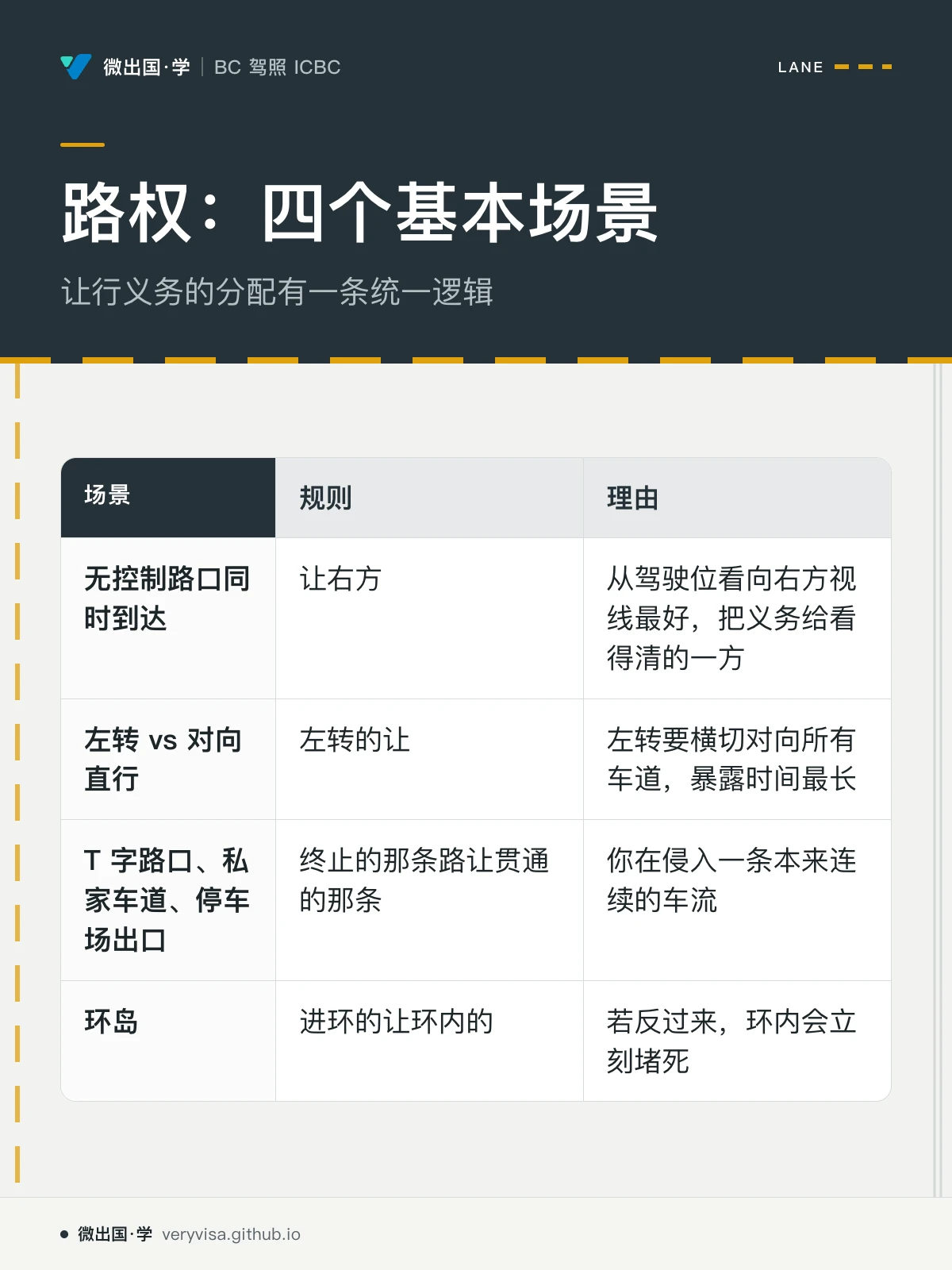
让行义务的分配有一条统一逻辑
把散落的规则排在一起,会看到同一个原则反复出现:义务落在「更能看清」或「侵入他人路径」的那一方。
图:路权:四个基本场景——让行义务的分配有一条统一逻辑
记住这条逻辑,比背下十几个场景更省力 ,而且能应付卷面上没出现过的组合。
弱势道路使用者:不对称的后果,不对称的义务
行人、骑车人、摩托车手在碰撞中承受的伤害与汽车驾驶者完全不在一个量级。制度据此把额外的注意义务加在能造成更大伤害的一方 身上——这不是道德劝告,是成文规则。
具体表现为三类容易被忽略的义务:
未标示的人行横道同样受保护 (下面详述);超越行人与骑车人须留出法定侧向距离 (1 公尺起,限速超过 50 km/h 的路上 1.5 公尺);转弯前须做肩查 ,因为你要横切的正是他们的路径。
节末检索小测 · 先别往回翻,凭记忆作答 Quick recall check: answer from memory before scrolling back
You are waiting to exit a shopping plaza driveway onto a busy street when a gap appears, while a pedestrian approaches on the sidewalk you must cross. How does the right-of-way principle apply here?
你正等待从购物广场出口车道驶入繁忙街道,此时车流出现空隙,但你即将横切的人行道上有一名行人走近。路权原则在此处如何适用?
a You may proceed first because vehicles exiting a driveway have priority before the traffic gap closes. ✗ 错误。从私家车道或商业出口驶入贯通道路属于「侵入连续车流与人行路径」(entering from a driveway),义务落在侵入方,不能因抢车流空隙而抢行,属于「无斑马线不算横道」陷阱。 Incorrect. Entering a through street from a private or commercial driveway is entering continuous traffic and pedestrian paths; the legal duty rests on the entering driver, who must not cut across to grab a traffic gap. This falls into the 'assuming no painted lines means no crosswalk' trap.
b You should sound your horn to alert the pedestrian and pull out slowly onto the main roadway. ✗ 错误。喇叭(horn)只能传递「我在这里」的警示,不能用来催促行人让路或替自己主张优先权,转弯或出车道时必须让行人先行。 Incorrect. A horn only communicates 'I am here' as a warning; it cannot be used to urge pedestrians to yield or to claim personal priority. You must yield to pedestrians when turning or exiting a driveway.
c You must wait and yield to both the pedestrian on the sidewalk and the traffic on the main street. ✓ 正确。路权规则(right of way)把等待义务分配给「侵入他人连续路径」且「能造成更大伤害」的一方,驶出车道(driveway)时必须同时让行人行道上的行人和主路车流。 Correct. Right-of-way rules assign the duty to wait to the party entering another user's continuous path and capable of causing greater harm. When exiting a driveway, you must yield to both pedestrians on the sidewalk and through traffic on the main street.
d You only need to yield to the pedestrian if there are painted crosswalk lines across the driveway. ✗ 错误。驶出私家车道或巷子(driveway or alley)是法定必须让行人的四个场合之一,无论地面是否画有斑马线都受保护,属于「无斑马线不算横道」陷阱。 Incorrect. Exiting a driveway or alley is one of four statutory situations where yielding to pedestrians is mandatory; pedestrians are protected whether crosswalk lines are painted or not. This falls into the 'assuming no painted lines means no crosswalk' trap.
看答案与每个选项的解析 Show the answer and why each option is right or wrong 答案 Answer :c
二、2026 现行实务 本节回答 This section answers 解答路口、行人、特种车辆、盲区观察、超车与失控处置的现行规则 Explains current rules regarding intersections, pedestrians, special vehicles, blind spot observation, passing, and emergency control. 本章考题 1 Question 1 本章考题 2 Question 2 本章考题 3 Question 3
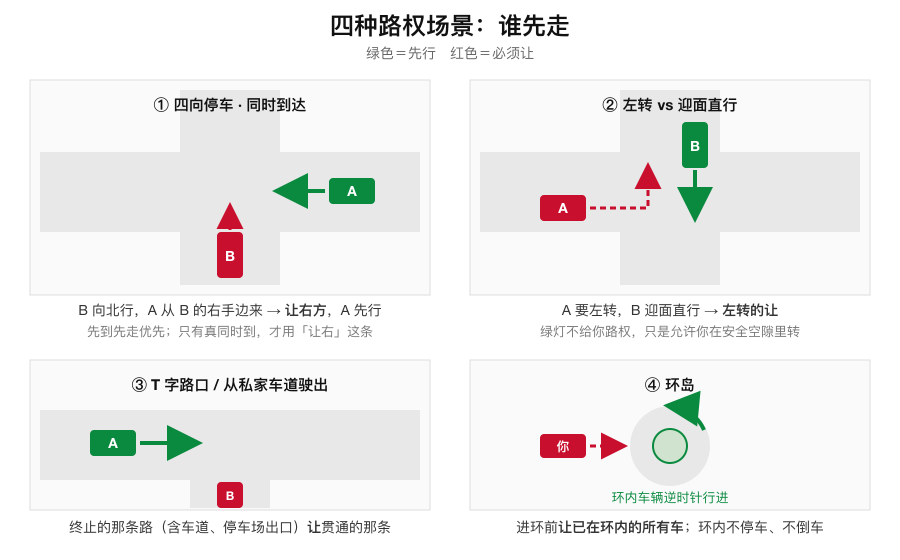
路权:四个基本场景
上图四格:① 四向停车同时到达,让右方;② 左转让对向直行;③ 支路与私家车道让贯通道路;④ 进入环岛前让环内车辆,环内逆时针行驶。绿色为先行方,红色为让行方。
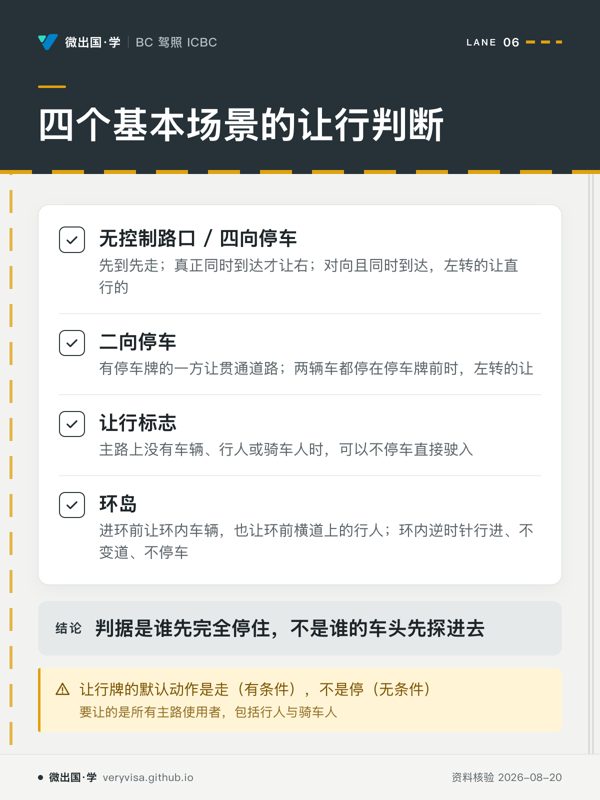
① 无控制路口 / 四向停车
判断是两级的,顺序不能颠倒 :
先到先走 ——只要分得出先后,就照这个走。判据是谁先完全停住 ,不是谁的车头先探进去;真正同时到达,才用让右 (法源 Motor Vehicle Act s.173(1));
若两车对向 且同时到达,左转的让直行的 。
大多数人只记住第 2 条,于是在明明自己先到时犹豫,反而制造混乱。
无标示的 T 字路口按普通无控制路口处理。
② 二向停车(只有一条路有停车牌)
有停车牌的一方让贯通道路。若两辆车都停在停车牌前而其中一辆要左转,左转的让 ——除非左转车已经进入路口并开始转弯 ,这时另一方须让。
③ 让行标志
让行牌的默认动作是走 (有条件),不是停 (无条件)。主路上没有车辆、行人或骑车人时,可以不停车直接驶入 ;有的话则减速、必要时停下、等安全空隙。
要让的是所有主路使用者 ,包括行人与骑车人——卷面上只写「让车辆」的选项是错的。
④ 环岛
进环前让环内车辆,也让环前横道上的行人 ;环内逆时针行进、不变道、不停车 ;出环时留意出口横道上的行人 。
住宅区里那种小型的 traffic circle 与 roundabout 不同,常配停车牌或让行牌,照牌面走。
行人:marked 与 unmarked 都受保护
这是最危险的一个认知缺口。
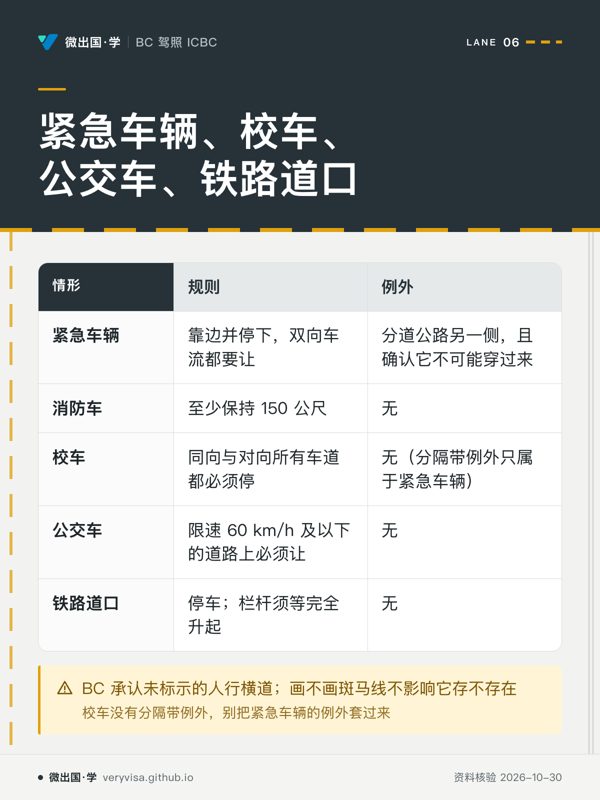
BC 承认未标示的人行横道 ——每个路口的延长线上都存在一条法律意义上的横道,画不画斑马线只影响它显不显眼,不影响它存不存在 。
必须让行的四个场合:
已标示的横道上 ,行人接近你这半边路面时;路口 ,即使没有画线;你在转弯 时;你从私家车道或巷子驶入道路 时。
后两条最容易漏——转弯时注意力都在找车流空隙,而你要横切的那条人行道上正有人在走。这也是路考里「右转不做右肩查」常年高居扣分榜的原因。
持白手杖的行人把手杖举起来 = 「我要过,我不确定安全」 ,是求助信号,不是让你先走的信号。正确动作是完整停住并保持停住 ,让对方能通过声音判断车已停下。不要挥手——他看不见。
紧急车辆、校车、公交车
校车那条的理由很直接:下车的孩子最常做的动作就是横穿马路走到对面 ,所以对向车才是最直接的威胁——只让后车停是不够的。
弱势道路使用者
骑自行车的人
超越时的法定侧向距离(Motor Vehicle Act s.157.1 与 Motor Vehicle Act Regulations Division 48):一般 1 公尺 ;限速超过 50 km/h 的路上 1.5 公尺 ;对方在人行道上或有实体隔离的自行车道里,0.5 公尺 。同样适用于路上的行人、骑马的人和个人代步设备使用者。这是下限不是目标值;
安全前提下可跨越单条黄实线 去超越;多车道路上应整条变道 ,不要在同一车道里挤过去;
右转前可以短距借入自行车道 ——这样把冲突从「横切」变成「同向排队」,避免所谓的「右钩」事故。前提是先做右肩查 ;骑车人在 BC 须戴合规头盔;夜间须有前白灯(150 公尺可见) 、后红灯与后红色反光片。
开门风险(dooring) :路边停放车辆里的人推开车门,对骑车人是零预警、零躲闪空间的威胁。开门前回头看 。这也是骑车人骑得离停放车辆略远的原因——不是在占道,是在避开门区。
大型车辆
卡车右转前会先向左摆车头 ,因为后轮走的弧线比前轮更靠内。这不是要左转,也不是让你从右边过;
由此两条硬规矩:永远不要停在大型车右侧那块空隙里 、永远不要在它右转过程中从右侧超越 ;
判据一句话:从后视镜里看不到卡车司机的脸,他就看不到你。
摩托车
汽车驾驶者最常出现的错误是误判摩托车的速度与距离 。这是视觉系统层面的问题,不是态度问题:人脑靠物体在视网膜上的增大速率估计接近速度,而摩托车正面投影小,增大得慢,大脑于是判定「它还远、还慢」。
后果集中在一个动作上——在摩托车前方左转 。对策不是「更小心」,而是换判据:看到摩托车就不要估速度,直接等它过去 。跟随摩托车留 3 秒 而非 2 秒。
观察:三个动作,三种风险
变道的标准顺序是查镜 → 打灯 → 肩查 ,三步分工不同,缺一步就漏掉一类风险。肩查是快速转头一瞥 ,不是长时间盯着看——盯太久,前方就成了新的盲区。
倒车影像不必关闭,但不能只依赖它。 它只覆盖固定视角,看不到从侧面快速进入路径的人。路考中只盯屏幕会被记为观察不足。
超车
绝对不该超车的位置 只有一个共同特征:你看不到对向来车 。坡顶、弯道、桥梁、隧道、铁路道口、路口附近全属此类。
值得算一遍代价:超车时你与对向车的接近速度是两车速度之和 。都跑 80 就是 160 km/h,每秒接近 44 公尺。坡顶后面 300 公尺处的车,7 秒后就到你面前,而一次完整超车往往正需要这么久。
所以判据不是「对面现在有没有车」,而是「我能看到多远」。
什么时候可以并回原车道 :后视镜里能完整看到被超越的那辆车 (包括前保险杠)。用镜子而不用距离,是因为距离在高速下极难估计,而「看得见整辆车」是个二值判断,不会错。并回后要恢复正常速度 ,不要马上减速。
沟通与态度
转向灯 是车上唯一能表达「我打算做什么」 的装置——刹车灯说的是已经发生的事,喇叭说的是「我在这」,只有转向灯讲未来。所以判据不是「有没有人看」,而是「我是不是要改变行进方向」。驶离路边车位也要打灯。
喇叭 只有一个信息量:「我在这里」 。它传达不了「快走」「让开」「你错了」——一声鸣笛无法编码这些内容,接收方只知道有人按了喇叭。正当场景是对方可能没看见你。对骑车人和马匹鸣笛还可能造成惊吓失控。
遇到侵略性驾驶者 (紧贴、别车、鸣笛挑衅),答案永远指向同一个方向:降级冲突、增加空间、不做眼神与手势交流 。底层判据是你能控制什么 ——控制不了对方的情绪,只控制得了你们之间的距离。若对方持续跟随,不要开回家 ,驶向人多的地方或警察局,必要时报警。
紧急处置
侧滑处置只需一句:看哪儿、转哪儿 。眼睛盯着想去的位置,手会自然跟上——盯着要撞的东西看,车就会开过去,这是真实存在的视觉引导效应。
先松油门而不是刹车,是因为侧滑的本质是轮胎抓地力被用光了 :刹车继续索取抓地力,松油门则把抓地力还给转向。
爆胎那条的关键是先什么都不做,只是握住 ——爆胎瞬间车辆被拽向一侧,此刻任何突然的输入(急刹、急转)都在同一方向上叠加。
节末检索小测 · 先别往回翻,凭记忆作答 Quick recall check: answer from memory before scrolling back
On a city street with a speed limit of 50 km/h, a public transit bus ahead at a stop turns on its left signal and flashes its yield-to-bus sign. What must you do?
在限速 50 km/h 的城市道路上,前方站台停靠的公交车打起左转向灯并亮起让行标识。你必须怎么做?
a Slow down or stop as needed to let the bus pull back into the traffic lane. ✓ 正确。在限速 60 km/h 及以下的道路上,当公交车(public transit bus)打灯并亮出让行标识(yield sign)准备驶离站台时,后方车辆必须减速或停车让其驶入车道。 Correct. On roads with a posted speed limit of 60 km/h or lower, drivers behind a public transit bus must slow down or stop to let the bus pull out when it signals and displays its flashing yield sign.
b Maintain your speed and pass the bus quickly before it begins to move out. ✗ 错误。限速 50 km/h 属于「60 km/h 及以下」的法定让行范围,加速抢行违反了公交车让行规则,容易引发侧面碰撞。 Incorrect. A 50 km/h speed limit falls within the statutory requirement of 60 km/h or lower; speeding up to pass violates transit yield rules and easily causes side-swipe collisions.
c Honk twice to let the bus driver know you are in the adjacent blind spot. ✗ 错误。公交车已亮起法定让行标志,后车承担的是让行义务(yield),而不是按喇叭要求公交车等待自己先过。 Incorrect. The bus has displayed its statutory yield sign; following vehicles have a duty to yield rather than honk to demand that the bus wait.
d Yield only if the bus is already moving across the lane line in front of you. ✗ 错误。只要公交车在限速 60 km/h 及以下路段打起转向灯并亮出让行标识准备驶离站台,后方车辆就必须主动让行,不能等它已经挤进车道才让。 Incorrect. As long as the transit bus signals and flashes its yield sign to pull out on a road of 60 km/h or less, following drivers must proactively yield without waiting until the bus has already pushed into the lane.
看答案与每个选项的解析 Show the answer and why each option is right or wrong 答案 Answer :a
三、现实案例 本节回答 This section answers 剖析右转漏肩查、钻大卡车右侧空隙及误判摩托车等高频事故场景 Analyzes frequent crash scenarios such as missed shoulder checks on right turns, cutting into gaps on the right of large trucks, and misjudging motorcycles. 本章考题 4 Question 4
场景一:四向停车,明明自己先到却在犹豫。
两辆车互相礼让、同时起步、在路口中心相遇——这类刮蹭的成因不是不懂规则,是只记住了「让右」而没记住「先到先走」优先 。规则的第一层就是消除这种犹豫。
场景二:右转时只看左边有没有车。
左边确实没车,于是转了过去——而右侧人行道上有个正在过马路的人,或者有辆自行车正沿路边直行。右转的风险在右边 ,这正是右肩查存在的理由,也是路考最高频的扣分项之一。
场景三:路口停着一辆等左转的大卡车,右边留出一条缝。
从那条缝里超过去,正好进入它后轮要扫过的区域。那块看起来空着的地方,是它转弯需要的空间。
场景四:绿灯准备左转,对面驶来一辆摩托车,看着还远。
这是摩托车致死事故里最典型的场景。它其实比看上去更近、更快。不要估算,等它过去。
场景五:被人紧贴着开了两公里。
点刹「教训」对方,是把一次骚扰升级成一次追尾。正确做法是增大自己车前的空间 ——这样即使被追尾,你也有余量避免连环撞。注意方向:应对后车太近的办法是加大前方空间 ,不是加大后方空间(那不由你控制)。
节末检索小测 · 先别往回翻,凭记忆作答 Quick recall check: answer from memory before scrolling back
A large truck ahead of you signals a right turn at an intersection and swings its cab toward the left side of the lane. What should you do?
你前方的一辆大卡车在路口打起右转向灯,但车头却向左摆动并在右侧留出空隙。你应该怎么做?
a Move into the open space on the right side to pass before the truck completes its turn. ✗ 错误。大卡车(large truck)右转前向左摆头是因为后轮轨迹比前轮更靠内,右侧看似空着的地方正是后轮即将扫过的区域,钻进去会直接被挤压,属于「盲信目测与后视镜」陷阱。 Incorrect. A large truck swings wide to the left before a right turn because its rear wheels follow a shorter path than the front wheels. The apparent opening on the right is directly in the path of the rear wheels, and squeezing in will cause a crushing collision. This falls into the 'blindly relying on visual estimation and mirrors' trap.
b Pull up alongside the right side of the trailer and wait for the truck to clear the lane. ✗ 错误。永远不要停在大型车右侧的空隙与盲区(blind spot)里,卡车司机在后视镜里看不到你,转弯时后轮会直接扫过该区域。 Incorrect. Never stop in the opening or blind spot on the right side of a large truck; the driver cannot see you in their mirrors, and the rear wheels will sweep through that space during the turn.
c Sound your horn continuously to warn the truck driver not to swing across the lane. ✗ 错误。大型车由于轴距长,右转前向左借空间是正常的几何需要,并非操作失误,按喇叭既无必要也无法改变其转弯轨迹。 Incorrect. Due to their long wheelbase, large trucks swing wide as a standard geometric necessity rather than a driver error. Sounding your horn is neither necessary nor effective in changing its turning path.
d Stay well behind the truck and never enter the space on its right side while it turns. ✓ 正确。大卡车右转时后轮走的弧线比前轮更靠内(off-tracking),右侧空隙是它转弯必需的空间且处于盲区,唯一安全的做法是留在其后方等待。 Correct. When a large truck turns right, its rear wheels track closer to the curb than the front wheels (off-tracking). The space on the right is essential turning clearance and lies within a blind spot; the only safe choice is to remain well behind.
看答案与每个选项的解析 Show the answer and why each option is right or wrong 答案 Answer :d
四、历史变迁 本节回答 This section answers 说明路边作业车减速让行清单扩展与方向盘9点3点握姿的现行口径 Explains the expanded list of roadside service vehicles under Slow Down, Move Over rules and the current standard for the 9-and-3 hand position on the steering wheel.
这一块的内容长青程度很高 :让行原则、观察顺序、超车判据几十年来没有实质变化,因为它们背后是几何与人类反应时间,不随政策调整。
有确切时间线索的两处:
减速让行规则(Slow Down, Move Over)的覆盖车辆清单已经扩展 ,如今远不止警车与救护车,还包括拖车、公路养护、公用事业、商用车检查员、土地测量员、动物管制、垃圾收集 等路边作业车辆。gov.bc.ca 的相关页面标注最近更新于 2026-07-08 。(细节见速度与泊车那一篇。)ICBC 现行考试口径教的方向盘握姿是 9 点/3 点 ,而不少旧资料仍写 10 点/2 点。改动与安全气囊的展开路径有关。
本篇未能核实的项,如实标出 :① 减速让行清单具体是哪一年扩展的 ——官方页面没有给出这个日期;② 电动滑板车与电动自行车 在 BC 的现行规则——核查的考试口径各章里完全没有提及,相关的政府页面也没找到。这两项这里不下结论。
节末检索小测 · 先别往回翻,凭记忆作答 Quick recall check: answer from memory before scrolling back
To reduce the risk of injury if the airbag deploys, what steering wheel hand position is taught in the current exam standard?
为了降低安全气囊展开时造成伤害的风险,现行考试口径教导的方向盘握姿是哪一个?
a The 10 o'clock and 2 o'clock position near the top rim of the wheel. ✗ 错误。10 点/2 点(10 o'clock and 2 o'clock)是旧资料的握姿,双手位置偏高,容易在安全气囊(airbag)弹出时受伤。 Incorrect. The 10 o'clock and 2 o'clock position is from older training materials; hands placed that high risk severe injury if the airbag deploys.
b The 9 o'clock and 3 o'clock position on the sides of the steering wheel. ✓ 正确。现行考试口径教导的方向盘握姿是 9 点/3 点(9 o'clock and 3 o'clock),这一改动正是为了避开安全气囊的展开路径。 Correct. The current exam standard teaches the 9 o'clock and 3 o'clock hand position, which keeps hands and arms clear of the airbag deployment path.
c One hand at the 12 o'clock position and the other resting on the gear shift. ✗ 错误。单手握在顶部正中既无法稳定控制车辆,也会正面迎上方向盘中央展开的安全气囊。 Incorrect. Placing one hand at the top centre fails to provide stable vehicle control and puts your arm directly in front of the deploying airbag.
d Both hands placed together at the bottom of the steering wheel rim. ✗ 错误。双手并拢在底部无法在紧急避险或转弯时提供足够的转向扭矩与控制力,不符合 9 点/3 点的标准握姿。 Incorrect. Keeping hands together at the bottom does not provide sufficient turning leverage or control during emergency maneuvers, and does not match the standard 9-and-3 position.
看答案与每个选项的解析 Show the answer and why each option is right or wrong 答案 Answer :b
五、边学边测
这一节的练习题在第 1 章考点页 :每题点选即判分,附逐项解析,答错的题自动进间隔复习。也可以先去备考中心 做一次诊断。
六、核心术语双语表
延伸阅读
论坛全文:2026 BC 笔试考点二|路权、让行与共享道路(Right of Way & Sharing the Road)
七、来源清单
均为 2026-08-20 核查。
ICBC《Learn to Drive Smart》第 4 章 Rules of the road——无控制路口、二向与四向停车、让行标志、环岛、左转、驶出私家车道、超车、掉头
ICBC《Learn to Drive Smart》第 5 章 See-Think-Do——跟车距离、扫描
ICBC《Learn to Drive Smart》第 6 章 Sharing the road——行人与未标示横道、视障行人、骑车人头盔灯光、大型车辆、摩托车、紧急车辆与 150 公尺、校车、公交车 60 km/h、铁路道口
ICBC《Learn to Drive Smart》第 9 章 Emergency strategies——侧滑、水面滑行、爆胎
ICBC《What to expect during your road test》(表格编号 MV2661)——倒车影像可不关闭但不可只依赖
ICBC《Tuning up for drivers》2026 版「Examiners' tips」——查镜/打灯/肩查、右转肩查、路口扫描
Motor Vehicle Act, RSBC 1996, c.318 s.149——校车:迎面或从后方遇到都要停;s.157.1 与 Motor Vehicle Act Regulations Division 48 ——超越行人与骑车人的 1/1.5/0.5 公尺(2026-10-30 核;现行版《Learn to Drive Smart》第 6 章同样写 1.5 公尺)Motor Vehicle Act, RSBC 1996, c.318 s.173(1)——无控制路口让右(法规站标注现行至 2026-10-27)gov.bc.ca《Slow down, move over》——受保护车辆清单(页面标注更新于 2026-07-08)
本页知识卡 不看正文也能拿到这一节的核心内容:先看导读,再看图。点图放大,左右翻页。
放大 ⤢ 能分先后就不进入让右判断。 先看 先看第一格的决策顺序;这里最容易把第二层条件提前用。易漏 二向停车还有已进入路口并开始转弯的例外;小型 traffic circle 要照牌面走。下一步 去练习,把四种场景改成自己判断谁先走的题。详情与分享 → 放大 ⤢ 让行范围会随对象和道路隔离条件改变。 先看 先沿四类对象看动作,再横向检查有没有特殊情况。易漏 人行横道并不以斑马线为成立条件;分隔带例外只属于紧急车辆,校车所有车道都停。下一步 去练习,专做对向来车和分隔带条件判断。详情与分享 → 本站依据官方原文自撰 · 出处见正文链接